

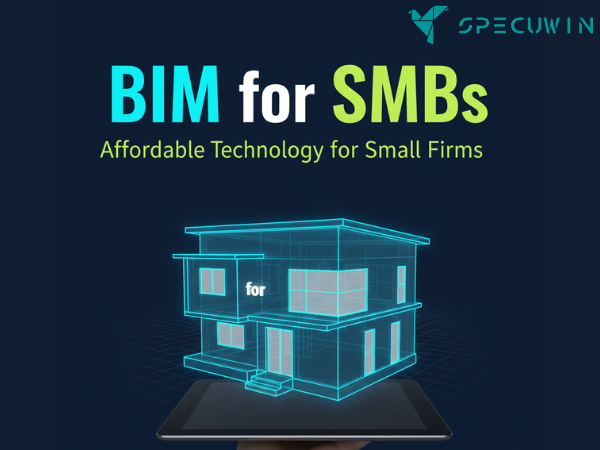
For years, Building Information Modeling (BIM) felt like an innovation reserved only for the industry’s titans the massive architectural and engineering conglomerates with endless budgets and dedicated tech departments. The prevailing narrative suggested that the initial investment in software, hardware, and, most critically, training was a mountain too high for a Small to Midsize Business (SMB) to climb. This misconception has caused countless small firms to hesitate, sticking to their familiar, comfortable, but ultimately limiting 2D CAD workflows.
But let’s be frank: times have changed. The landscape of the Architecture, Engineering, and Construction (AEC) industry has evolved rapidly, making BIM not just a luxury, but a necessity for survival and growth, regardless of firm size. The real question is no longer “Can we afford BIM?” but “Can we afford not to use BIM?”
For small firms, the value proposition of BIM has shifted dramatically. It’s no longer about competing on scale; it’s about competing on efficiency, accuracy, and agility. This is a critical distinction, especially when you are trying to navigate the transition From CAD to BIM for enhanced project delivery. This guide is for the ambitious small firm owner or project manager who’s ready to peel back the layers of misconception and see the tangible, human benefits that BIM brings to a streamlined, smart operation. BIM isn’t just modeling; it’s a strategy for smarter business.
The Myths vs. The Reality: BIM’s True Cost:-
The most significant barrier for SMBs considering BIM is almost always cost. Small firms worry about the high software licenses, expensive hardware upgrades, and the time lost during staff training. It is true that BIM implementation can incur substantial initial and ongoing costs for software, licensing, and training. However, this perspective overlooks the catastrophic financial and temporal costs inherent in traditional 2D workflows:
- Rework and Errors: The biggest drain on any small firm’s profitability is rework caused by design conflicts and errors caught too late, during construction. BIM’s clash detection capabilities identify these conflicts in the design phase, before they become expensive fixes on-site. This ability to mitigate risk is often the single greatest source of cost savings.
- Wasted Time: In CAD, a design change means manually updating plans, sections, elevations, and schedules. With BIM, a single change to the 3D model automatically updates all linked documentation simultaneously. This automation allows your small team to focus on design quality instead of tedious drafting.
- The Power of 5D: BIM models are information-rich. They can be linked to cost data (5D) to automatically generate accurate quantity takeoffs and cost estimates. This precision allows SMBs to offer more competitive and accurate bids, minimizing financial risks and helping to secure higher project margins.
When you calculate the reduced time, minimized material waste, and eliminated on-site errors, the Return on Investment (ROI) for BIM can be immediate and profound, transforming what was perceived as an unaffordable expense into a strategic investment.
The Competitive Edge: Why BIM Makes Small Firms Agile:-
For an SMB, being agile is crucial. You don’t have the manpower of a large firm, so every member of your team needs to be operating at peak efficiency. BIM is the key to unlocking this agility.
Collaboration and Communication:
Small firms thrive on tight-knit communication, and BIM enhances this exponentially. It provides a central, real-time platform where all stakeholders architects, engineers, and clients can access the same project data. This unified workflow eliminates fragmented communication and ensures that everyone is working from the single, most accurate model, regardless of their location.
Furthermore, BIM’s 3D visualization capabilities are a powerful tool for enhanced client communication. Interactive 3D models and virtual walkthroughs make it easier to communicate complex design concepts and secure faster client approvals, helping your firm foster trust and secure higher repeat footfalls. When you consider how BIM (Building Information Modeling) is Transforming Consultancy, you see how a technology-forward approach can drastically improve your client relationships and service quality.
Leveling the Playing Field:
In the bidding process, a large firm’s size can be intimidating. BIM empowers SMBs to punch above their weight. By presenting sophisticated 4D (scheduling) and 5D (cost) models, your firm demonstrates superior project management, quality control, and risk mitigation capabilities. BIM equips smaller companies with advanced tools that were once exclusively used by larger firms, giving you the competitive advantage needed to attract and win more significant and complex projects.
Strategic Implementation: How to Introduce BIM Without Overwhelming Your Team:-
Transitioning to BIM can be disruptive, but a thoughtful, phased approach can minimize chaos and resistance to change.
- Start Small and Build Momentum: Don’t try to switch every project overnight. Begin by implementing BIM on a single, less complex project. This pilot project serves as a low-risk environment for your team to understand how the new workflow integrates with your current processes.
- Define a BIM Champion: Assign a BIM champion a motivated staff member to lead the internal initiative. This person will manage the transition, define clear BIM standards and protocols, and act as the primary resource for team questions and challenges.
- Smart Software and Hardware Choices: You don’t always need the most expensive solutions. Look into cloud-based BIM solutions which offer more flexible, subscription-based pricing that is easier on a small firm’s budget. Prioritize core features like modeling, documentation, and clash detection over costly extras that you may not need.
- Leverage Outsourcing for Scaling: To manage complex tasks or sudden increases in workload without making massive long-term hiring or software commitments, consider leveraging the Value of BIM Outsourcing. Outsourcing can be a strategic way to access specialized BIM expertise and technology when needed, keeping your overhead low while still delivering high-quality, fully-modeled projects.
Training and Growth: Making BIM a Crucial Skill for Your Future-Ready Career:-
The skills gap is a reality, and a shortage of BIM expertise is a common post-adoption challenge for SMBs. The solution isn’t just hiring; it’s investing in your existing team.
Making BIM a Crucial Skill for a future-ready career in AEC is vital for attracting and retaining talent. Small firms that invest in training are seen as innovative and committed to employee development. Targeted training programs, online resources, and mentorship focused on practical, project-based learning can quickly bridge the gap. Encourage your team to utilize resources like Your Guide to Becoming an Outstanding BIM Specialist to foster internal expertise.
By doing so, you turn the adoption of BIM from a daunting compliance exercise into a catalyst for professional growth and business excellence.
Conclusion:-
The future of the AEC industry is digitized, integrated, and collaborative. For the small firm, BIM is the essential tool that enables this future. It shifts the focus from simple drafting to complex, information-rich models, allowing SMBs to compete on quality, efficiency, and intelligence, rather than just size. Embracing BIM is not just about adopting new software; it’s about choosing a smarter, more profitable, and more sustainable way to design and build.
FAQ’s:-
1. Is BIM software too expensive for a small firm’s budget?
A. The initial cost can be a barrier, but it’s crucial to look at the Total Cost of Ownership (TCO). BIM reduces costly rework, minimizes change orders, and accelerates project delivery, often making the long-term TCO significantly lower than continued use of traditional CAD. Cloud-based solutions and subscription models are increasingly available to ease the financial burden.
2. How much time does it take to train a small team on BIM?
A. The investment in training is necessary. A phased approach works best: train a small group of BIM Champions first, who can then lead internal knowledge transfer. Focusing on practical, project-based training minimizes disruption, and the efficiency gains often recover the training costs quickly.
3. Does BIM require a massive hardware upgrade?
A. While BIM modeling can be graphically intensive, the need for a “massive” upgrade is often overstated. Modern, mid-range workstations are typically sufficient, and leveraging cloud-based BIM solutions can significantly reduce the internal hardware burden and associated capital expenditure.
4. Can BIM be used for small residential or minor commercial projects?
A. Absolutely. BIM is not just for large-scale projects. Even on a small residential project, BIM’s ability to instantly generate accurate quantity takeoffs, detect clashes between systems, and produce high-quality visualizations makes the design process faster, more accurate, and more profitable than traditional 2D drafting.
5. How can a small firm use BIM to win bigger projects against larger competitors?
A. BIM levels the playing field. By submitting proposals that include 4D (scheduling) and 5D (cost) models, offering superior visualization, and demonstrating a clear process for clash detection, a small firm can showcase a level of sophistication and risk mitigation that attracts bigger clients and builds greater trust.
Read More On:-
For more information about engineering, architecture, and the building & construction sector, go through the posts related to the same topic on the Specuwin Blog Page.
Find out more accurately what we are going to take off in the course of applying leading new technologies and urban design at Specuwin.