

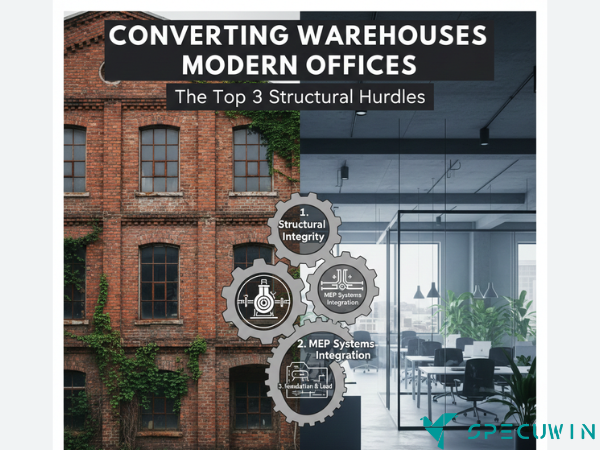
There is something undeniably magnetic about an old warehouse. Maybe it’s the high ceilings that seem to hold a century of secrets, the gritty texture of exposed brick, or the massive industrial windows that flood the space with light. Walking into one, you don’t just see a dusty storage space; you see potential. You see a buzzing hub of creativity, collaboration, and innovation.
It’s no wonder that adaptive reuse taking these industrial giants and turning them into sleek workspaces is one of the hottest trends in architecture today. We are moving away from sterile cubicle farms and toward spaces with soul. However, bridging the gap between a 1920s storage facility and the safety standards required for Modern Offices is rarely a straight line.
Beneath the charm of timber beams and riveted steel lies a reality check that every developer and architect must face: the structure itself. These buildings were designed for a different era, different loads, and different codes. If you are eyeing a conversion project, you need to peel back the layers and understand exactly what you are up against. Let’s dive into the gritty details of the structural challenges that stand between you and your dream workspace.
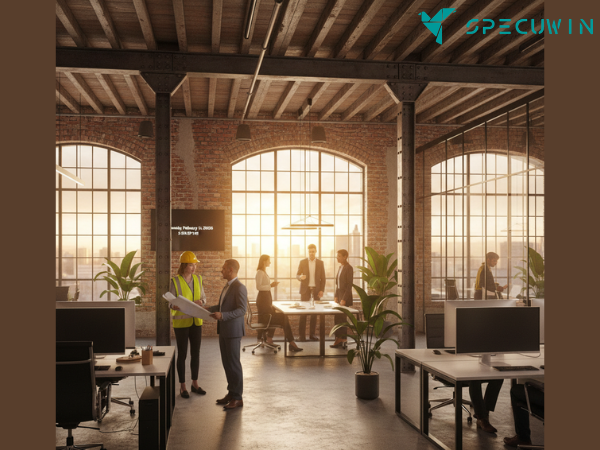
Hurdle 1: Load Capacity and Redistribution in Modern Offices:-
When these warehouses were built, they were often designed to hold massive static loads think piles of heavy machinery, crates of raw cotton, or stacks of steel components. You might assume, “Great! If it could hold heavy machinery, it can certainly hold desks and computers.”
But structural engineering isn’t quite that simple. The type of load matters just as much as the weight.
The Shift from Storage to Human Occupancy Warehouses were designed for “dead loads” (permanent, non-moving weight) and specific “live loads” (temporary weight) that were often concentrated in specific areas. When you convert these spaces into Modern Offices, you change the behavior of the building. You are introducing dynamic human movement, partition walls, new HVAC units on the roof, and heavy server rooms.
For example, a timber floor that has settled over 80 years might be perfectly stable holding a static pile of boxes. But once you introduce the vibrations of foot traffic and the point-loads of heavy modern equipment, that floor might bounce, creak, or deflect beyond what is comfortable or safe for office workers.
The “Open Concept” Challenge Furthermore, the aesthetic of Modern Offices often demands tearing down internal walls to create open-plan environments. In many older masonry buildings, those internal walls weren’t just partitions; they were providing vital lateral support to the roof and floor diaphragms. Removing them without adding new steel frames or bracing can compromise the building’s ability to stand up.
Before any design is finalized, a rigorous analysis is required. This is where a professional assessment becomes non-negotiable. You need to identify if the existing skeleton can support the new vision or if it needs a prosthetic boost. Before buying a property or starting demolition, look for the warning signs. Check out our guide on the top 5 signs your building needs a structural inspection to understand what to look for during your initial walkthrough.
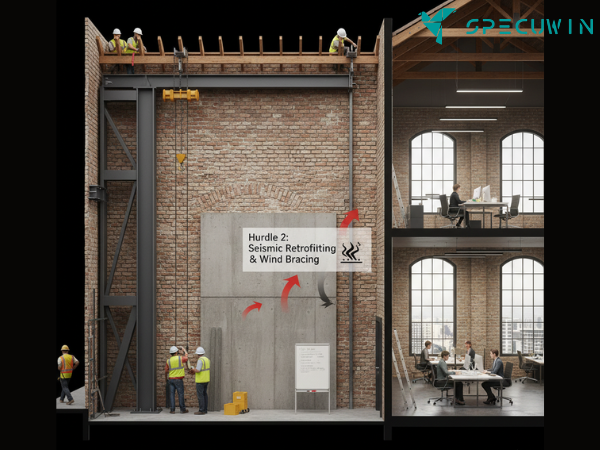
Hurdle 2: Seismic Retrofitting and Wind Bracing for Modern Offices:-
If your target warehouse was built in the early 20th century (or earlier), the building codes used at the time are now ancient history. Engineers back then understood gravity loads (weight pushing down) very well, but their understanding of lateral loads (forces pushing sideways, like wind and earthquakes) was rudimentary compared to today’s standards.
The Unreinforced Masonry Problem Many coveted warehouse spaces are built of Unreinforced Masonry (URM) essentially brick walls held together by mortar and gravity, with no steel reinforcing bars inside. While these thick walls look indestructible, they are notoriously brittle. In a seismic event, or even under high wind loads, they don’t bend; they crack and crumble.
To bring these buildings up to code for Modern Offices, you often have to implement “seismic retrofitting.” This isn’t just about safety; it’s a legal requirement in many jurisdictions when you change the building’s “use category” from storage to commercial office space.
The Retrofit Reality This process can be invasive. It might involve:
- Steel Moment Frames: Inserting rigid steel frames that can flex during an earthquake without breaking.
- Concrete Shear Walls: Pouring new concrete walls to take the lateral hit.
- Bracing Parapets: Tying the roof to the walls so they don’t separate during shaking.
It is a delicate balance. You want to preserve the exposed brick that makes the space “cool,” but you also need to ensure the building doesn’t collapse. Smart engineering can hide these reinforcements or turn them into design features, blending the old industrial look with new structural resilience. Curious about how engineers strengthen massive buildings against these forces? Read our case study on Seismic retrofitting to see how we reinforce high-rise structures the principles often apply to adaptive reuse projects as well.
Hurdle 3: Material Degradation and “Hidden” Damage in Modern Offices:-
Time is the ultimate enemy of any structure. A warehouse that has been sitting semi-vacant for decades has likely suffered from neglect. When you peel back the layers to convert it into Modern Offices, you are going to find surprises and they are rarely the good kind.
The Big Three: Rot, Rust, and Spalling:
- Timber: Those beautiful, thick timber columns might look sturdy, but probing often reveals core rot from decades of roof leaks, or damage from termites and beetles. Sometimes, the damage is internal, leaving a hollow shell that cannot support the loads of a busy office.
- Steel: In older industrial buildings, steel components were often encased in concrete or masonry. If water has seeped in over the years, that steel may have rusted. As rust expands (taking up up to seven times the volume of the original steel), it cracks the surrounding masonry or concrete a phenomenon known as “oxide jacking.”
- Concrete: Early 20th-century concrete is not the same as modern concrete. It is often more porous and prone to “carbonation,” which lowers the pH of the concrete and causes the reinforcing steel inside to corrode.
The Cost of “Character” Preserving the character of the building often means repairing, rather than replacing, these materials. This requires specialized testing. Engineers might use ultrasound to test timber density or take core samples of concrete to test for compressive strength.
If you ignore material degradation, you aren’t just risking structural failure; you are inviting a maintenance nightmare that will plague your budget for years. Addressing these issues upfront is the only way to ensure longevity. The materials you choose to repair these damages matter immensely. Learn more about The impact of material selection on structural integrity to understand how we match new materials with old structures.
Navigating Compliance and Code Upgrades for Modern Offices:-
Beyond the physical bricks and mortar, there is the invisible hurdle of bureaucracy. Changing a building’s use triggers a cascade of code requirements that go beyond just “holding the roof up.”
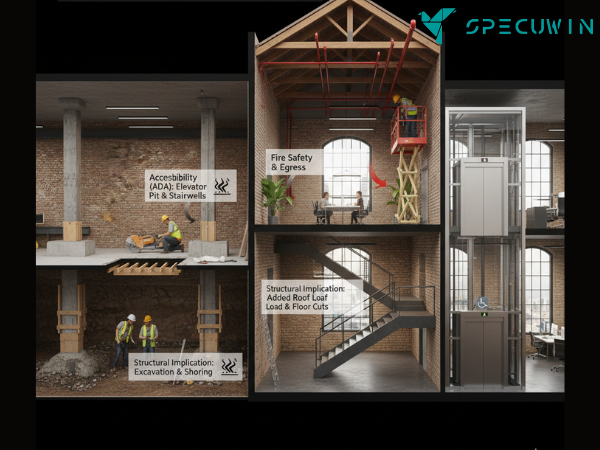
Fire Safety and Egress Warehouses were designed for a handful of workers moving crates. Modern Offices are designed for hundreds of people. This means you need more exits, wider staircases, and robust fire suppression systems.
- Structural Implication: Cutting new stairwells through existing concrete floors requires significant structural reinforcement. Adding a heavy sprinkler system adds new weight to the roof trusses.
Accessibility (ADA) Old loading docks and freight elevators are rarely wheelchair friendly. Installing modern elevators often requires digging new pits (impacting the foundation) or cutting through every floor slab in the building.
- Structural Implication: Excavating inside an existing building can undermine the footings of the very columns holding the building up. It requires careful shoring and underpinning.
Conclusion: Is the Transformation into Modern Offices Worth It?:-
Converting an old warehouse is not for the faint of heart. It requires a tolerance for risk, a flexible budget, and a team that knows how to solve problems on the fly. You will encounter rot where you didn’t expect it. You will find that the floor isn’t level. You will likely spend a significant portion of your budget on things your tenants will never see steel hidden inside walls, epoxy injected into cracks, and new footings buried underground.
But, when the dust settles, the result is incomparable. You get a workspace with a narrative, a texture, and a vibe that new construction simply cannot mimic. The juxtaposition of rugged history and sleek, high-tech amenities creates an environment that inspires.
The key to success is not ignoring the hurdles, but anticipating them. By partnering with the right experts early before you even sign the lease you can turn these structural challenges into manageable tasks. Don’t navigate this complex process alone. Check out our guide on How to choose the right structural engineer for your project to ensure you have the best team in your corner.
FAQ’s:-
1. Do I always need a structural inspection before buying an old warehouse?
A. Absolutely. Old warehouses often hide significant issues like foundation settling, water damage, or sub-standard modifications made by previous owners. A structural inspection gives you a roadmap of the costs involved before you commit to the project.
2. What is the most common hidden cost in warehouse conversions?
A. Seismic retrofitting and foundation reinforcement are often the biggest budget eaters. Because code requirements for offices are stricter than for storage, bringing the building up to modern safety standards often requires adding significant amounts of steel and concrete.
3. Can I keep the exposed brick walls in my new office?
A. Yes, but they may need treatment. If the brick is structural (holding up the building), it might need reinforcement. If it’s unreinforced masonry in an earthquake zone, you may need to add a steel frame interior, which allows you to keep the brick visible but ensures it won’t collapse.
4. How does changing the building’s “use” affect the renovation?
A. When you change from “Industrial/Storage” to “Commercial/Office,” you trigger a requirement to bring the entire building up to current building codes. This includes fire safety, energy efficiency, and structural stability, which is much more demanding than “grandfathered” existing conditions.
5. Is it cheaper to build new or convert an old warehouse?
A. It varies. Conversions can be more expensive due to unforeseen structural repairs and retrofitting. However, the “speed to market” can sometimes be faster with conversions since the shell is already there, and the resulting property often commands higher rent due to its unique character.
Read More On:-
For more information about engineering, architecture, and the building & construction sector, go through the posts related to the same topic on the Specuwin Blog Page.
Find out more accurately what we are going to take off in the course of applying leading new technologies and urban design at Specuwin.