

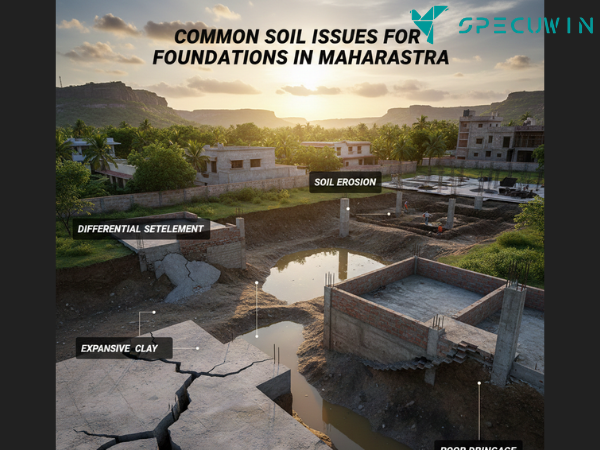
In Maharashtra, nearly 90% of the land is composed of basalt rock, which weathers into various forms of clay and silt. While this basalt provides a solid base in some regions, the weathered “Black Cotton Soil” covers a significant portion of the state including Marathwada and Vidarbha presenting the most formidable Soil Issues for civil engineers.
For those in the early phases of construction, our Guide to becoming an outstanding BIM specialist highlights how digital modeling helps predict site issues.

1. The Challenge of Black Cotton Soil Issues:-
Black Cotton Soil (Regur) is a boon for farmers but a nightmare for foundations. Its primary mineral, montmorillonite, is highly expansive, meaning it undergoes drastic volume changes based on moisture levels.
- Swelling and Shrinkage: During the monsoon, the soil absorbs water and swells, exerting upward pressure (heave) on foundations. In the scorching Maharashtra summer, it shrinks and develops deep cracks (up to 3 meters deep), causing the foundation to lose support.
- Low Bearing Capacity: When wet, this soil becomes “slushy” and loses its stability, leading to differential settlement where one part of the building sinks more than the others.
2. Structural Instability and Foundation Soil Issues:-
Foundation failures in regions like Pune, Nagpur, and Aurangabad are often linked to how these soils interact with the structure.
- Differential Settlement: Because the soil doesn’t always dry or wet uniformly, it can cause “tilting” of the foundation, leading to diagonal cracks in walls and beams.
- Pavement and Slab Failure: It’s not just the main building; driveways and ground-floor slabs often crack and buckle due to the relentless movement of the subgrade.
You can learn more about the Role of a structural engineer in calculating these soil loads.

3. Geographical Variants of Soil Issues in Maharashtra:-
The “Maharashtra soil profile” isn’t uniform, and different regions face unique geotechnical hurdles:
- Konkan & Sahyadri (Laterite Soils): These brick-red soils are rich in iron but can become acidic and porous. While generally more stable than black soil, they are prone to heavy erosion and leaching due to high rainfall.
- Coastal Regions (Saline and Marshy Soils): In areas like Mumbai and Raigad, foundations face salinity-induced corrosion of reinforcement steel and high groundwater tables that require complex dewatering.
- Upland Ridges (Shallow Soils): On the ridges of the Western Ghats, soil is often too thin (less than 1 foot), requiring expensive rock anchoring or excavation into hard basalt.
4. Remedial Strategies for Foundation Soil Issues:-
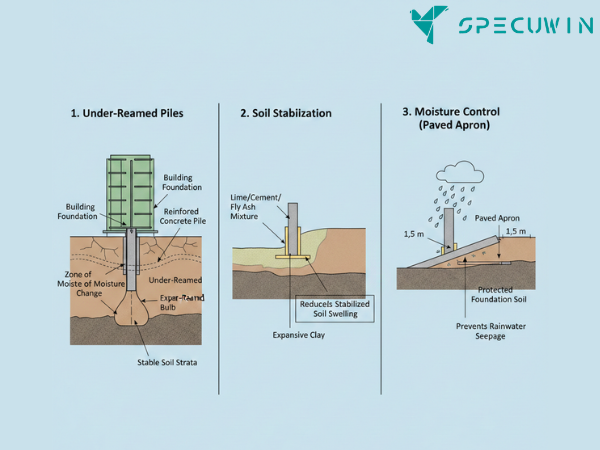
To build safely, engineers in Maharashtra employ several “ground improvement” techniques:
- Under-Reamed Piles: These are specialized deep foundations with bulbs at the bottom that “anchor” the building into stable soil layers below the zone of moisture change.
- Soil Stabilization: Mixing the soil with lime, cement, or fly ash can chemically reduce its “plasticity” and swelling potential.
- Moisture Control: Providing a “paved apron” (a concrete path) around the building helps prevent rainwater from seeping directly into the foundation soil.
It’s helpful to understand How to read a structural engineering report to see if your soil test results are properly addressed.
FAQ’s:-
1. Why is Black Cotton Soil so dangerous for houses?
A. It contains a mineral called montmorillonite that expands when wet and shrinks when dry, literally moving the house up and down, which leads to structural cracks.
2. Can I build a house on soil with high salinity?
A. Yes, but you must use specialized “Sulphate Resisting Cement” and ensure a higher concrete cover for your reinforcement to prevent salt-induced rusting.
3. What is the best foundation for Maharashtra’s black soil?
A. Under-reamed piles or raft foundations are generally preferred as they distribute the load or anchor the structure below the unstable soil layers.
4. How deep should a foundation be in Maharashtra?
A. It depends on the “hard strata.” In many parts of Maharashtra, you must dig until you hit weathered rock (Murrum) or hard basalt, which could be anywhere from 1.5 to 5 meters deep.
5. Does soil testing really matter for a small home?
A. Absolutely. Saving money on a soil test often leads to spending lakhs later on repairing foundation cracks.
Read More On:-
For more information about engineering, architecture, and the building & construction sector, go through the posts related to the same topic on the Specuwin Blog Page.
Find out more accurately what we are going to take off in the course of applying leading new technologies and urban design at Specuwin.