

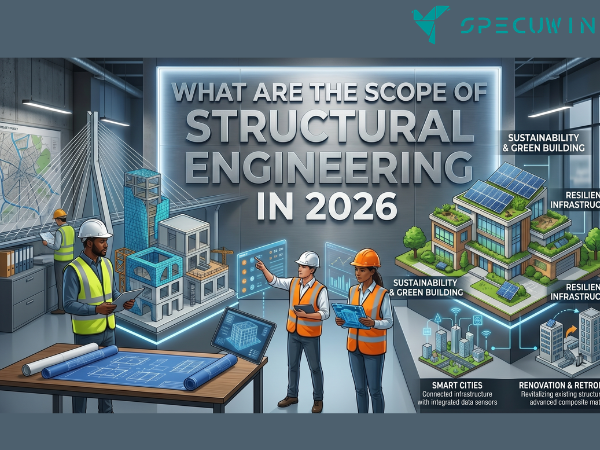
The skyline of our world is changing, and it isn’t just about height anymore. In 2026, the backbone of every skyscraper, bridge, and carbon-neutral stadium is the result of a field undergoing a massive digital and ecological rebirth. If you are a student, a professional, or an industry stakeholder, understanding the Scope of Structural Engineering today is essential to navigating the complexities of modern construction.
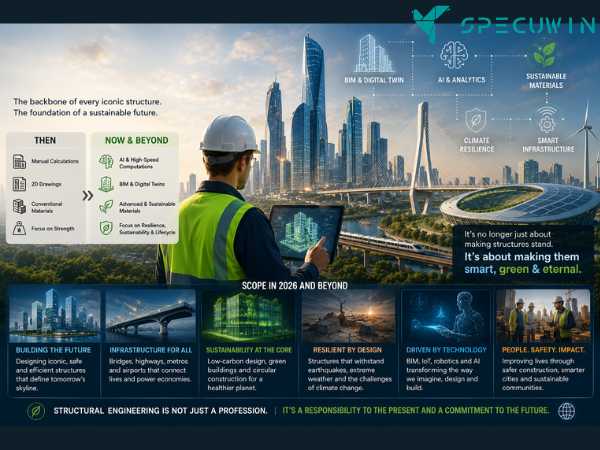
Gone are the days when a structural engineer’s role was limited to manual calculations and blueprints. Today, we stand at the intersection of high-speed computation, material science, and climate resilience. The industry is no longer just about making things “stand up”; it’s about making them “smart,” “green,” and “eternal.”
The Evolving Digital Scope of Structural Engineering:-
The most significant shift in the Scope of Structural Engineering involves the integration of advanced digital workflows. We have moved past basic computer-aided design into an era of deep simulation.
1. The Proliferation of BIM and Digital Twins:
Building Information Modeling (BIM) is no longer an “extra” service; it is the industry standard. Engineers now work within high-fidelity 3D environments that allow for real-time collaboration. By Choosing the right structural engineer who is fluent in these tools, firms can identify clashes before a single brick is laid.
Beyond BIM, 2026 has seen the rise of Digital Twins. These are virtual replicas of physical structures that stay “alive” throughout the building’s lifecycle. Sensors embedded in the concrete feed data back to the digital model, allowing engineers to predict maintenance needs or structural fatigue before they become hazards.
2. AI and Generative Design:
Artificial Intelligence has expanded the Scope of Structural Engineering by acting as a “co-designer.” Through Generative design in structural engineering, an engineer can input parameters such as weight limits, material types, and budget and an AI algorithm will generate thousands of optimized design iterations. This ensures the most efficient use of materials, significantly reducing waste.
Sustainability: A New Pillar in the Scope of Structural Engineering:-
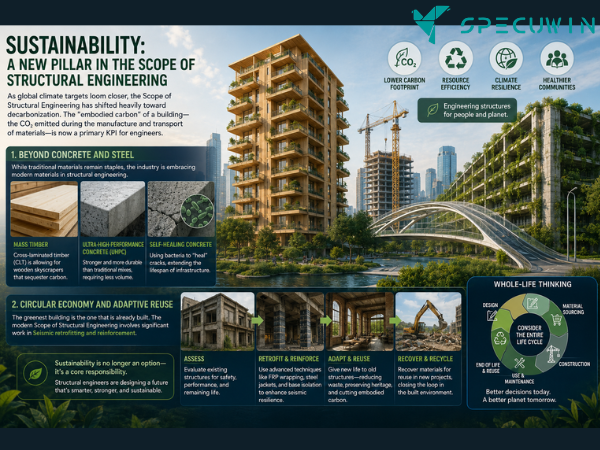
As global climate targets loom closer, the Scope of Structural Engineering has shifted heavily toward decarbonization. The “embodied carbon” of a building the CO2 emitted during the manufacture and transport of materials is now a primary KPI for engineers.
1. Beyond Concrete and Steel:
While traditional materials remain staples, the industry is embracing Modern materials in structural engineering. We are seeing the widespread adoption of:
- Mass Timber: Cross-laminated timber (CLT) is allowing for wooden skyscrapers that sequester carbon.
- Ultra-High-Performance Concrete (UHPC): Stronger and more durable than traditional mixes, requiring less volume.
- Self-Healing Concrete: Using bacteria to “heal” cracks, extending the lifespan of infrastructure.
2. Circular Economy and Adaptive Reuse:
The greenest building is the one that is already built. The modern Scope of Structural Engineering involves significant work in Seismic retrofitting and reinforcement. Instead of demolishing old structures, engineers are finding ways to strengthen them to meet modern safety standards and energy codes.
Urbanization and the Scope of Structural Engineering in High-Rise Design:-
With the world’s population continuing to migrate to urban centers, the demand for vertical living has never been higher. However, the challenges of high-rise buildings are evolving.
1. Combatting Natural Disasters:
In 2026, seismic and wind engineering have reached new heights of sophistication. Engineers are now implementing active damping systems massive tuned mass dampers controlled by AI to counteract the sway of super-tall towers during storms or tremors. Understanding the secrets of earthquake-resistant design is now a core requirement for anyone entering the field.
2. Infrastructure for Smart Cities:
The Scope of Structural Engineering now extends to integrated infrastructure. Bridges aren’t just for cars; they are conduits for fiber optics, sensors, and renewable energy harvesters. The role of BIM in bridge design has been pivotal in creating these multi-functional assets that serve the needs of a connected society.
Career Opportunities: Is the Scope of Structural Engineering Growing?
For those entering the workforce, the Scope of Structural Engineering is broader than ever. The role has diversified into several specialized niches:
- Forensic Structural Engineer: Investigating why buildings fail and providing expert testimony.
- Sustainability Consultant: Helping firms minimize their carbon footprint through material selection and efficient design.
- BIM Manager: Overseeing the digital lifecycle of complex projects.
- Restoration Specialist: Focusing on the maintenance of historic monuments and old residential houses.
The demand for these roles is being driven by both new construction in developing nations and the urgent need to repair aging infrastructure in developed ones.
The Critical Role of Interdisciplinary Collaboration:-
In 2026, the Scope of Structural Engineering is no longer a siloed discipline. The success of a project depends on collaboration between contractors and engineers.
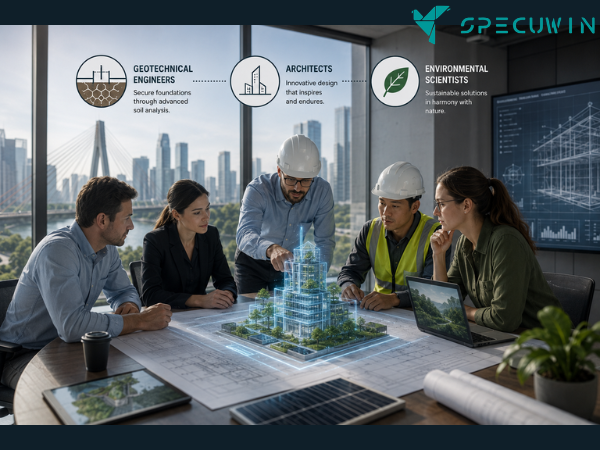
Structural engineers now work closely with:
- Geotechnical Engineers: To ensure foundations are secure through comprehensive soil testing.
- Architects: To push the boundaries of form without compromising safety.
- Environmental Scientists: To ensure the structure harmonizes with the local ecosystem.
Conclusion: The Future Horizon:-
The Scope of Structural Engineering in 2026 is defined by resilience. Whether it’s protecting a family home by identifying common structural issues or designing the next global icon like the Burj Khalifa, the structural engineer is the guardian of the built environment.
As we look toward the future, the integration of robotics, AI, and bio-materials will only continue to expand this field. For the aspiring engineer, the message is clear: the scope is vast, the technology is ready, and the world is waiting for you to build its future.
FAQ’s:-
1. Is Structural Engineering still a good career in 2026?
A. Absolutely. With the global push for sustainable infrastructure and the renovation of aging cities, the demand for skilled structural engineers is at an all-time high.
2. How has AI affected the Scope of Structural Engineering?
A. AI has automated repetitive calculations and optimized material usage, allowing engineers to focus more on creative problem-solving and complex design challenges.
3. What skills are most important for structural engineers today?
A. Beyond core physics and math, proficiency in BIM software, an understanding of sustainable material science, and data analysis skills are crucial.
4. Does the Scope of Structural Engineering include residential work?
A. Yes. From inspecting balconies for safety to diagnosing foundation issues in old homes, residential engineering is a vital and steady sector.
5. How do I stay updated with the changing Scope of Structural Engineering?
A. Continuous learning through BIM training and following industry-leading blogs is the best way to stay ahead of the curve.
Read More On:-
For more information about engineering, architecture, and the building & construction sector, go through the posts related to the same topic on the Specuwin Blog Page.
Find out more accurately what we are going to take off in the course of applying leading new technologies and urban design at Specuwin.