

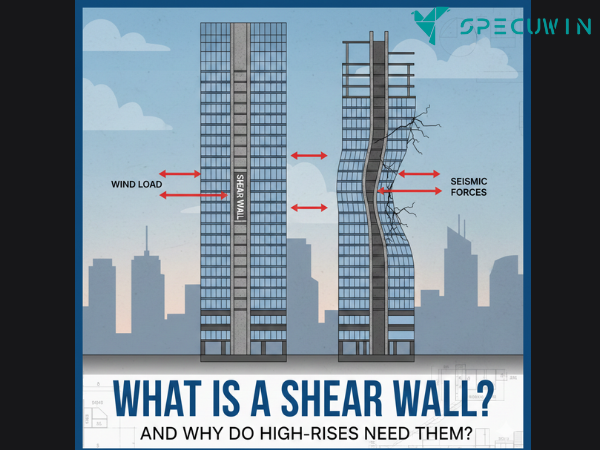
Have you ever stood on the upper floor of a skyscraper, looked out at the horizon, and felt… nothing? No swaying, no dizziness, just solid ground beneath your feet. It’s easy to take that stability for granted, but when you consider the physics involved, it’s actually a marvel of engineering known as Shear Wall.
High-rise buildings are constantly battling invisible giants: the relentless push of high-velocity winds and the sudden, violent shaking of seismic activity. While columns and beams handle the weight of gravity (keeping the building standing up), they aren’t always enough to stop the building from falling over. Enter the unsung hero of modern architecture: the Shear Wall.
In this guide, we will break down exactly what a shear wall is, why it is the backbone of skyscraper safety, and how it keeps our concrete jungles from crumbling.

What is a Shear Wall Exactly?:-
In simple terms, a shear wall is a vertical structural element designed to resist lateral forces. Think of it as a bracing panel. If you were to build a house of cards, it’s fragile. But if you glued a solid piece of cardboard vertically between the cards, the structure becomes rigid. That cardboard is acting as a shear wall.
While standard walls are room dividers, shear walls are the muscles of the building. They typically start at the foundation level and run continuously all the way to the top of the building. Their thickness and reinforcement are calculated precisely to handle “shear” forces—the unaligned forces pushing one part of a body in one specific direction, and another part of the body in the opposite direction.
The Anatomy of the Wall:
Most modern shear walls in high-rises are made of reinforced concrete (RC). This composite material combines the compressive strength of concrete with the tensile strength of steel bars (rebar). This combination is crucial because, during an earthquake or windstorm, the wall needs to hold immense weight without buckling while also flexing slightly without snapping.
The Two Invisible Enemies: Wind and Earthquakes:-
To understand the shear wall, you have to understand the forces it fights. In the world of structural engineering, we look at two main types of loads:
- Vertical Loads (Gravity): The weight of the building, furniture, and people. Columns handle this well.
- Lateral Loads (Horizontal): Wind and Seismic activity. This is where columns often fail, and shear walls shine.
1. The Wind Factor:
As buildings get taller, they act like giant sails. The wind pressure at 500 feet is significantly higher than at ground level. Without adequate bracing, a skyscraper would sway uncomfortably or worse, suffer structural damage. Shear walls provide the “stiffness” required to limit this sway to a safe, imperceptible level. Building tall comes with unique difficulties. Read more about the Structural Engineering of High-Rise Buildings: Challenges and Solutions.
2. The Seismic Factor:
During an earthquake, the ground moves violently. This creates a “base shear” force that ripples up the building. If the building is too flexible, it whips back and forth. If it’s too rigid and brittle, it cracks. A well-designed shear wall system offers a balance: it is rigid enough to stop the building from deforming excessively but has enough “ductility” to absorb the energy of the quake without collapsing. Want to dive deeper into seismic safety? Check out our article on Innovations in Earthquake-Resistant Design.

Why Do High-Rises Need Shear Walls?:-
You might wonder, “Can’t we just use thicker columns?” Not really. As you go higher, the lateral forces grow exponentially. Relying solely on a “frame system” (beams and columns) becomes inefficient and expensive because the columns would have to be massive, eating up valuable floor space.
Here is why the shear wall is non-negotiable for high-rises:
1. Maximizing Stiffness:
Shear walls provide immense lateral stiffness. By placing them strategically usually around the elevator core or stairwells engineers create a rigid “spine” for the building. This core resists the twisting (torsion) and bending that wind and earthquakes try to inflict on the structure.
2. Reducing Sway (Drift):
“Inter-story drift” is the technical term for how much one floor moves relative to the floor below it. If this drift is too high, windows shatter, partitions crack, and elevators jam. Shear walls lock the floors together, keeping this drift within safe limits.
3. Cost-Efficiency:
Because shear walls are so effective at handling lateral loads, the rest of the building’s columns can be smaller. This saves on material costs and allows architects more freedom to design open, airy floor plans without a forest of thick pillars obstructing the view. Materials matter. Learn about Modern Materials in Structural Engineering Beyond Concrete and Steel.
Where are Shear Walls Placed?:-
Placement is an art form. You can’t just put a concrete slab anywhere; it affects the building’s balance.
- The Core: The most common placement is the center of the building, surrounding the elevators and stairs. This creates a “central core” that anchors the building.
- The Perimeter: sometimes shear walls are placed on the exterior. This is effective for resisting twisting forces (torsion).
- Symmetrical Arrangement: Engineers strive for symmetry. If you have a heavy shear wall on the left but not the right, the building will twist during an earthquake.
Shear Wall Retrofitting: Saving Older Buildings:-
It’s not just about new construction. Many older high-rises were built before we fully understood modern seismic dynamics. These buildings are often “retrofitted” by adding new shear walls to the existing structure. It’s like giving an old building a new spine. Curious how we fix existing structures? Read our case study on Seismic Retrofitting: How We Reinforced a High-Rise for Earthquakes.
Types of Shear Walls:-
While reinforced concrete is the standard, technology is evolving.
- RC Shear Walls: The industry standard. Concrete and rebar.
- Steel Plate Shear Walls: Used in super-tall structures where concrete would be too heavy.
- Plywood Shear Walls: Common in residential timber homes (not high-rises), but the physics principle remains the same.

Conclusion:-
The next time you walk into a high-rise lobby and see a massive, blank concrete wall near the elevators, give it a nod of respect. That isn’t just a partition; it’s a shear wall, standing guard against the forces of nature.
Whether it is holding steady against a hurricane or absorbing the shock of a tectonic shift, the shear wall is arguably the most critical component in modern vertical living. It ensures that while the world outside might be shaking, life inside remains safe and sound.
If you are planning a project or evaluating a property, understanding these structural elements is key. Not sure where to start with your building’s needs? Here is What is Structural Engineering to help you understand the basics.
FAQ’s:-
1. Can a shear wall be removed during renovation?
A. Absolutely not without professional consultation. Shear walls are load-bearing and critical for lateral stability. Removing one can compromise the entire building’s structural integrity. Always consult a structural engineer before modifying walls in a high-rise.
2. How do I identify a shear wall in my apartment?
A. Shear walls are typically much thicker than standard partition walls. They are usually found around stairwells, elevator shafts, or forming the exterior shell of the building. In blueprints, they are often shaded differently than non-structural walls.
3. Do all buildings have shear walls?
A. Not all. Low-rise buildings might rely on moment-resisting frames or cross-bracing. However, nearly all modern concrete high-rises utilize shear walls or a combination of shear walls and frames (dual systems) for safety.
4. What is the difference between a retaining wall and a shear wall?
A. A retaining wall is designed to hold back soil or water (horizontal pressure from the side, usually at ground level). A shear wall is designed to resist lateral forces like wind and earthquakes affecting the entire building structure.
5. Are shear walls expensive to build?
A. While they require significant materials (concrete and steel), they are often cost-effective for high-rises because they reduce the need for massive columns and beams elsewhere, optimizing the overall structural budget.
Read More On:-
For more information about engineering, architecture, and the building & construction sector, go through the posts related to the same topic on the Specuwin Blog Page.
Find out more accurately what we are going to take off in the course of applying leading new technologies and urban design at Specuwin.