

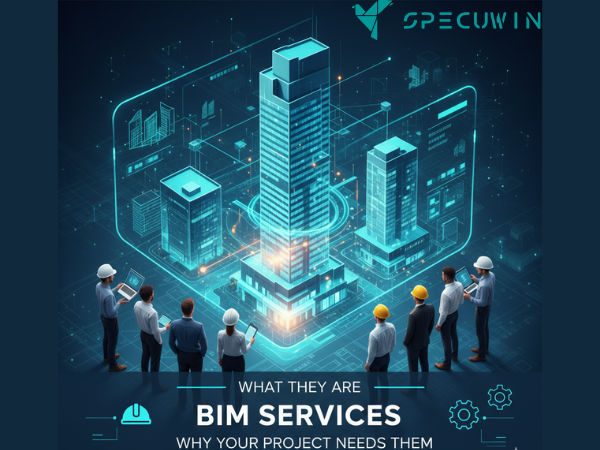
Remember the days of relying solely on rolls of paper blueprints? It feels like ancient history now, thanks to a revolution that has fundamentally changed how we design, build, and operate structures. That revolution is Building Information Modeling, and the comprehensive offerings that bring it to life are known as BIM Services.
At its core, Building Information Modeling (BIM) is more than just advanced 3D software; it’s a profound shift in mindset and a powerful process. It involves the creation and management of a structured, intelligent, and data-rich digital representation of a building or asset. These digital models aren’t just pretty pictures; they are a shared knowledge resource for information about a facility, forming a reliable basis for decisions throughout its entire lifecycle, from the earliest concept all the way to demolition.
So, what exactly are BIM Services? Simply put, they are the professional solutions that help you leverage the power of this technology. They provide the expert people, processes, and technology needed to create, manage, and utilize these intelligent models. Whether you are an architect exploring a complex design, a contractor coordinating installations, or an owner planning long-term maintenance, BIM Services offer a single, shared source of truth that ensures everyone is on the same (digital) page.

What Exactly Are BIM Services? Beyond 3D Graphics:-
To fully understand the value of BIM Services, we have to recognize that the modeling process goes far beyond the three spatial dimensions (width, height, and depth). A true BIM model is an information powerhouse, embedding crucial data into every digital component, allowing for multi-dimensional project control. This is why you often hear the terms 4D, 5D, 6D, and even 7D BIM.
| BIM Dimension | Data Focus | Service Provided | Why it Matters |
| 3D BIM | Geometry and Visualization | Detailed 3D modeling of architecture, structure, and MEP systems. | Allows stakeholders to visualize the design and identify potential geometric issues (clashes). |
| 4D BIM | Time/Scheduling | Linking the 3D model components with project time and scheduling information. | Helps project managers visualize the construction sequence, identify critical paths, and track progress against the schedule. |
| 5D BIM | Cost/Quantities | Extracting accurate quantities (Quantity Takeoffs) and assigning cost data to the model elements. | Provides real-time budget tracking, accurate cost estimates, and helps prevent budget overruns. |
| 6D BIM | Sustainability/Analysis | Analyzing the model for energy consumption, material sourcing, and life-cycle environmental impact. | Supports the design of greener, more efficient, and sustainable buildings. |
| 7D BIM | Facility Management | Integrating asset data into the model for use after construction is complete. | The model becomes a “digital twin” for operations, maintenance, and facility management. |
By using these comprehensive BIM Services, project teams move from simply drawing a building to building with data, maximizing clarity and efficiency at every stage.
The Practical Perks: Key Benefits of Utilizing BIM Services:-
The move to a BIM workflow isn’t just a trend; it’s a competitive necessity driven by tangible benefits that cut costs, save time, and dramatically improve project outcomes.
1. Collaboration Made Easy: The Power of a Shared Digital Space:
In traditional construction, communication often moves sequentially from the architect to the engineer to the contractor, creating potential for misunderstandings at every handoff. BIM Services flip this script by providing a single, centralized digital platform a Common Data Environment (CDE).
This shared model allows architects, engineers, and contractors to work together more effectively and in real-time, drastically reducing miscommunication and ensuring everyone is working from the most current information. When communication flows smoothly, projects run smoothly. The collective understanding and ability to make joint, informed decisions is perhaps the greatest non-technical advantage of professional BIM Services.
2. Catching Mistakes Before They’re Expensive: Clash Detection:
The most notorious and costly problems in construction happen when a design conflict a “clash” is discovered on the job site. This could be anything from a ventilation duct running straight through a structural beam to a pipe interfering with a light fixture. Fixing these issues on-site leads to costly rework, material waste, and significant delays.
A core component of BIM Services is Clash Detection and Coordination. By integrating the architectural, structural, and MEP models, specialized software can automatically identify all these spatial overlaps or interferences before any physical construction begins. Resolving these clashes in the digital model saves time and money, making the construction phase far more predictable.

3. Predictable Project Delivery & Financial Certainty:
The detailed, data-rich nature of the BIM model enhances financial and temporal predictability. Through 5D BIM Services, project managers can generate highly accurate Bills of Quantities (BOQs) and material takeoffs by extracting detailed information directly from the model’s geometry. This precision minimizes material wastage and ensures procurement is accurate, preventing budget overruns. Similarly, 4D BIM Services link the model to the construction schedule, allowing teams to visualize the timeline and optimize workflows, which often leads to faster project delivery with less rework.
Navigating the Transition: From CAD to BIM Services:-
For decades, the industry relied on CAD (Computer-Aided Design), a tool that primarily focuses on creating 2D drawings or basic 3D geometry. While CAD is still useful, the shift to BIM Services represents an evolutionary leap.
The difference is simple but crucial: CAD produces drawings, while BIM produces an intelligent, data-rich model. When you change a wall’s thickness in a CAD drawing, you have to manually update every related drawing (section, elevation, schedule). When you change a wall’s thickness in a BIM model, the entire project all related views, schedules, and quantity estimates updates automatically. The effort to transition from the old ways to this data-driven standard pays off exponentially in enhanced project delivery.
Want to see how this transition works in practice? Read our guide: From CAD to BIM: Navigating the Transition for Enhanced Project Delivery
Who Needs BIM Services? A Project-Wide Advantage:-
The beauty of Building Information Modeling is that its benefits are not siloed; they cascade to every person involved in the asset’s life.
- Architects & Designers: They gain enhanced design accuracy, real-time visualization, and the ability to perform complex analyses (like daylight and energy studies) early in the conceptual phase.
- Structural & MEP Engineers: They use the collaborative environment to ensure their systems are perfectly coordinated, resolving conflicts before they ever become site problems.
- Contractors & Fabricators: They benefit from precise quantity takeoffs, visual 4D scheduling, and the confidence of working with a clash-free model, enabling greater use of prefabrication and modular construction.
- Owners & Facility Managers: After construction, they inherit a “digital twin” (7D BIM) that helps them manage the building’s operations, maintenance schedules, and energy usage efficiently for decades.
If you are an industry professional seeking a competitive edge, understanding and adopting this workflow is critical. In fact, BIM is a crucial skill for a future-ready career in the AEC industry.

Making the Smart Move: Investing in BIM Services Outsourcing
For many firms especially those looking to scale quickly or manage peak workload immediately building a fully-staffed, in-house BIM team can be costly and time-consuming. This is where specialized BIM Services firms come in.
Outsourcing to a dedicated BIM provider allows your company to access high-level expertise, the latest software, and established best practices without the heavy upfront investment in training and infrastructure. It allows your core team to focus on their primary competencies design and project management while ensuring the digital modeling and coordination work is handled by experts, optimizing your internal resources.
To explore the strategic advantage, Read more here: The Value of BIM Outsourcing for Architectural and Engineering Firms
Conclusion: Why BIM Services Are Your Next Step:-
The era of guess-work, manual coordination, and on-site errors is drawing to a close. BIM Services have emerged as the backbone of modern, efficient, and sustainable construction globally.
By transforming a building project into an intelligent, shared database, BIM enhances communication, maximizes efficiency, and delivers greater value across the entire lifecycle of an asset. Whether you are a beginner looking to understand the fundamentals or a veteran firm ready to fully digitalize, adopting BIM is no longer optional it is the foundation for success in the future of the built environment.
If you’re just getting started on your journey, we recommend beginning with the fundamentals.
Need a detailed resource? Check out our guide: BIM for Beginners: A Guide to Getting Started in Building Information Modeling
FAQ’s:-
1. Is BIM just software, or is it a process?
A. BIM is first and foremost a process a methodology for creating and managing information throughout the life of a built asset. Software, such as Autodesk Revit or ArchiCAD, are merely the tools that are used to facilitate this process and create the intelligent models.
2. What is the biggest difference between BIM and traditional 3D CAD?
A. The key difference is data. Traditional 3D CAD only provides the geometry (lines and shapes). BIM models contain relational, geometric, spatial, and material data, making the objects “intelligent”. When you change one element in a BIM model, all associated data and drawings update automatically.
3. What does 4D and 5D BIM Services mean?
A. The “D” stands for dimension beyond the standard 3D space. 4D BIM Services link the model to project scheduling (Time), helping teams visualize the construction sequence. 5D BIM Services link the model to cost data, enabling real-time cost estimation and quantity takeoffs.
4. Can BIM Services be used for existing buildings?
A. Yes. Scan-to-BIM Services use laser scanning or photogrammetry to create a highly accurate point cloud of an existing building. This point cloud is then converted into an intelligent BIM model, which can be used for renovation planning, facility management, and maintenance.
5. How does BIM improve Facility Management after construction?
A. This is typically known as 7D BIM. The final model serves as a “digital twin” containing all the necessary information such as equipment specifications, maintenance schedules, and material details needed to efficiently operate, maintain, and manage the building’s systems for its entire lifespan.
Read More On:-
For more information about engineering, architecture, and the building & construction sector, go through the posts related to the same topic on the Specuwin Blog Page.
Find out more accurately what we are going to take off in the course of applying leading new technologies and urban design at Specuwin.