

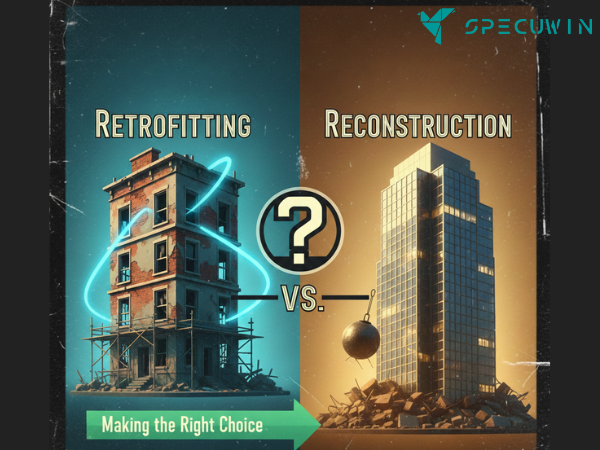
It is the classic dilemma for property owners and developers: you have an existing structure that isn’t quite living up to modern standards. Maybe the layout is obsolete, the energy bills are skyrocketing, or the structural integrity is questionable. Do you tear it all down and start from scratch, or do you work with what you have? This brings us to the debate of Retrofitting vs. Reconstruction.
In the Architecture, Engineering, and Construction (AEC) industry, this decision is rarely black and white. It involves a complex balancing act between budget, timeline, heritage preservation, and environmental impact. While starting fresh offers a blank canvas, the alternative strengthening and upgrading the existing fabric often provides a more sustainable and cost-effective path.
In this guide, we will explore the critical factors you need to consider. We will look at why Retrofitting is becoming the preferred choice for many, when demolition is unavoidable, and how to navigate this high-stakes decision.
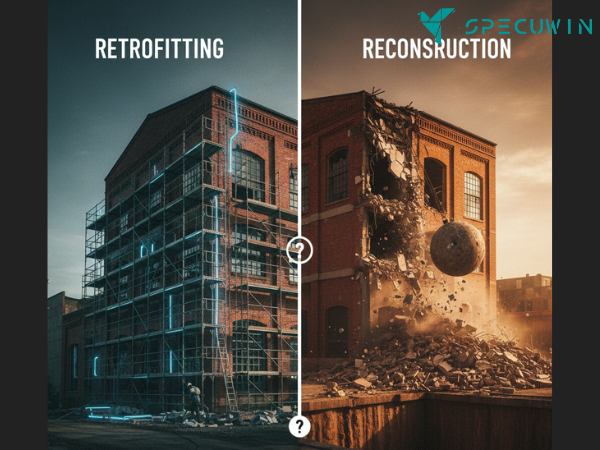
Understanding the Core Differences: Retrofitting vs. Reconstruction
Before diving into the financials, it is essential to define what we are actually talking about. While both approaches result in an improved asset, the journey to get there is vastly different.
The process of upgrading an existing facility involves adding new technology, building systems, or structural components to an older edifice. It is about taking good “bones” and giving them a modern heart and brain. This might mean reinforcing columns to withstand higher loads, installing modern HVAC systems in a heritage shell, or updating the facade for better thermal performance.
On the other hand, reconstruction is the act of demolition and rebuilding. It wipes the slate clean. This allows for zero compromises on design layout but comes with a massive carbon footprint and significant waste generation. If you are unsure if your current building has “good bones” or serious underlying issues, you should first understand the typical faults found in older properties. Read more about Common structural problems in old houses and how to fix them.
The Case for Retrofitting: Why Choose Restoration?:-
For decades, the default response to an aging building was the wrecking ball. However, the tide is turning. Modern engineering allows us to achieve incredible feats without destroying the original structure.
1. Cost-Effectiveness and ROI:
In many scenarios, refurbishment is significantly cheaper than a complete rebuild. You are saving on demolition costs, foundation work (which is often the most expensive part of a build), and the sheer volume of new materials required. The project timeline is often shorter, meaning the building can return to generating revenue or being habitable much faster.
2. Preserving Heritage and Character:
You cannot manufacture history. An older building often possesses architectural charm high ceilings, unique masonry, or a specific cultural significance—that a modern steel-and-glass box simply cannot replicate. Updating these spaces allows you to keep the aesthetic soul of the neighborhood while ensuring the building functions safely for modern occupants.
3. Structural Safety Upgrades:
Many owners worry that keeping an old building means compromising on safety. This is a myth. Through advanced engineering techniques, existing frames can be strengthened to meet or even exceed current safety codes. For example, we’ve seen successful projects where older high-rises were fortified against natural disasters without tearing them down. Check out our case study on Seismic retrofitting: How we reinforced a high-rise for earthquakes.
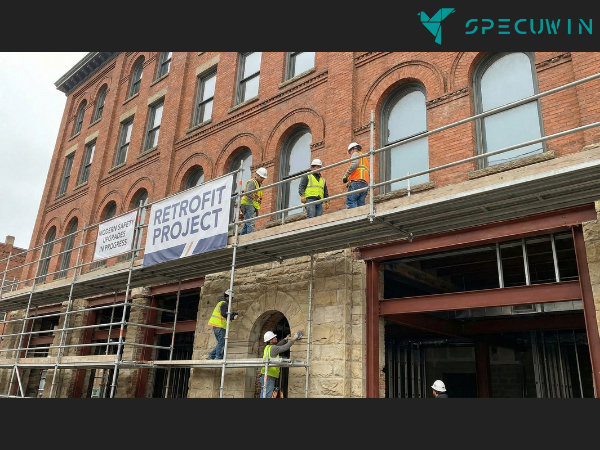
When Reconstruction Makes More Sense than Retrofitting:-
Despite the benefits of preservation, there are times when starting over is the logical, responsible choice. It is important to recognize when a structure has reached the end of its viable life.
If the existing foundation is compromised beyond repair, or if the layout is so incompatible with the intended new use (e.g., trying to turn a small residential unit into a heavy industrial warehouse), the cost of modification might eclipse the cost of a new build.
Furthermore, sometimes “hidden” damage is so extensive that once you peel back the walls, the scope of work explodes. If the cumulative cost of repairs approaches 70-80% of the cost of a new building, reconstruction is usually the smarter investment. Before making a final call on demolition, it is vital to have a professional assess the severity of the damage. Here are the Top 5 signs your building needs a structural inspection.
The Sustainability Factor in Retrofitting Projects:-
We cannot discuss modern construction without talking about the environment. The construction industry is a massive contributor to global carbon emissions, and this is where keeping the existing structure shines.
Reusing an existing building structure saves the “embodied carbon” the energy that was used to create the concrete, steel, and bricks decades ago. When you demolish, you waste that energy and generate tons of landfill debris. Then, you burn more carbon manufacturing new materials.
By choosing to update and improve rather than destroy, you are drastically reducing the project’s environmental impact. This aligns perfectly with the global push toward Net Zero buildings. It turns an energy-inefficient liability into a green asset without the heavy carbon cost of new construction. To dive deeper into how preserving structures aids the environment, read our article on Sustainable structures: Eco-friendly approaches in modern construction.
Financial Implications: Cost Analysis of Retrofitting:-
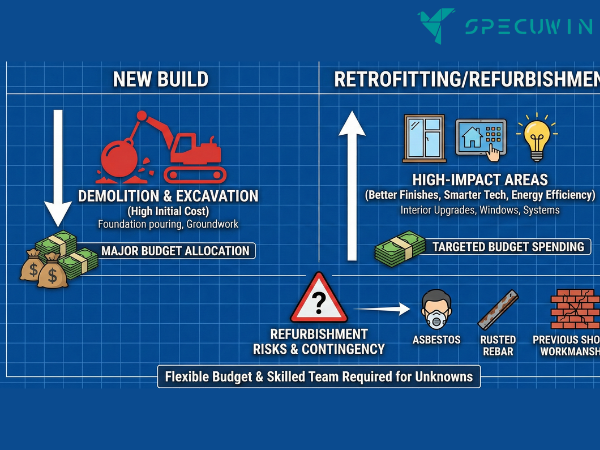
Let’s talk money. When you budget for a refurbishment, the allocation of funds looks different than a new build.
With a new build, a huge chunk of the budget vanishes into the ground demolition, excavation, and pouring new foundations. With a renovation project, your budget is spent on high-impact areas: better finishes, smarter technology, and energy-efficient windows.
However, refurbishment does carry risk. The “unknowns” in an old building can lead to contingency spending. You might find asbestos, rusted rebar, or previous shoddy workmanship. Therefore, while the base cost is usually lower, it requires a flexible budget and a highly skilled team to manage the surprises that pop up when the walls are opened.
Making the Decision: Is Retrofitting Right for You?:-
Ultimately, the choice relies on a feasibility study. You need to gather data. This isn’t a decision to be made on a “gut feeling.”
Ask yourself:
- What is the goal? Is it strictly financial return, or is there a branding value in the heritage?
- What is the condition? Have you had a structural audit?
- What are the local laws? Zoning laws might prevent you from building a new structure as large as the current one (grandfather clauses), making preservation the only way to keep your square footage.
If the structure is sound and the geometry works for your needs, preservation is usually the winner. It saves time, money, and the planet. But it requires a team that understands the nuances of working with existing materials.
Conclusion:-
The debate between Retrofitting and reconstruction is about more than just concrete and steel; it is about value. It is about finding the sweet spot where safety, sustainability, and economics meet. While the allure of a shiny new building is strong, the untapped potential in our existing built environment is massive.
By choosing to strengthen and revitalize, we honor the past while engineering a safer, greener future. If you are sitting on an aging asset, don’t call the demolition crew just yet call a structural engineer. The best building for your future might be the one you are standing in right now.
FAQ’s:-
1. Is it always cheaper to update an old building than to build a new one?
A. Generally, yes. You save on demolition and structural materials. However, if the building requires massive structural interventions or hazardous material removal (like asbestos), the costs can sometimes rival new construction.
2. Does updating a building make it earthquake-proof?
A. While no building is 100% “proof,” modern engineering techniques can significantly increase seismic resistance, bringing older buildings up to current safety codes and protecting lives during tremors.
3. How long does a renovation project take compared to rebuilding?
A. Renovation is usually faster because the shell and foundation are already in place. You skip the lengthy excavation and curing times associated with new concrete foundations.
4. Can I change the use of the building (e.g., office to residential) without rebuilding?
A. Yes, this is called Adaptive Reuse. It is a popular trend, but it requires careful structural analysis to ensure the floors can support the new load requirements (e.g., heavy library books vs. residential furniture).
5. Will my building be as energy-efficient as a new one?
A. It can be very close. By insulating walls, replacing windows, and updating HVAC systems, an older building can achieve high energy performance ratings, though perhaps not the “passive house” standards of a brand-new optimized design.
Read More On:-
For more information about engineering, architecture, and the building & construction sector, go through the posts related to the same topic on the Specuwin Blog Page.
Find out more accurately what we are going to take off in the course of applying leading new technologies and urban design at Specuwin.