

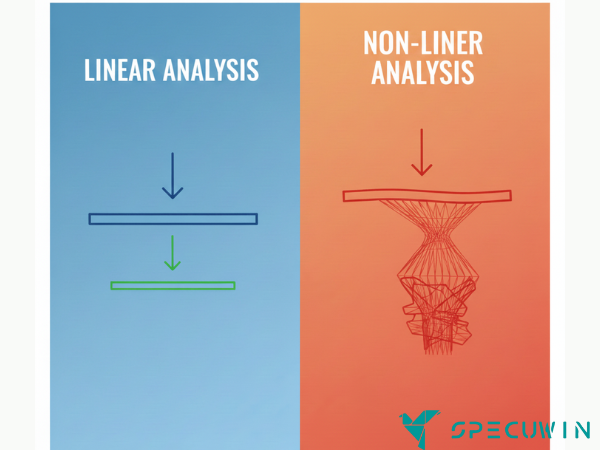
If you’ve ever wondered how a skyscraper withstands a hurricane or how a bridge supports traffic without collapsing, the answer lies in the rigorous math and physics happening behind the scenes. In the world of structural engineering, we don’t just “hope” a building stands up; we simulate its future behavior to ensure it does. This process is generally divided into two camps: the straightforward path of Linear Analysis and the more rugged, complex terrain of Non-Linear Analysis.
For many standard buildings, the simpler approach works perfectly fine. But as we push the boundaries of architecture with twisting towers and cutting-edge materials, the math has to get smarter. Understanding the distinction between these two methods isn’t just academic it is the difference between a safe structure and a potential failure.
In this guide, we will break down these concepts and explore exactly when your project demands a more sophisticated Analysis.

What Is Linear Analysis and Why Is It Popular?:-
Linear analysis is the bread and butter of structural engineering. Think of it like a rubber band: if you pull it a little, it stretches; let go, and it snaps back to its exact original shape. In engineering terms, this relies on the assumption that the relationship between applied forces (loads) and the resulting deformations (displacements) is directly proportional.
This method follows Hooke’s Law, where stress is proportional to strain. Because the math involved is relatively simple solving a system of linear equations computers can crunch these numbers incredibly fast.
For the majority of projects, such as standard residential homes or low-rise commercial buildings, linear static simulation is sufficient. It assumes the material never yields (breaks or permanently deforms) and that the deformations are so small that they don’t affect the overall stiffness of the structure. However, the real world isn’t always linear. Nature is chaotic, and materials don’t always behave like perfect rubber bands. That is where we hit the limits of this traditional Analysis.
The Shift to Non-Linear Analysis for Real-World Accuracy:-
While linear methods assume a perfect world, non-linear analysis deals with reality. In the real world, structures crack, steel yields, and tall buildings sway enough that their center of gravity shifts. When these things happen, the “proportional” relationship breaks down. The stiffness of the structure changes as it is being loaded.
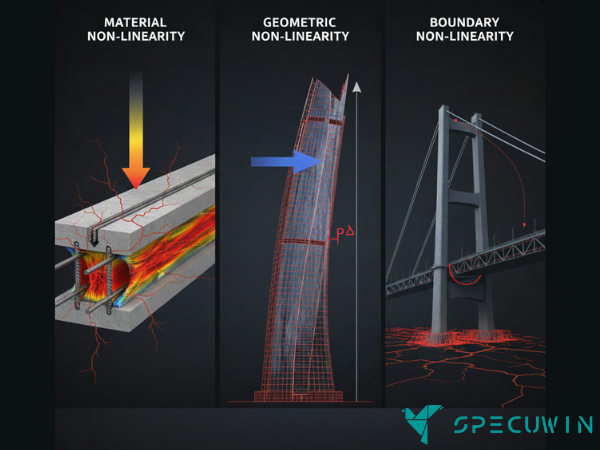
Non-linear simulation is required when the response of the structure is not directly proportional to the applied load. This usually stems from three main sources:
- Material Non-linearity: This occurs when materials stop behaving elastically. For example, concrete cracks and steel undergoes plastic deformation. If you are exploring modern materials in structural engineering beyond concrete and steel , you need a method that can predict how these advanced composites behave under extreme stress.
- Geometric Non-linearity: If a structure deforms significantly, its shape changes, which in turn changes how it handles loads. A classic example is the “P-Delta” effect in high-rises.
- Boundary Non-linearity: This happens when the contact between two parts changes, such as a building lifting off its foundation during an earthquake or cables going slack.
When to Use Advanced Analysis for Complex Geometries:-
Knowing when to switch from simple to complex methods is a hallmark of a skilled engineering team. While linear methods are faster, they can be dangerously inaccurate for complex geometries.
1. High-Rise Skyscrapers and P-Delta Effects:
In tall, slender buildings, wind and gravity loads cause the building to drift. As the building sways, the weight of the upper floors is no longer perfectly centered over the bottom floors. This creates secondary stresses known as P-Delta effects. A linear model might miss this entirely, underestimating the danger.
For instance, the Structural engineering of high-rise buildings challenges and solutions often revolve around mitigating these specific forces. Iconic structures like the Burj Khalifa rely heavily on these advanced simulations to ensure stability. You can read more about that in our Case study of the Burj Khalifa.
2. Seismic and Vibration Design:
Earthquakes are inherently non-linear events. During a major tremor, we actually want parts of the building to deform (ductility) to absorb energy and prevent total collapse. Linear methods cannot accurately predict this damage. If you are looking into Innovations in earthquake-resistant design, you are looking at non-linear time-history simulations.
3. Irregular Architectural Forms:
Modern architecture loves curves, cantilevers, and asymmetry. These shapes distribute loads in unpredictable ways. A standard grid analysis won’t catch the stress concentrations in a Zaha Hadid-style curve. Advanced simulation is the only way to verify these “impossible” shapes.
The Role of Technology in Modern Analysis:-
Decades ago, non-linear calculations were done by hand and were incredibly time-consuming. Today, the role of technology in structural analysis and design has transformed the industry.
Powerful software using Finite Element Analysis (FEA) can now break a complex building into millions of tiny “elements.” The software calculates the stress on every single brick and beam, updating the stiffness matrix in real-time as the load increases. This allows engineers to see exactly where a beam might buckle or where a concrete slab might crack before a single shovel hits the dirt.
This technological leap also enables Generative design in structural engineering, where AI helps explore thousands of design iterations to find the most efficient geometric solution.
Comparing the Cost and Effort of Analysis Methods:-
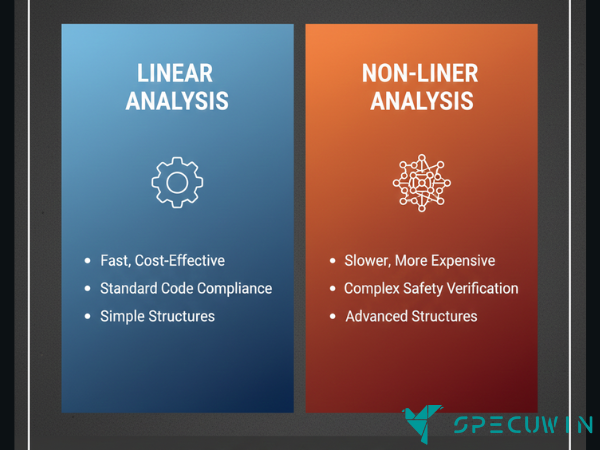
It is important to note that advanced doesn’t always mean “better” for every project. Non-linear simulation is computationally expensive. It requires more powerful hardware, expensive software licenses, and significantly more engineering hours to set up and interpret.
- Linear: Fast, cost-effective, standard for code compliance on regular structures.
- Non-Linear: Slower, more expensive, but essential for performance-based design, forensics, and complex safety verification.
Clients must understand that if they want a unique, complex structure, the engineering fees may be higher because the “math” required to ensure safety is exponentially harder. However, this investment often saves money in construction materials by optimizing the structure exactly where it is needed.
Conclusion on Structural Analysis:-
The choice between Linear and Non-Linear methods isn’t just a technical toggle in a software program; it’s a strategic decision that affects the safety, cost, and feasibility of a project. While linear methods serve as the reliable backbone for standard construction, the non-linear approach unlocks the potential for modern marvels.
Whether you are building a simple warehouse or the next city icon, understanding the behavior of your structure is paramount. If you are unsure which approach your project needs, it is vital to consult with experts who understand the nuances of these methodologies. Not sure where to start? Check out our guide on How to choose the right structural engineer for your project.
FAQ’s:-
1. What is the main difference between Linear and Non-Linear Analysis?
A. Linear analysis assumes that a structure returns to its original shape after the load is removed and that materials do not yield. Non-linear analysis accounts for permanent deformations, material yielding (breaking/cracking), and changes in the structure’s shape under load.
2. When is Non-Linear Analysis absolutely necessary?
A. It is necessary for high-rise buildings (to account for P-Delta effects), irregular/complex geometries, cable structures, and seismic design where the building is expected to deform to absorb earthquake energy.
3. Does Non-Linear Analysis take longer to perform?
A. Yes, significantly. Because the stiffness of the structure changes constantly during the calculation, the computer must solve the equations iteratively (step-by-step), which takes much more computing power and time than a single-step linear calculation.
4. Can Linear Analysis predict structural failure?
A. It can predict the onset of failure (e.g., when stress exceeds capacity), but it cannot accurately predict how the structure fails or what happens after that first yield point. For post-failure behavior, you need non-linear methods.
5. Is Non-Linear Analysis required for residential houses?
A. Generally, no. Most standard residential houses are stiff enough and simple enough that linear static analysis is perfectly safe and accurate. Advanced methods are reserved for custom, complex, or large-scale residential projects.
Read More On:-
For more information about engineering, architecture, and the building & construction sector, go through the posts related to the same topic on the Specuwin Blog Page.
Find out more accurately what we are going to take off in the course of applying leading new technologies and urban design at Specuwin.