

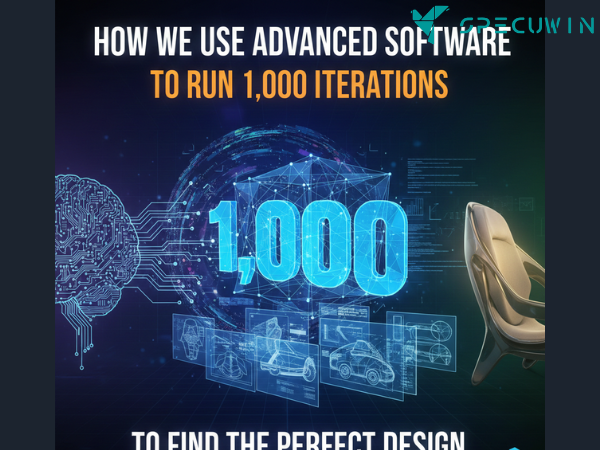
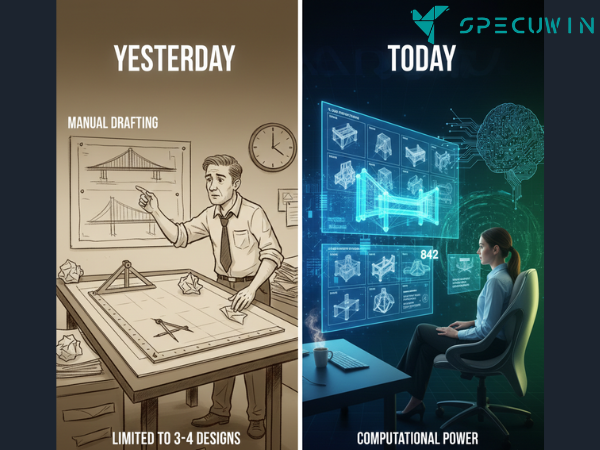
In the traditional world of architecture and engineering, “perfection” was often limited by the clock. An engineer might have had the time to manually calculate three or four design variations before a deadline loomed. You picked the best of the bunch, added a safety factor for good measure, and moved to construction. But what if the “perfect” version the one that uses 15% less steel, withstands higher seismic loads, and lowers carbon emissions was actually the 842nd variation?
Today, we don’t have to guess. By leveraging Advanced Software, our team has transitioned from manual drafting to computational power. We are now able to run 1,000 iterations of a single design component in the time it used to take to drink a cup of coffee. This isn’t just about speed; it’s about exploring a digital universe of possibilities to find the absolute needle in the haystack.
The Evolution of Iterative Design via Advanced Software:-
The leap from CAD (Computer-Aided Design) to BIM (Building Information Modeling) was the first step, but the real revolution lies in generative design and algorithmic modeling. When we talk about “running 1,000 iterations,” we are describing a process where the designer defines the goals (e.g., “minimize weight while maximizing stiffness”) and the Advanced Software uses algorithms to “grow” or “evolve” the best possible geometry.
Why 1,000 Iterations Matter:-
In structural engineering, variables are interconnected. If you change the thickness of a beam, it affects the load on the column, which affects the depth of the foundation. Manually adjusting these is like playing a never-ending game of Whac-A-Mole. Advanced Software allows us to treat these variables as parameters. By running a massive number of iterations, we can see the “stress test” of every possible scenario, ensuring that the final selection isn’t just “good enough” it’s mathematically optimized.
How Our Advanced Software Workflow Functions:-
The process begins with “Parametric Design.” Instead of drawing a static line, we write a rule. For example, “This roof must slope between 5 and 15 degrees.”
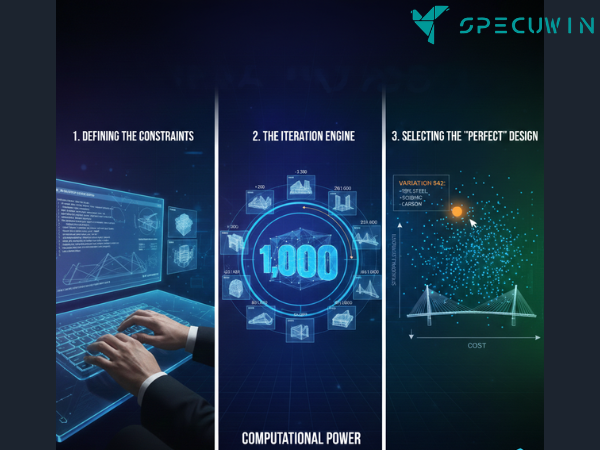
1. Defining the Constraints:
Before the software runs, the human expert sets the boundaries. We input data regarding local building codes, material costs, and environmental factors like wind speed or soil density. This ensures that while the Advanced Software is creative, it stays grounded in reality.
2. The Iteration Engine:
Once the “play” button is hit, the engine begins generating versions.
- Iteration 1-200: The software explores wild, diverse shapes.
- Iteration 201-600: It begins to “learn” which shapes perform better under stress.
- Iteration 601-1,000: The software fine-tunes the top-performing designs, shaving off millimeters of material where they aren’t needed.
3. Selecting the “Perfect” Design:
The result isn’t just one drawing; it’s a data cloud. We can see a graph of 1,000 dots, where one axis is “Cost” and the other is “Structural Performance.” The “perfect” design is usually found at the intersection of these two needs a point often called the Pareto Front.
Sustainability and Efficiency through Advanced Software:-
One of the most human-centric reasons we use this technology is the planet. Construction is one of the world’s largest carbon emitters. Much of that comes from “over-engineering” using more concrete and steel than necessary because we didn’t have the data to prove a leaner design would work.
By using Advanced Software to iterate 1,000 times, we can identify exactly where material is dead weight. We’ve seen projects where we could reduce steel consumption by 20% simply by letting the software find a more efficient truss pattern that a human eye would never have thought to draw. This is the future of sustainable structures.
The Synergy of Human Intuition and Advanced Software:-
There is a common fear that “1,000 iterations” means the computer is the architect. This couldn’t be further from the truth.
Think of Advanced Software as a high-powered telescope. The telescope doesn’t decide which star to look at; the astronomer does. The software provides the options, but the human engineer provides the soul, the aesthetics, and the final “vibe check.” Sometimes the 842nd iteration is the strongest, but the 845th iteration is much easier for a contractor to actually build. We choose the one that balances math with “constructability.”
Real-World Impact: From Skyscrapers to Residential Safety:-
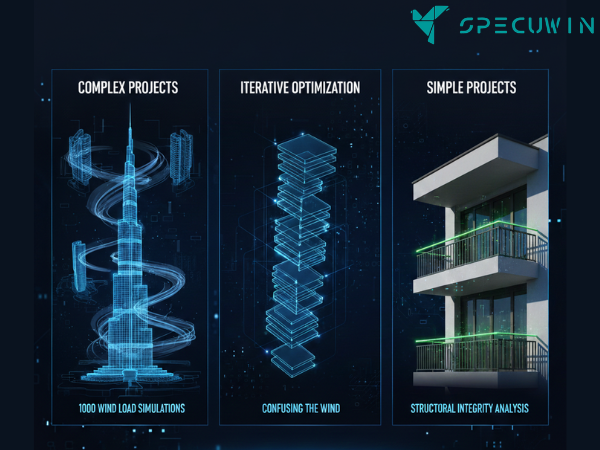
Whether we are analyzing the Seismic retrofitting of a high-rise or ensuring a simple balcony is safe, iteration is key. In complex projects like the Burj Khalifa, the wind loads are so complex that manual calculation is impossible.
By using Advanced Software, we can simulate wind swirling around a building from 1,000 different angles and intensities. This allows us to “confuse the wind” by changing the building’s shape slightly at different heights a feat only possible through massive iterative testing.
Conclusion: Embracing the Future with Advanced Software:-
The era of “one and done” design is over. As we look toward a future of Digital Twins and AI-integrated construction, the ability to run 1,000 iterations will become the industry standard. It allows us to be bolder, safer, and more sustainable. We aren’t just building structures; we are hovering over a digital sandbox, testing every “what if” until we find the perfect solution for our clients.
Frequently Asked Questions:-
1. Does running 1,000 iterations with Advanced Software make the project more expensive?
A. Actually, it usually saves money. While the initial digital setup takes time, the material savings (using less steel or concrete) and the reduction in “errors on-site” far outweigh the software costs.
2. Can this Advanced Software be used for small residential projects?
A. Absolutely. While often used for skyscrapers, iterative design is incredibly helpful for optimizing residential deck safety or solving common structural problems in old houses.
3. Is the “perfect” design always the one the computer picks?
A. Not always. The computer picks the “mathematically optimal” design based on the data we give it. A human engineer then reviews it to ensure it is practical to build and aesthetically pleasing.
4. How long does it take to run 1,000 iterations?
A. Depending on the complexity, it can take anywhere from a few minutes to a few hours. This is a massive improvement over the weeks it would take to do even ten iterations manually.
5. Do I need a special engineer to use this Advanced Software?
A. Yes, it requires a specialist who understands both structural principles and algorithmic logic. It’s a key part of the modern role of a structural engineer.
Read More On:-
For more information about engineering, architecture, and the building & construction sector, go through the posts related to the same topic on the Specuwin Blog Page.
Find out more accurately what we are going to take off in the course of applying leading new technologies and urban design at Specuwin.