

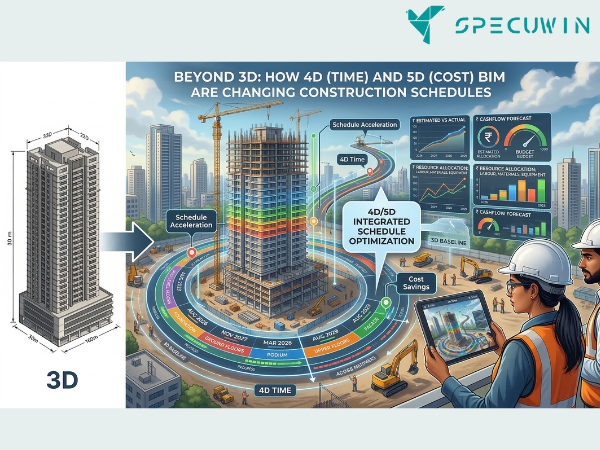
The construction industry has long been haunted by two primary ghosts: delays and budget overruns. For decades, project managers relied on 2D blueprints and separate Excel sheets to manage complex timelines and fluctuating costs. However, the evolution of BIM (Building Information Modeling) has moved far beyond simple 3D visualization. We are now entering the era of “Multi-Dimensional Modeling,” where time and money are baked directly into the digital DNA of a project.
By integrating 4D (Time) and 5D (Cost), BIM is fundamentally changing how we plan, execute, and deliver modern infrastructure. It is no longer just about how a building looks; it’s about how it grows over time and how much every brick costs in real-time.
Understanding the Dimensions of BIM: From 3D to 5D
To appreciate where we are going, we have to look at where we started. Traditional 3D BIM gave us the spatial geometry the width, height, and depth of a structure. While revolutionary, it didn’t account for the “when” or the “how much.”
1. The 4D Element: Scheduling and Time in BIM:
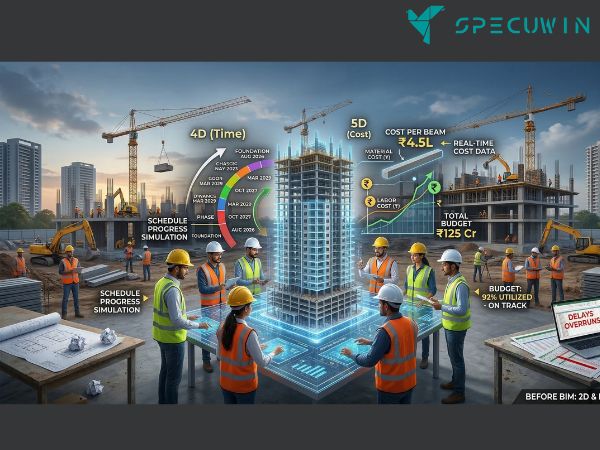
4D BIM adds the dimension of time to the 3D model. Imagine watching a time-lapse video of your building being constructed before a single shovel hits the ground. Each component in the model is linked to a specific date in the project schedule. This allows teams to visualize the sequence of construction, identifying potential logistical bottlenecks or safety hazards months in advance.
2. The 5D Element: Real-Time Cost Estimation in BIM:
5D BIM takes it a step further by integrating cost data. As the 3D model is built and the 4D schedule is set, the 5D dimension calculates quantities and costs. If a designer changes the material of a façade in the model, the budget updates automatically. This creates a living, breathing financial map of the project.
How 4D BIM Revolutionizes Project Scheduling:-
In traditional construction, the schedule is often a static Gantt chart taped to a trailer wall. When things go wrong, the chart is manually updated, often leading to communication gaps. 4D BIM changes this by making the schedule visual and interactive.
Visualizing Construction Sequences with BIM:
With 4D BIM, stakeholders can “play” the construction process. This visualization helps in:
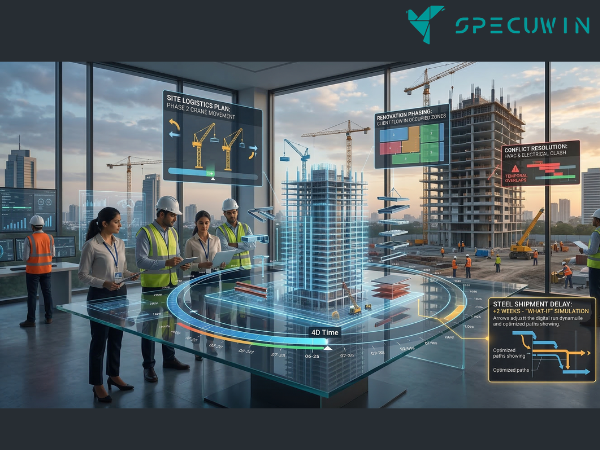
- Site Logistics: Planning where cranes, materials, and temporary structures should be placed at different phases of the project.
- Phasing Plans: Clearly communicating to clients how a renovation will occur while a building remains occupied.
- Conflict Resolution: Seeing if two different subcontractors (like HVAC and Electrical) are scheduled to work in the same cramped space at the same time.
Improving Predictability Through BIM Simulation:
The ability to simulate the “what-if” scenarios is perhaps the greatest gift of 4D BIM. If a shipment of steel is delayed by two weeks, the project manager can run a simulation to see the ripple effect on the entire timeline and adjust other tasks to keep the project moving.
The Financial Impact: Managing Budgets with 5D BIM:-
Cost overruns are often cited as the biggest pain point in the AEC (Architecture, Engineering, and Construction) industry. 5D BIM provides a level of financial transparency that was previously impossible.
Automated Quantity Take-offs in BIM:
One of the most tedious tasks for a surveyor is the “take-off” counting every door, window, and cubic meter of concrete. In a 5D BIM environment, this is automated. Because the model knows the volume and specifications of every element, it can generate precise material lists instantly.
Real-Time Budget Tracking with BIM:
As the project progresses through the 4D timeline, 5D BIM allows for “Earned Value Analysis.” You can see exactly how much money should have been spent by a specific date versus how much has actually been spent. This proactive approach prevents the “end-of-project surprise” where contractors realize they are significantly over budget.
The Synergy: Why 4D and 5D BIM Must Work Together:-
While 4D and 5D are powerful individually, their true potential is unlocked when used together. This integration creates a “Digital Twin” of the project’s lifecycle.
Enhanced Collaboration through BIM Integration:
When time and cost are linked, the entire “silo” mentality of construction dissolves. The architect, the engineer, the contractor, and the owner are all looking at the same data. This is particularly relevant when navigating From CAD to BIM for enhanced project delivery. The transition isn’t just about software; it’s about a collaborative mindset.
Risk Mitigation and Safety in BIM:
By visualizing the schedule (4D), you identify safety risks. By attaching costs (5D), you can budget for the necessary safety equipment or specialized labor required for high-risk phases. This holistic view ensures that safety isn’t compromised by budget cuts.
Overcoming Challenges in Adopting 4D and 5D BIM:-
Despite the benefits, the industry has been slow to fully adopt 5D. The primary hurdles are data quality and the initial investment in training.
Data Accuracy in the BIM Model:
A 5D model is only as good as the data entered into it. If the 3D geometry is inaccurate, the 5D cost estimate will be wrong. This is why many firms are realizing that BIM is a crucial skill for a future-ready career. It requires a new generation of professionals who understand how to manage data-rich models.
The Learning Curve of BIM Software:
Moving from 3D to 5D requires sophisticated software and a team that knows how to use it. Many companies start their journey by looking into BIM for beginners to build a solid foundation.
The Future: Beyond 5D BIM:-
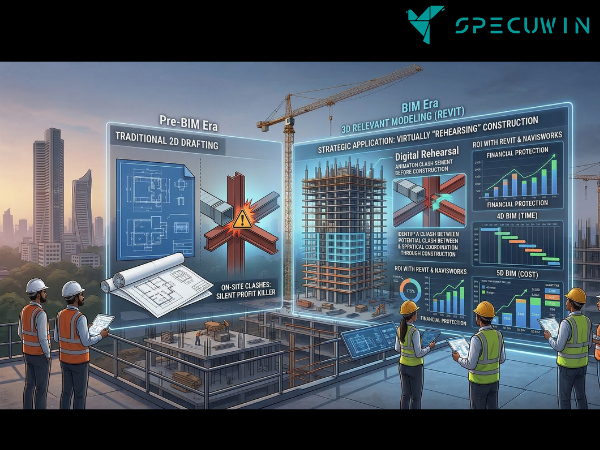
We are already seeing the emergence of 6D (Sustainability) and 7D (Facility Management). As we look Beyond BIM to next-gen construction technology, the integration of AI and IoT will make these models even more autonomous.
Imagine a BIM model that not only tracks cost and time but also monitors the carbon footprint of every material used, ensuring the project meets “Green Building” standards.
Conclusion: Embracing the Multi-Dimensional Future of BIM:-
The move to 4D and 5D BIM represents a shift from reactive management to proactive strategy. It allows us to build twice—once in the digital world and once in the physical world. By the time the first stone is laid, the project has already been “constructed” thousands of times in a simulation, optimized for the fastest timeline and the most efficient budget.
For firms looking to stay competitive, the question is no longer “if” they should adopt these dimensions, but “how fast.” The future of construction isn’t just in 3D; it’s in the data that flows through every second and every cent of the project.
FAQ’s:-
1. What is the main difference between 3D and 4D BIM?
A. 3D BIM focuses on the physical geometry and spatial relationships of a building, while 4D adds the dimension of time, allowing for schedule visualization and sequence planning.
2. How does 5D BIM help in reducing project costs?
A. 5D BIM reduces costs by providing automated, highly accurate quantity take-offs and real-time budget tracking, which helps prevent expensive manual errors and unexpected overruns.
3. Is 4D/5D BIM only for large-scale projects?
A. While highly beneficial for complex projects, these tools are increasingly used for smaller projects to ensure efficiency and transparency for clients who have strict budget constraints.
4. What software is typically used for 4D and 5D BIM?
A. Common tools include Autodesk Revit (for 3D/5D data), Navisworks or Synchro (for 4D scheduling), and various specialized plugins for cost estimation.
5. Does using 5D BIM replace the need for a Quantity Surveyor?
A. No. Instead, it changes their role. They move away from tedious manual counting and toward higher-level data analysis, risk management, and strategic financial planning.
Read More On:-
For more information about engineering, architecture, and the building & construction sector, go through the posts related to the same topic on the Specuwin Blog Page.
Find out more accurately what we are going to take off in the course of applying leading new technologies and urban design at Specuwin.