

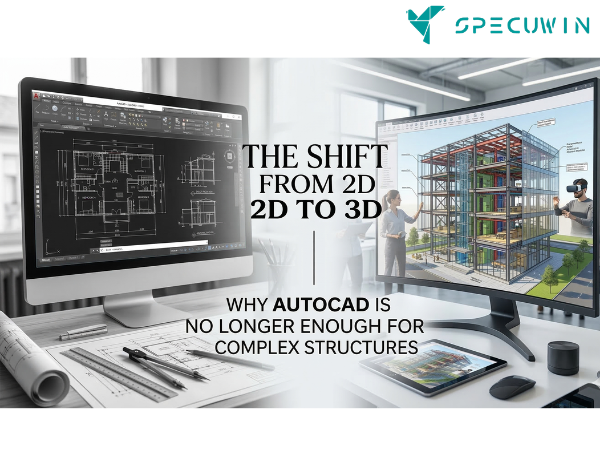
Let’s be honest: there is a certain romance to traditional drafting. For decades, architects and engineers relied on flat lines, arcs, and circles to communicate grand visions. However, as our skylines grow more ambitious and our buildings more technologically advanced, the limitations of those flat lines become glaringly obvious. The transition from 2D to 3D is no longer just a trendy tech upgrade; it is an absolute necessity for survival in the modern architecture, engineering, and construction (AEC) industry.
If you are still relying entirely on standard drafting software to design complex, multi-layered structural marvels, you are likely leaving money on the table, inviting errors, and frustrating your project partners. Today, we are going to explore why moving beyond planar drafting is the only way forward for intricate projects.
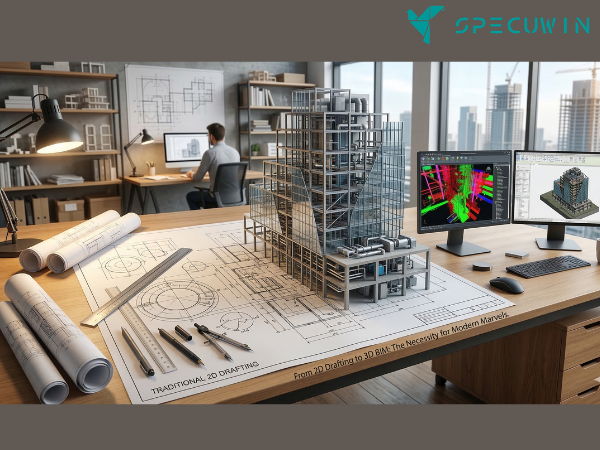
The Historical Context of Moving from 2D to 3D:-
When basic computer-aided design first hit the market, it was nothing short of a miracle. It allowed professionals to ditch their protractors and erasers, offering unprecedented precision and speed. Drawing a floor plan became faster, and reproducing those plans became instantaneous.
However, standard drafting is essentially an electronic pencil. It does not understand what it is drawing. To the software, a line representing a load-bearing steel beam is exactly the same as a line representing a cosmetic wooden baseboard. The intelligence of the design relies entirely on the human reading the blueprint. For a simple residential garage or a basic rectangular warehouse, this method works fine. The human brain can easily bridge the gap between flat elevations and spatial reality.
But modern architecture is rarely simple. We are dealing with twisting skyscrapers, irregular facades, asymmetrical load paths, and intricate internal systems. When you try to represent a beautifully complex, organic shape using only top-down and side-view flat drawings, critical information gets lost in translation. This is exactly where traditional methods begin to break down, highlighting the need for a smarter, more integrated approach.
To understand how this evolution impacts project delivery, you can explore detailed guides on navigating the transition from basic drafting to intelligent modeling.
Why Upgrading from 2D to 3D is Essential for Clash Detection:-
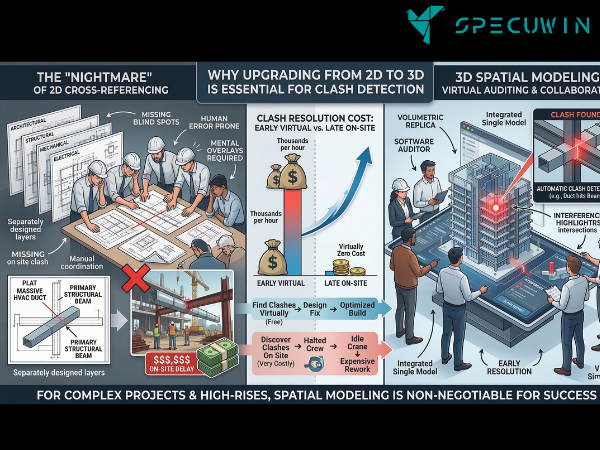
One of the most significant nightmares on any construction site is discovering a “clash” a moment where two different building systems are accidentally designed to occupy the exact same physical space. Imagine a massive HVAC duct routed right through a primary structural beam, or plumbing pipes intersecting with electrical conduits.
In a flat drafting environment, these systems are often drawn on separate layers or entirely different sheets by different teams. The mechanical engineer is looking at their schematic, the structural engineer is looking at theirs, and the architect is trying to overlay them mentally. Finding intersections requires cross-referencing dozens of static drawings, a process that is highly prone to human error.
Spatial modeling completely eliminates this blind spot. When you build a virtual, volumetric replica of the structure before breaking ground, the software itself acts as an auditor. It automatically highlights exactly where a pipe hits a wall or a duct clips a beam. Resolving these clashes in a virtual environment costs practically nothing. Discovering them on a live construction site with a crane idling and a crew waiting can cost thousands of dollars per hour. For high-rise developments, managing these spatial challenges early is non-negotiable.
The Power of Data: Understanding the 2D to 3D Paradigm Shift:-
Another fundamental reason flat drafting falls short for complex projects is the absence of embedded data. As mentioned earlier, standard lines are dumb; they hold no information beyond length and placement coordinates.
When you adopt spatial modeling specifically Building Information Modeling (BIM) you are not just drawing a wall; you are dropping a “wall object” into your project. This digital object knows exactly what it is. It knows its exact volume, its fire-resistance rating, its acoustic properties, the specific type of concrete required, and its manufacturer.
This data-rich environment transforms the design file from a simple picture into a comprehensive database. Need a highly accurate cost estimation? The model can generate a precise bill of materials in seconds because it knows exactly how many steel rebars and panes of glass exist within the virtual space. Need to run an energy performance simulation? The software understands the thermal mass of the materials you selected. This level of consultancy and data extraction is fundamentally transforming how firms operate and deliver value to their clients.
Enhancing Collaboration During the 2D to 3D Migration:-
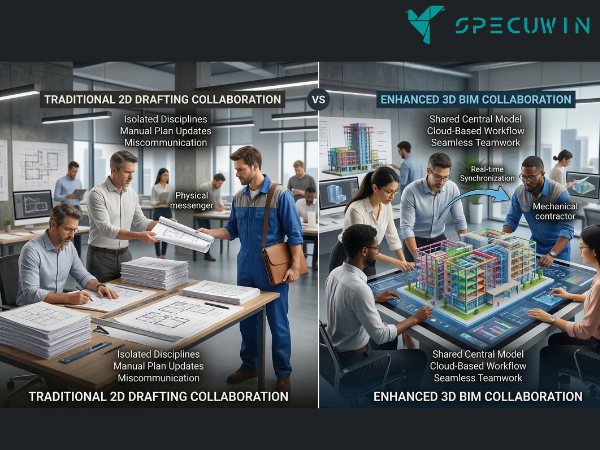
Complex structures are never built in a vacuum. They require the synchronized effort of architects, structural engineers, mechanical contractors, and interior designers. Relying on flat, disconnected drawings often creates information silos.
When a structural engineer makes a critical update to a foundation plan in a standard drafting program, they have to manually issue new sheets and hope that the plumbing contractor sees the update before laying out their pipes. Miscommunication is rampant, leading to the infamous “blame game” when things go wrong on site.
Intelligent modeling fosters true collaboration. Modern platforms are cloud-based, allowing multiple disciplines to work within the exact same central model simultaneously. If the architect moves a load-bearing wall, the structural engineer’s structural model updates, and the mechanical contractor immediately sees that they need to reroute their ventilation shafts. Everyone is singing from the same sheet music. This level of seamless teamwork between contractors and engineering teams is the bedrock of a successful, delay-free project.
Winning Clients with a 2D to 3D Presentation Strategy:-
Let’s step away from the technical side for a moment and look at the business aspect. Clients—whether they are wealthy homeowners, corporate board members, or city council officials rarely possess the technical training required to look at a complex set of blueprints and actually visualize the finished product.
When you hand a client a dense stack of floor plans, sections, and elevations, they often just nod along, masking their confusion. This disconnect can lead to massive problems late in the construction phase when the client walks onto the site and says, “Wait, I didn’t realize the ceiling would feel this low,” or “I thought this window would look out over the park.”
Spatial modeling bridges this communication gap beautifully. You can offer your clients virtual walkthroughs, realistic lighting simulations, and true-to-life spatial experiences before a single shovel hits the dirt. They can see exactly how the afternoon sun will hit the lobby or how the cantilevered balcony will look from the street. When clients truly understand what they are paying for, approvals happen faster, trust is built, and post-construction dissatisfaction is dramatically reduced.
Future-Proofing: The Final Argument for the 2D to 3D Transition:-
Finally, relying on flat drafting isolates you from the future of construction technology. The AEC industry is rapidly adopting tools that require volumetric data to function.
Consider the rise of automated construction robotics, which rely on spatial coordinates to lay bricks or weld steel. Think about augmented reality (AR) headsets used on job sites, allowing foremen to overlay the digital model directly onto the physical environment to verify installations. Or look toward the future of facility operations, where digital replicas of buildings are used to monitor energy use and schedule maintenance in real-time.
The complexity of modern building demands more than an electronic pencil. It demands a holistic, intelligent, and collaborative approach. Moving beyond flat lines is no longer an optional upgrade for the ambitious firm; it is the fundamental baseline for competing in today’s complex structural landscape.
Frequently Asked Questions:-
1. Is standard drafting software completely obsolete now?
A. Not entirely! Basic flat drafting is still highly useful for very simple projects, quick conceptual sketches, or detailing specific, localized manufacturing components. However, for the primary design and coordination of whole buildings, spatial modeling is now the industry standard.
2. Is the learning curve for intelligent modeling software steep?
A. It does require an investment of time. Unlike flat drafting, where you just learn how to draw lines, intelligent software requires you to understand how a building is actually constructed virtually. However, the long-term time savings in avoiding errors far outweigh the initial training period.
3. Will moving away from standard drafting increase my firm’s software costs?
A. Generally, yes. Advanced spatial modeling software and the robust computers required to run them carry higher upfront costs. But again, catching a single major structural clash before construction begins often pays for the software licenses for the entire year.
4. Can I convert my old flat drawings into spatial models?
A. Yes, but it is rarely an automated “one-click” process. Usually, a drafter must use the old flat blueprints as a tracing reference to build the new volumetric model from scratch, ensuring all the intelligent data is properly embedded.
5. Do smaller residential projects really need complex modeling?
A. While a basic shed doesn’t need it, modern custom homes absolutely benefit from it. Spatial modeling helps residential clients understand their layouts better, and it helps contractors flawlessly route plumbing and electrical systems through tight framing spaces.
Read More On:-
For more information about engineering, architecture, and the building & construction sector, go through the posts related to the same topic on the Specuwin Blog Page.
Find out more accurately what we are going to take off in the course of applying leading new technologies and urban design at Specuwin.