

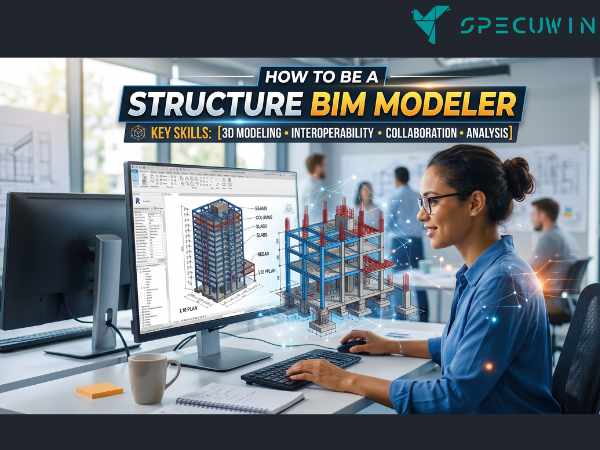
The construction industry is no longer just about bricks, mortar, and 2D blueprints. We have entered an era where data is as vital as steel. If you are looking to pivot your career toward a role that blends engineering logic with cutting-edge technology, learning how to be a Structure BIM Modeler is one of the most rewarding paths you can take.
In today’s market, Building Information Modeling (BIM) isn’t just a “plus” it is the standard. As the industry moves away from traditional drafting, the demand for professionals who can navigate complex 3D environments while ensuring structural integrity is skyrocketing. This guide will walk you through the essential roadmap to mastering this craft.
Understanding the Role of a Structure BIM Modeler:-
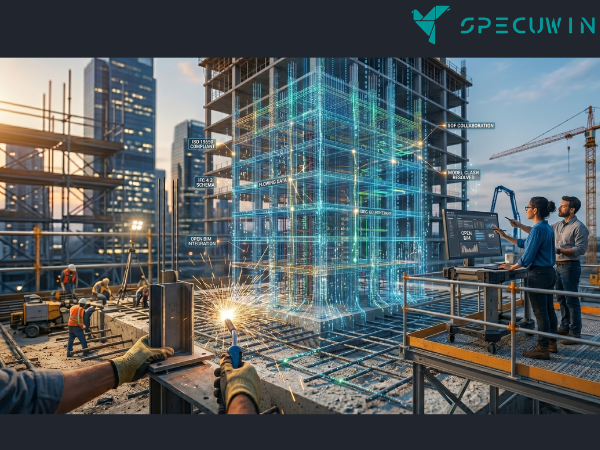
Before diving into the “how,” we must understand the “what.” A Structure BIM Modeler is responsible for creating intelligent 3D models that represent the structural components of a building columns, beams, slabs, foundations, and reinforcement.
Unlike a traditional CAD drafter, a BIM modeler embeds data into these elements. When you place a beam in a BIM environment, the software knows its material properties, its weight, its cost, and how it connects to the rest of the skeleton. This role is the bridge between the structural engineer’s calculations and the contractor’s execution on-site.
Why the Shift to BIM Matters:
The transition from traditional methods to digital modeling has revolutionized project delivery. By creating a virtual twin of the structure before a single shovel hits the ground, firms can identify “clashes” like a pipe running through a steel beam long before they become expensive mistakes. To understand the broader context of this shift, you might find it helpful to read about From CAD to BIM: navigating the transition.
Core Skills Required for a Structure BIM Modeler:-
To excel as a Structure BIM Modeler, you need a balanced mix of technical proficiency and “soft” analytical skills. You aren’t just drawing; you are problem-solving in a digital space.
1. Structural Engineering Fundamentals:
You cannot model what you do not understand. While you may not always be performing the heavy calculus of a lead engineer, you must understand load paths, connection types, and material behavior. Knowing the difference between a moment connection and a shear connection is vital for accurate modeling.
2. Proficiency in Industry-Standard Software:
Your primary tools will likely be Autodesk Revit, Tekla Structures, or Navisworks.
- Revit: The industry leader for general BIM coordination.
- Tekla: Highly specialized for steel detailing and complex reinforcement.
- Navisworks: Essential for clash detection and 4D scheduling.
3. Attention to Detail (LOD Knowledge):
In BIM, we talk about “Level of Development” (LOD). A Structure BIM Modeler must know whether they are modeling for a conceptual stage (LOD 200) or for fabrication-ready shop drawings (LOD 400). Over-modeling too early wastes time; under-modeling too late causes construction delays.
Educational Pathways for an Aspiring Structure BIM Modeler:-
Most successful modelers start with a foundation in Civil or Structural Engineering. Having a Diploma or a Bachelor’s degree provides the necessary background in physics and material science. However, formal education is often just the starting point.
Specialized BIM Training:
The gap between a university degree and a job-ready skill set is often filled by specialized training. Enrolling in a targeted course that focuses specifically on structural workflows rather than general architectural modeling is a smart move. If you are just starting out, check out this BIM for beginners guide to get a handle on the basics.
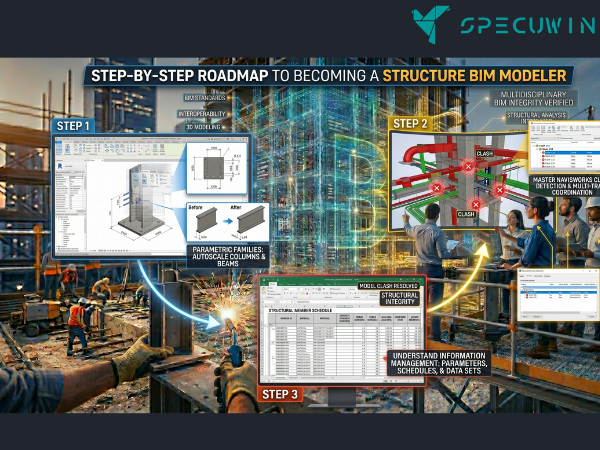
Step-by-Step Roadmap to Becoming a Structure BIM Modeler:-
Step 1: Master Revit Structure:
Start by learning how to navigate the Revit interface. Focus on “Families” the building blocks of any model. Learn how to create parametric families for columns and beams so that when a dimension changes, your entire model updates automatically.
Step 2: Learn Coordination and Clash Detection:
A Structure BIM Modeler does not work in a vacuum. Your model must coexist with HVAC ducts, electrical conduits, and architectural finishes. Learning how to use tools like Navisworks to run clash reports is what separates a “drafter” from a “BIM professional.” This level of collaboration is a Crucial skill for a future-ready career.
Step 3: Understand Information Management:
BIM is 10% “Modeling” and 90% “Information.” You need to learn how to manage parameters, schedules, and data sets within the model. A model that looks pretty but contains no data is just a 3D picture; it isn’t BIM.
Advanced Growth as a Structure BIM Modeler:-
Once you have mastered the basics, the journey doesn’t stop. The field is constantly evolving with the integration of AI and automation.
Generative Design and AI:
Imagine an algorithm that can suggest 100 different ways to frame a floor to minimize steel usage while maintaining safety. This is the future of the industry. Professionals who understand Generative design in structural engineering will be at the forefront of the next decade’s innovations.
Automation with Dynamo:
Learning “Visual Programming” through tools like Dynamo allows a Structure BIM Modeler to automate repetitive tasks. If you have to place 5,000 bolts in a steel connection, you shouldn’t do it manually. A script can do it in seconds.
The Career Outlook for a Structure BIM Modeler:-
The career trajectory for this role is incredibly promising. You can progress from a Junior Modeler to a BIM Coordinator, and eventually to a BIM Manager or Digital Construction Lead.
Beyond the title, the role offers the chance to work on iconic infrastructure. From bridges to skyscrapers, the structural skeleton is the most critical part of any building. For those interested in the pinnacle of structural achievement, exploring a Case study on the Burj Khalifa shows just how vital digital precision is for tall buildings.
Key Challenges and How to Overcome Them:-
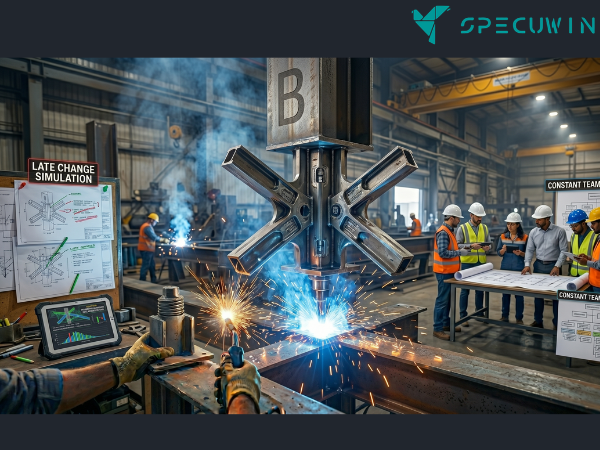
Every Structure BIM Modeler faces hurdles. The most common is the “Late Change.” An architect might move a wall, which shifts a column, which affects the entire foundation.
- Solution: Use the parametric power of BIM. Build your models with constraints so that changes ripple through the design logically rather than breaking it.
- Communication: Stay in constant contact with the design team. Understanding why collaboration is key will save you hours of rework.
Conclusion: Starting Your Journey as a Structure BIM Modeler:-
Becoming a Structure BIM Modeler is a journey of continuous learning. It requires a curious mind, a steady hand in software, and a deep respect for the physics of the real world. As cities become smarter and buildings become more complex, your role in “building it twice” once digitally and once physically will become the heartbeat of the AEC (Architecture, Engineering, and Construction) industry.
If you’re ready to take the next step, focus on building a portfolio that shows not just your 3D models, but the data and coordination behind them. The future of construction is digital, and there is a seat waiting for you at the table.
FAQ’s:-
1. Do I need to be a licensed engineer to be a Structure BIM Modeler?
A. No, a license is not strictly required for modeling, but a solid understanding of structural principles is essential. Most firms look for a degree or diploma in civil engineering.
2. What is the most important software to learn?
A. Autodesk Revit is the most widely used for general structural BIM, but Tekla Structures is highly valued for steel-intensive and industrial projects.
3. How is a BIM Modeler different from a CAD Technician?
A. A CAD Technician creates 2D drawings (lines and circles). A BIM Modeler creates 3D objects that contain data, such as material strength, cost, and manufacturer details.
4. Can I learn BIM modeling online?
A. Yes, there are many reputable platforms offering certifications. However, hands-on project experience or specialized BIM training is often the best way to land a job.
5. Is there a high demand for this role?
A. Absolutely. Governments worldwide are mandating BIM for public infrastructure projects, making skilled modelers some of the most sought-after professionals in construction.
Read More On:-
For more information about engineering, architecture, and the building & construction sector, go through the posts related to the same topic on the Specuwin Blog Page.
Find out more accurately what we are going to take off in the course of applying leading new technologies and urban design at Specuwin.