

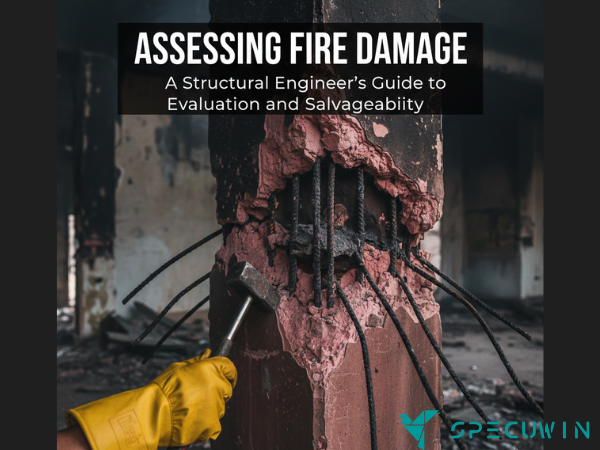
Fire is one of the most destructive forces a building can endure. Beyond the visible charred wood and smoke stains, intense heat can fundamentally alter the load-bearing capacity of a structure. Once the flames are extinguished and the smoke clears, the critical work begins. This is where the expertise of a structural engineer becomes paramount in Assessing Fire Damage.
The aftermath of a fire is often chaotic and emotional. Property owners are desperate to know if their home or business can be saved. However, the answer is rarely simple. It requires a meticulous, scientific investigation to look past the surface and understand the residual strength of the building’s skeleton.
In this guide, we will walk through the professional process of Assessing Fire Damage, exploring how engineers evaluate different materials, the tools they use, and the complex decision-making process between demolition and restoration.
The Initial Phase of Assessing Fire Damage: Safety First:-
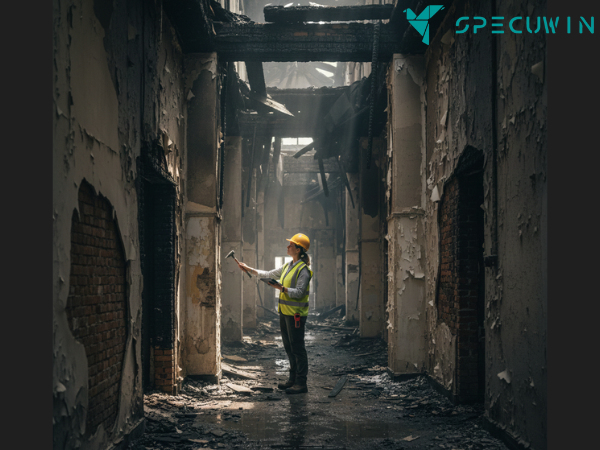
Before any detailed analysis can occur, the site must be deemed safe enough to enter. Structural engineers do not just walk into a burned-out shell; they perform a preliminary risk assessment.
The primary goal in the early stages of Assessing Fire Damage is to identify immediate hazards. This might involve looking for overhead debris, unstable walls, or compromised floor systems. In many cases, temporary shoring or bracing is required to stabilize the structure before a full inspection can take place.
This phase is critical because fire introduces unpredictability. A steel beam might look intact but could be on the verge of collapse due to thermal expansion and subsequent contraction. Understanding the broad scope of structural engineering is vital here, as it dictates the protocols for safety and stability.
Assessing Fire Damage in Concrete Structures:-
Concrete is generally resilient, but it is not invincible. When Assessing Fire Damage in concrete structures, engineers look for specific tell-tale signs of thermal distress.
- Color Change: Concrete changes color as it heats up (turning pinkish-red between 300°C and 600°C). This color mapping helps engineers estimate the maximum temperature reached in different zones.
- Spalling: Rapid heating causes moisture trapped inside the concrete to boil and expand, causing the surface to pop off (spall). This exposes the reinforcing steel to direct heat.
- Cracking and Micro-cracking: High heat causes thermal expansion, while the subsequent cooling (often by fire hoses) causes rapid contraction. This thermal shock can shatter the bond between the cement paste and the aggregate.
If you are interested in how Materials are selected to prevent this, understanding the best fire-resistant building materials is a crucial preventative step for future construction.
Assessing Fire Damage in Steel Frameworks:-
Steel behaves very differently from concrete. While it doesn’t burn, it loses strength rapidly as temperatures rise. At approximately 600°C, steel loses about half of its yield strength.
When Assessing Fire Damage in steel, the engineer looks for:
- Buckling and Distortion: Steel expands significantly when heated. If the beam is restrained (pinned at both ends), it has nowhere to go but out, leading to bowing or buckling.
- Connection Failure: Bolts and welds can shear off due to the immense forces generated by thermal expansion.
- Permanent Deformation: Once the steel cools, it may not return to its original shape. If the deformation is permanent (plastic), the load-carrying capacity is permanently compromised.
Engineers must calculate whether the steel can be straightened (heat straightened) or if the metallurgical properties have been altered so severely that replacement is the only option.

Assessing Fire Damage in Timber and Wood:-
Wood is combustible, but it degrades in a predictable way. When wood burns, it forms a layer of char on the outside. Surprisingly, this char acts as an insulator, protecting the inner core of the wood from the heat.
The process of Assessing Fire Damage in timber involves measuring the depth of this char.
- Scraping: The engineer scrapes away the charred layer to reveal the unburned wood underneath.
- Measuring: They measure the remaining cross-section of the timber.
- Calculation: If the remaining “clean” wood is thick enough to support the required loads, the member can often be sealed and kept.
However, connections (nails, metal plates) conduct heat into the wood, often causing internal charring that is not immediately visible. This requires careful probing.
Advanced Technologies for Assessing Fire Damage:-
Visual inspection is the first line of defense, but modern engineering demands more precision. To accurately determine the extent of the damage, engineers employ advanced diagnostic tools.
1. Non-Destructive Testing (NDT):
Techniques such as ultrasonic pulse velocity and rebound hammer tests allow engineers to check the density and strength of concrete without drilling into it. This is essential for Assessing Fire Damage without causing further harm to a fragile structure.
2. 3D Laser Scanning and BIM:
In complex fire events, documenting the geometry of the deformation is difficult. This is where “BIM” technology shines. By using laser scanners, engineers can create a precise 3D model of the damaged state. This allows them to overlay the damaged model against the original design to measure exact deflections and deformations. You can read more about how BIM services explain and boost efficiency in engineering assessments.
Furthermore, the Role of technology in structural analysis allows for precise measurement of deformations.
The Decision: Salvageability vs. Demolition:-
After gathering data, the engineer faces the ultimate question: Can the building be saved?
Assessing Fire Damage concludes with a feasibility study that weighs three main factors:
- Technical Feasibility: Can the damaged members be repaired to meet current building codes? (Note: Repaired structures often must meet current codes, not the codes from when they were built).
- Economic Viability: Is the cost of testing, design, demolition of damaged parts, and reconstruction higher than the cost of razing the structure and starting over?
- Heritage and Sentimental Value: For historic landmarks, money is not the only metric. The goal often shifts to preservation at all costs. Engineers must use innovative approaches to preserve heritage structures, even when the damage is severe.
Assessing Fire Damage with a Forensic Lens:-
Sometimes, the engineer’s job is not just to decide “what now,” but to figure out “how” and “why.” Forensic structural engineering involves piecing together the timeline of the collapse. Did a specific column fail first? Did a lack of fireproofing contribute to the spread?
Learning from structural failures is a vital part of the profession. By analyzing how the building behaved during the fire, engineers can provide data that improves future building codes and safety standards.
The Path to Restoration:-
If the verdict of Assessing Fire Damage is favorable, the engineer designs a remediation plan. This might involve:
- Epoxy Injection: To fill cracks in concrete.
- Sistering: Bolting new wood or steel members alongside damaged ones to take the load.
- Shotcrete: Spraying new concrete over damaged surfaces to restore cover and strength.
For older or culturally significant buildings, this process is akin to surgery. It requires a delicate touch and often involves renovation strategies that respect the original architecture. You can explore more on how experts renovate historical landmarks to understand the complexity involved.

Conclusion:-
Assessing Fire Damage is a high-stakes puzzle. It requires a deep understanding of material science, physics, and construction methodology. A structural engineer does not just look at the burns; they look at the bones of the building. Through rigorous visual inspection, advanced technology like 3D scanning, and forensic analysis, they provide the roadmap for recovery. Whether the path leads to a wrecking ball or a grand reopening, the assessment ensures that the decision is based on safety and science, not just soot and ash.
FAQ’s
1. How long does assessing fire damage typically take?
A. The duration depends on the severity of the fire and the size of the building. A residential inspection might take a few hours to a day, while a large commercial complex requiring non-destructive testing and 3D scanning could take several weeks.
2. Can a house be saved if the roof has collapsed?
A. Not necessarily. While a roof collapse is serious, if the perimeter walls and foundation remain structurally sound, the “shell” of the house might be salvageable. A structural engineer must perform a detailed inspection to verify the stability of the remaining walls.
3. Does fire damage concrete permanently?
A. It can. High temperatures can cause concrete to lose compressive strength and bond strength with rebar. However, if the heat exposure was not prolonged or extreme, the damage might be limited to the surface (spalling), which can often be repaired.
4. Why do engineers need to remove drywall during an assessment?
A. Fire and heat can travel behind walls, damaging studs, electrical wiring, and insulation without showing signs on the surface. Engineers often need to expose the framing to check for char depth and connection failures.
5. What is the difference between a fire investigator and a structural engineer?
A. A fire investigator determines the cause and origin of the fire (e.g., arson, electrical fault). A structural engineer evaluates the physical integrity of the building after the fire to determine if it is safe to enter, repair, or occupy.
Read More On:-
For more information about engineering, architecture, and the building & construction sector, go through the posts related to the same topic on the Specuwin Blog Page.
Find out more accurately what we are going to take off in the course of applying leading new technologies and urban design at Specuwin.