

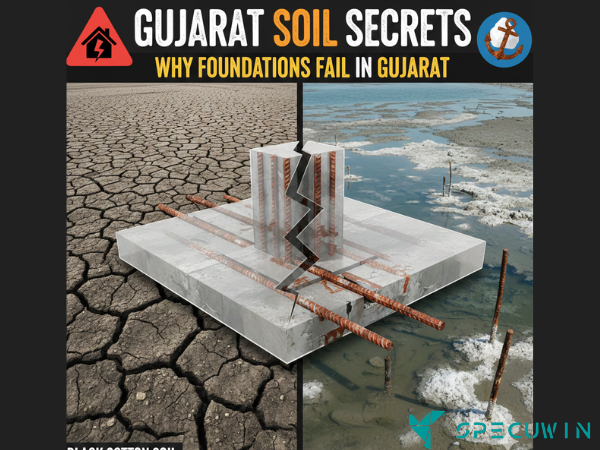
When you’re planning a construction project in the vibrant state of Gujarat, your mind likely jumps to architectural designs or the latest smart-city technologies. However, the most critical factor for a building’s longevity isn’t what goes up, but what lies beneath. In Gujarat, the earth is as diverse as the culture, ranging from the salt-crusted Rann of Kutch to the deep fertile plains of the south. This diversity brings a unique set of Soil Issues that every developer, architect, and homeowner must address.
Building a foundation here isn’t a “one size fits all” task. Without a proper grasp of local geotechnical challenges, a structure can quickly fall victim to cracks, settlement, or even structural failure. Let’s dive into the most prevalent Soil Issues in the region and how you can prepare for them.
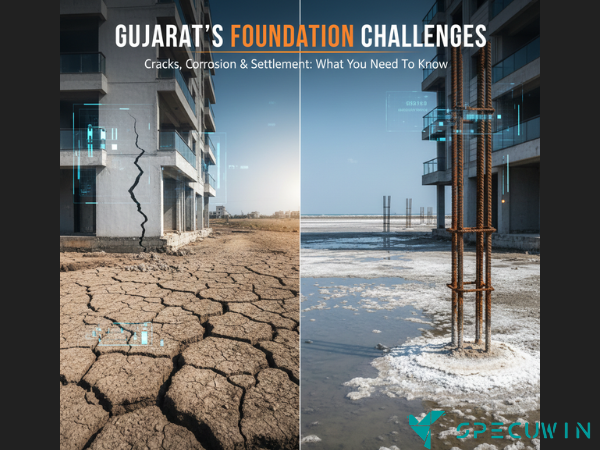
The Challenge of Expansive Black Cotton Soil Issues:-
Perhaps the most notorious challenge in middle Gujarat and parts of Saurashtra is “Regur” soil, commonly known as Black Cotton soil. While a boon for farmers, it is often a nightmare for civil engineers.
Why Black Cotton Soil is Problematic:
The primary Soil Issues here stem from the presence of montmorillonite clay. This mineral makes the soil highly “expansive.”
- Swelling: During the monsoon, the soil absorbs water and expands significantly in volume.
- Shrinkage: In the scorching Gujarat summer, it loses moisture and develops deep, wide cracks.
This constant “heaving” and “shrinking” cycle exerts immense pressure on foundations, often leading to misaligned doors, cracked walls, and uneven floors. To counter this, engineers often suggest replacing the top layers with non-expansive materials or using specialized foundation techniques like under-reamed piles.
Read more on:- Top 5 signs your building needs a structural inspection
Coastal Salinity and Foundation Soil Issues:-
With the longest coastline in India, Gujarat faces significant Soil Issues related to saltwater ingress. This isn’t just an agricultural problem; it’s a structural one.
The Impact of Salinity on Infrastructure:
In areas like Bhavnagar, Amreli, and the Gulf of Khambhat, the soil has a high concentration of sodium chloride.
- Corrosion: High salinity can lead to the rapid corrosion of steel reinforcement within concrete foundations.
- Soil Instability: Coastal soils are often highly dispersive and poorly drained.
If you are building near the coast, ensuring high-grade concrete and protective coatings for your rebars is essential to prevent the “silent decay” caused by saline ground conditions.
Alluvial Deposits and Liquefaction Soil Issues:-
The fertile plains of North and Middle Gujarat including cities like Ahmedabad are built on deep alluvial deposits. While these soils are generally productive, they present their own set of Soil Issues, particularly during seismic events.
The Risk of Liquefaction:
Gujarat is a seismically active zone, as the 2001 Bhuj earthquake tragically reminded the world. In sandy or silty alluvial soils with a high water table, a phenomenon called liquefaction can occur during a tremor.
- The soil loses its shear strength and behaves like a liquid.
- Foundations can suddenly sink or tilt, as the ground “washes away” beneath them.
Geotechnical investigations, such as Standard Penetration Tests (SPT), are vital in these areas to determine if the soil layers are dense enough to resist such movement.

Regional Variations in Soil Issues:-
| Region | Predominant Soil Type | Primary Foundation Challenge |
| South Gujarat | Deep Black Clayey Soil | Severe cracking and low permeability. |
| North Gujarat | Sandy Loam | Erosion and potential for settlement. |
| Saurashtra | Shallow Medium Black / Calcareous | High salinity and variable depth to bedrock. |
| Kutch | Arid / Desert / Saline | Liquefaction risk and low organic content. |
Overcoming Foundation Soil Issues with Expert Guidance:-
The key to overcoming these Soil Issues is never to guess. Before the first brick is laid, a professional structural engineer should evaluate the soil report. Whether it’s choosing a raft foundation for alluvial soil or using piles to bypass expansive clay, the right technical approach ensures your building stands the test of time.
To learn more about the technical side of building safety, you might find it helpful to read about What is the role of a structural engineer or how to identify Top 10 structural issues in residential buildings.
FAQ’s:-
1. Can I build a heavy structure on Black Cotton soil?
A. Yes, but it requires specific engineering. Techniques like replacing the expansive soil with a CNS (Cohesive Non-Swelling) layer or using deep pile foundations are often necessary to reach stable strata.
2. How do I know if my site has salinity issues?
A. Visual signs include a white crust on the ground or stunted vegetation. However, a chemical soil analysis is the only sure way to measure chloride and sulfate levels.
3. What is the best foundation for sandy soil in Ahmedabad?
A. Depending on the load, raft foundations are common as they distribute the weight evenly, reducing the risk of differential settlement in alluvial deposits.
4. Why is soil testing important before construction?
A. It reveals the soil’s Bearing Capacity and identifies hidden Soil Issues like high water tables or expansive clay, preventing costly repairs later.
5. Does seismic activity affect all soil types in Gujarat?
A. Seismic waves affect everything, but loose, saturated sandy soils are most prone to liquefaction, whereas rocky or dense clay soils might behave differently.
Read More On:-
For more information about engineering, architecture, and the building & construction sector, go through the posts related to the same topic on the Specuwin Blog Page.
Find out more accurately what we are going to take off in the course of applying leading new technologies and urban design at Specuwin.