

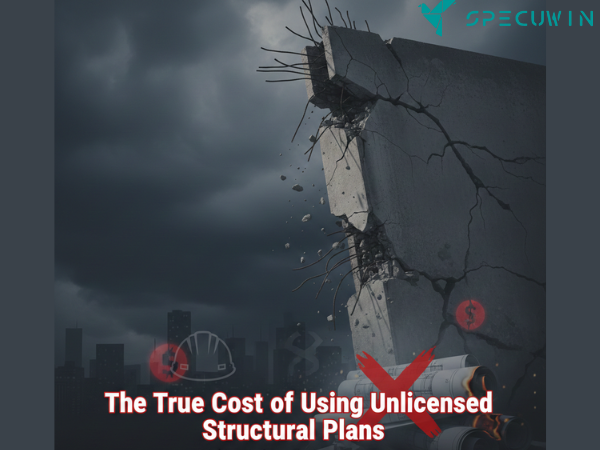
We all love a good bargain. Whether it’s finding a discount on materials or securing a great rate from a contractor, saving money is a natural part of the construction game. But there is one area where cutting corners isn’t just a bad idea it’s potentially catastrophic. We are talking about the foundation of your safety: the engineering design.
In the Architecture, Engineering, and Construction (AEC) industry, there is a quiet but dangerous trend of relying on Unlicensed structural plans. These are designs created by individuals who lack the professional licensure (P.E. or S.E. designation) required by law to sign off on structural drawings. While the upfront price tag might look appealing, the long-term reality is a nightmare of legal liabilities, financial ruin, and genuine safety hazards.
Let’s dive into why relying on Unlicensed work is a gamble you simply cannot afford to take.

The Legal Quagmire of Unlicensed Structural Plans:-
When you start a construction project, you aren’t just building walls and roofs; you are navigating a complex web of building codes and municipal regulations. These codes exist for a reason to keep people alive.
A licensed structural engineer has stamped their seal on a plan, accepting legal responsibility for that structure’s integrity. When you utilize Unlicensed structural plans, you are effectively removing that layer of accountability. If the building fails, the local municipality will not look for the “designer” who drew the plans; they will look at the property owner.
Furthermore, most city planning departments will outright reject plans that do not bear a valid stamp. This leads to immediate project delays. You might think you can sneak a project past the permit office, but if you get caught, you face “stop-work” orders, heavy fines, and the mandate to tear down what you’ve already built. To understand what a legitimate professional brings to the table compared to an unlicensed drafter. Read more about What is the role of a structural engineer to understand the legal weight they carry.
Safety First: The Physical Dangers of Unlicensed Design:-
The most terrifying aspect of this issue isn’t the paperwork; it’s gravity. A licensed engineer understands the physics of load paths, shear forces, and seismic activity. They calculate how a building behaves under stress—whether that stress is a heavy snow load, high winds, or just the weight of the furniture and occupants.
Unlicensed structural plans often rely on “rule of thumb” guesswork rather than mathematical certainty. An unlicensed designer might assume a beam is strong enough because “it looks like the one in the other house,” failing to account for specific span lengths or load discrepancies.
This negligence can lead to sagging floors, cracking walls, or total collapse. In older properties, where renovations are common, the risk is even higher because you are altering an equilibrium that has existed for decades.
Financial Ruin: The Economic Impact of Unlicensed Decisions:-
Let’s talk about your wallet. The primary driver for choosing Unlicensed structural plans is usually cost savings. You might save a few thousand dollars initially, but the backend costs are staggering.
- Insurance Voidance: If your home suffers structural damage and the insurance company discovers the work was done based on unlicensed plans or without permits, they can (and likely will) deny your claim. You could be left with a mortgage on a house that doesn’t exist.
- Resale Value: When you sell a property, you must disclose unpermitted work. Smart buyers will hire inspectors who will spot the irregularities immediately. This can force you to lower your asking price significantly or pay for expensive retrofits to bring the building up to code before the sale can close.
- The “Fix-It” Premium: Fixing a mistake is always more expensive than doing it right the first time. If a beam is undersized, you have to rip open the drywall, shore up the ceiling, remove the bad beam, and install a new one.

Why Unlicensed Plans Fail at Soil and Environmental Analysis:-
Structural engineering isn’t just about the building; it’s about the ground it sits on. A licensed engineer knows that the soil composition dictates the foundation design. Clay, sand, and bedrock all behave differently.
Unlicensed structural plans rarely take geotechnical reports into account. A drafter without an engineering license might prescribe a standard foundation slab for a site that actually requires deep piles due to shifting soil. The result? A foundation that cracks and settles within years of construction.
The Technology Gap in Unlicensed Workflows:-
Modern structural engineering relies on sophisticated software to model complex scenarios. Licensed firms invest heavily in technology to simulate earthquakes, wind tunnels, and thermal expansion.
Providers of Unlicensed structural plans rarely have access to these high-end simulation tools. They are often working with basic CAD software that draws lines but doesn’t analyze physics. In an era where we are building taller and more complex structures, relying on manual calculations or intuition is a recipe for disaster. See how professionals use advanced tools in The role of technology in structural analysis and design.

Conclusion: Don’t Compromise on Safety:-
Building a home or a commercial space is likely the biggest investment of your life. It is the shelter for your family or your business. While the allure of saving money with Unlicensed structural plans is understandable, the risks are simply too high.
From legal battles and insurance nightmares to the terrifying prospect of physical collapse, the “savings” evaporate the moment something goes wrong. Always verify the credentials of the professionals you hire. Look for the stamp, check the license number with your state board, and build with the peace of mind that comes from professional integrity.
FAQ’s:-
1. What is the main difference between a drafter and a licensed structural engineer?
A. A drafter creates the technical drawings and blueprints based on specifications, but they cannot legally take responsibility for the structural integrity of the design. A licensed structural engineer has the education, experience, and legal authority to calculate loads, sign off on safety, and stamp the plans for permit approval.
2. Can I use Unlicensed structural plans for small renovations?
A. It depends on your local municipality, but generally, if you are moving or altering load-bearing walls, adding a second story, or changing the roofline, you need a licensed engineer. Using Unlicensed structural plans for these tasks can result in code violations and unsafe living conditions.
3. Will my home insurance cover damages if I used Unlicensed plans?
A. Likely not. Most insurance policies have clauses that exclude coverage for unpermitted work or faulty workmanship resulting from non-code-compliant designs. If an investigation reveals the structure was built using Unlicensed structural plans, your claim for structural failure could be denied.
4. How can I verify if a structural engineer is actually licensed?
A. Every licensed engineer is registered with a state board. You can usually go to your state’s “Department of Consumer Affairs” or “Board for Professional Engineers” website and perform a license lookup using their name or license number. Never rely solely on a business card.
5. Is it illegal to sell Unlicensed structural plans?
A. It is generally not illegal to draw plans, but it is illegal to represent oneself as an engineer if unlicensed. It becomes a legal issue when those plans are used for construction without being reviewed and stamped by a licensed professional in the jurisdiction where the building is located.
Read More On:-
For more information about engineering, architecture, and the building & construction sector, go through the posts related to the same topic on the Specuwin Blog Page.
Find out more accurately what we are going to take off in the course of applying leading new technologies and urban design at Specuwin.