


Imagine standing in a high-rise building during an earthquake. The ground beneath you creates a violent, chaotic dance, yet the floor you are standing on remains relatively calm. The coffee on your desk barely ripples. This isn’t science fiction; it is the reality of modern structural engineering. Specifically, it is the result of a revolutionary safety technique known as Base Isolation.
For decades, we designed buildings to withstand earthquakes by making them stronger and stiffer. We effectively told our structures, “When the earth shakes, you must fight it.” But as we learn more about seismic activity and structural resilience, the philosophy has shifted. Instead of fighting the energy of an earthquake, what if the building could simply step aside and let the energy pass beneath it? This is the core promise of Base Isolation. In this guide, we will explore how this technology works, why it is becoming the gold standard for safety in seismic zones, and how it is changing the way we think about protection.

What is Base Isolation and Why Do We Need It?:-
At its simplest, Base Isolation is a collection of structural elements used to decouple a building’s superstructure from its substructure (the foundation). It acts like a giant suspension system for a building, similar to how the shocks on your car absorb the bumps of a rough road so the passengers don’t feel them.
In a traditional fixed-base building, the structure is bolted directly to the ground. When the ground moves, the building moves with it, often amplifying the motion as you go up higher floors. This can lead to catastrophic structural damage or, at the very least, severe non-structural damage to windows, plumbing, and interiors. Base Isolation changes this dynamic entirely. By separating the building from the moving ground, we drastically reduce the inter-story drift and floor accelerations, ensuring that the building and the people inside it remain safe.
The Mechanics of Base Isolation: How It Works:-
To understand Base Isolation, you have to understand a little bit about physics. Every building has a “natural period” the time it takes to vibrate back and forth. During an earthquake, if the frequency of the ground shaking matches the natural period of the building, resonance occurs, leading to violent shaking.
Base Isolation works by lengthening the building’s natural period. It shifts the building’s frequency away from the high-energy frequencies of the earthquake. The isolators are flexible horizontally but stiff vertically. This allows the foundation to move rapidly back and forth with the ground while the building “floats” above it, moving slowly and gently.
This decoupling effect can reduce the seismic energy entering the building by up to 60-80%. It turns a violent, sharp shock into a gentle swaying motion.
Common Types of Base Isolation Systems Used Today:-
Not all isolation systems are the same. Engineers choose specific types based on the building’s weight, the local soil conditions, and the seismic risks. Here are the most common forms of Base Isolation:
1. Lead-Rubber Bearings (LRB):
These are perhaps the most recognizable form of Base Isolation. They consist of alternating layers of rubber and steel plates with a lead core in the center. The rubber provides flexibility, allowing the building to move sideways. The steel plates add vertical strength to support the building’s weight. The lead core yields during an earthquake, absorbing energy (damping) and stopping the building from swaying for too long after the shaking stops.
2. Friction Pendulum Bearings:
This system relies on geometry and gravity. The device consists of a slider that moves along a concave dish surface. When the ground shakes, the slider moves up the curvature of the dish. Gravity then forces the slider back to the center, naturally re-centering the building. This type of Base Isolation is excellent for heavy structures and bridges.
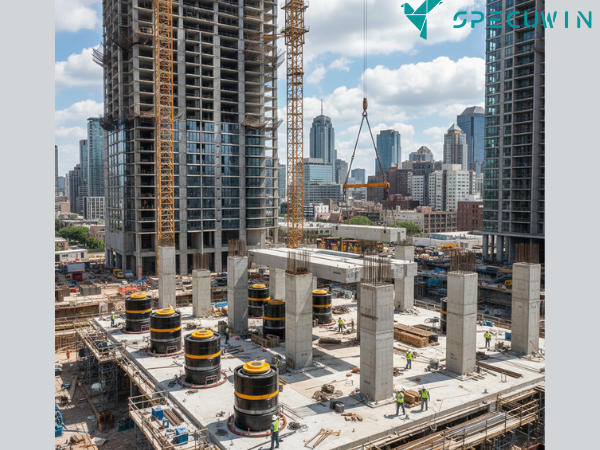
The Benefits of Base Isolation for Modern Infrastructure:-
The advantages extend far beyond just keeping the building standing. While life safety is always the priority, Base Isolation offers economic and functional resilience that traditional methods cannot match.
- Operational Continuity: In critical facilities like hospitals, data centers, or emergency response centers, it is not enough for the building to just “not collapse.” It needs to remain functional. Base Isolation protects the sensitive equipment inside, ensuring the lights stay on and surgeries can continue even during a quake.
- Protection of Non-Structural Elements: Most earthquake losses come from damage to facades, partitions, and mechanical systems. By reducing the shaking, Base Isolation preserves these assets.
- Minimal Repair Costs: A fixed-base building might survive a major quake but require demolition due to irreparable cracks. An isolated building often requires little to no repair, saving millions in the long run.
Challenges and Cost Implications of Base Isolation:-
If this technology is so great, why isn’t every building utilizing Base Isolation? The reality is that it requires a complex interplay of engineering precision and budget allocation.
- Initial Cost: Installing these systems can add 5-10% to the total construction cost. However, this is often offset by the reduced need for heavy structural reinforcement in the superstructure.
- Site Constraints: To work, the building needs a “moat” a gap around the perimeter that allows it to move freely without crashing into adjacent structures or the ground. In dense urban environments, finding space for this clearance can be difficult.
- Maintenance: While durable, isolators require inspection. We must ensure that the “rattle space” (the gap for movement) remains clear of debris over the building’s lifespan.
Base Isolation in Retrofitting: Saving Old Structures:-
One of the most exciting applications is in saving historical or existing structures. We don’t always have the luxury of building from scratch. Base Isolation allows engineers to cut the columns of an existing building and insert isolators.
This is famously done in historic city halls and state capitols. Instead of ruining the beautiful architecture with ugly concrete shear walls or steel braces, engineers perform surgery on the foundation. They insert Base Isolation systems underneath, preserving the historic look while providing modern safety. This technique is particularly vital when we look at high-value assets. For a deeper dive into how engineers reinforce existing structures, you can read about Seismic retrofitting and how we reinforced a high-rise for earthquakes.

The Future of Base Isolation in Global Construction:-
As our cities grow denser and our buildings grow taller, the demand for resilience is skyrocketing. We are moving toward a “functional recovery” standard, where the goal isn’t just survival, but immediate re-occupancy.
Base Isolation is evolving. We are seeing “smart” isolators equipped with sensors that feed real-time data to digital twins, allowing engineers to monitor the health of the foundation remotely. We are also seeing hybrid systems that combine isolation with active mass dampers to control wind vibrations in super-tall skyscrapers. To explore more about where the industry is heading, check out our insights on Innovations in earthquake-resistant design, which covers the cutting-edge technologies shaping our skylines.
Conclusion:-
Earthquakes are inevitable; disasters are not. Base Isolation represents a shift in human ingenuity, moving from a brute-force resistance of nature to a harmonious coexistence with it. By decoupling our structures from the ground, we protect our investments, our history, and most importantly, our lives. As technology becomes more accessible, we can expect Base Isolation to become not just a luxury for critical facilities, but a standard for safe, sustainable living in seismic zones.
FAQ’s:-
1. Is Base Isolation suitable for all types of buildings?
A. Not necessarily. While highly effective, it is most cost-efficient for critical facilities (hospitals, emergency centers), high-value residential buildings, and historic retrofits. For very lightweight or low-rise buildings, traditional strengthening might be more economical. However, for tall structures, understanding the structural engineering of high-rise buildings helps determine if isolation is the right choice.
2. Can an existing building be fitted with Base Isolation?
A. Yes, this is called seismic retrofitting. It is a complex process that involves shoring up the building, cutting the foundation columns, and inserting the isolators. It is a popular choice for historic buildings where preserving the architectural appearance is mandatory.
3. How long do Base Isolation bearings last?
A. Most modern elastomeric and friction pendulum bearings are designed to last the life of the building, typically 50 to 100 years. They are robust and resistant to environmental factors, though routine inspections are recommended to ensure the “moat” gap remains clear.
4. Does Base Isolation eliminate earthquake damage completely?
A. It significantly reduces it, often to the point of being negligible. While no system can guarantee zero damage in a catastrophic event, base isolated buildings typically suffer no structural damage and very little non-structural damage compared to fixed-base buildings, which may crack or deform permanently.
5. How much does Base Isolation increase construction costs?
A. Typically, it adds about 5% to 10% to the total construction cost. However, this upfront premium is often recovered by the reduced need for heavy steel or concrete in the superstructure and the massive savings in potential repair costs after an earthquake. For a broader view on cost and planning, it helps to understand what the role of a structural engineer is early in the project.
Read More On:-
For more information about engineering, architecture, and the building & construction sector, go through the posts related to the same topic on the Specuwin Blog Page.
Find out more accurately what we are going to take off in the course of applying leading new technologies and urban design at Specuwin.