

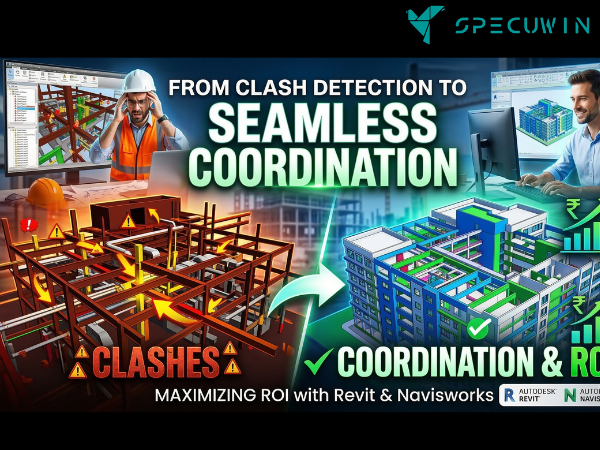
In the rapidly evolving landscape of Indian construction, the shift from traditional 2D drafting to sophisticated 3D modeling is no longer a luxury it is a survival tactic. For years, the Indian AEC (Architecture, Engineering, and Construction) industry struggled with the “silent profit killer”: on-site clashes. Imagine a massive HVAC duct reaching its designated path in a high-rise in Mumbai, only to find a structural steel beam already occupying that space. In the pre-BIM era, this meant immediate work stoppages, expensive demolition, material waste, and cascading schedule delays.
However, the industry is changing. By moving From CAD to BIM, developers and contractors are now virtually “rehearsing” the construction process. The primary vehicle for this financial protection is the strategic application of ROI with Revit and Navisworks. This combination allows teams to eliminate errors in a digital environment long before a single shovel hits the ground on an Indian job site.
The Financial Architecture: Understanding Revit and Navisworks:-
When we discuss ROI with Revit, we aren’t just talking about software subscriptions; we are talking about risk mitigation. Revit acts as the “Source of Truth” where intelligent, data-rich models of architecture and structure are created. Navisworks then serves as the “Referee,” aggregating these models to perform rigorous clash detection.
The Return on Investment is realized through three specific channels in the Indian context:
- Reduction in Change Orders: Identifying a pipe hitting a column in the software saves lakhs of rupees compared to a field change order.
- Labor Efficiency: With a “clash-free” plan, labor crews don’t stand idle waiting for a redesign.
- Material Waste Mitigation: Precision modeling ensures you order exactly what is needed, reducing the scrap pile on site.
The Role of Authoring in Establishing ROI with Revit:-
Revit is the foundation of any BIM for beginners journey. It allows designers to move beyond flat lines into “parametric objects.” Every wall and pipe in Revit contains data. This data-rich environment is the first step toward maximizing ROI with Revit.
In India, where structural integrity is paramount due to varying seismic zones, using Revit allows for a more integrated approach between the architect and the structural engineer. However, even the best Revit model needs a dedicated environment to test for interferences against other disciplines, which is where Navisworks enters the frame.
Navisworks: The Engine Room of ROI with Revit and Navisworks:-
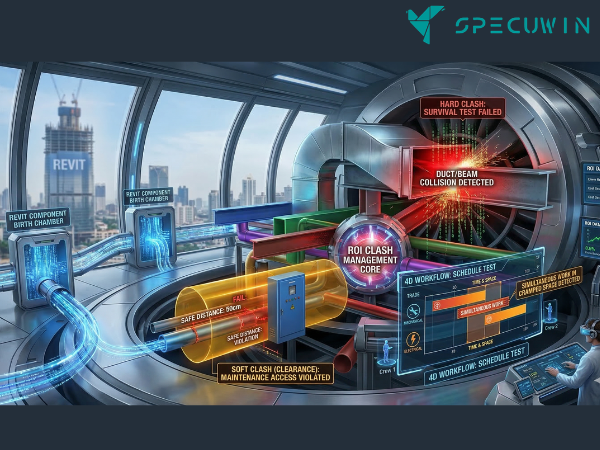
If Revit is where components are born, Navisworks is where they are tested for survival. Navisworks Manage allows BIM Coordinators to run three specific types of tests to ensure ROI with Revit:
- Hard Clashes: Two objects occupying the same physical space.
- Soft Clashes (Clearances): Objects that are too close for safety or maintenance (e.g., a water pipe too close to an electrical panel).
- 4D Workflow Clashes: Scheduling conflicts where two different crews are expected to work in the same cramped space simultaneously.
Moving Toward Seamless Coordination in India:-
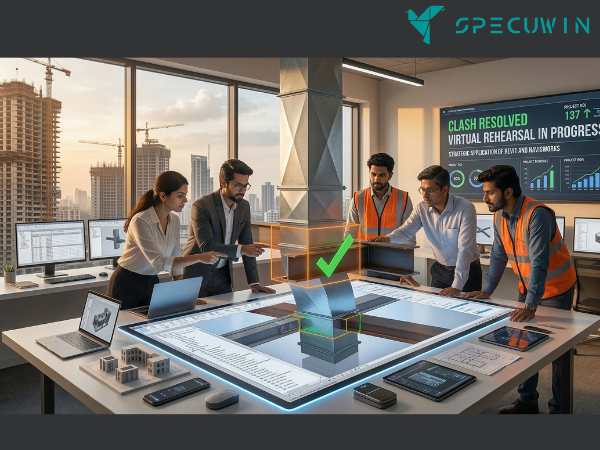
True success isn’t just about finding clashes; it’s about the value of BIM outsourcing and professional management to resolve them. In India, coordination is a collaborative process. It involves “Clash Resolution Meetings” where stakeholders decide who moves their component based on cost and feasibility.
The ultimate goal is “Seamless Coordination.” This state allows for pre-fabrication. When components are built off-site based on a coordinated, clash-free model, the speed of assembly increases, significantly boosting the ROI with Revit.
Future-Proofing Projects with ROI with Revit:-
As India looks toward a Sustainable future with Green Building initiatives, the baseline requirement is a clash-free 3D model. You cannot optimize a building’s energy performance or use AI and robotics for construction if the underlying design has unresolved physical conflicts.
Furthermore, these coordinated models eventually evolve into Digital Twins, providing long-term value for facility management. The ROI with Revit therefore extends far beyond the construction phase and into the entire lifecycle of the building.
FAQ’s:-
1. What is the biggest barrier to high ROI in India?
A. The biggest barrier is often “siloed” communication. Success requires all stakeholders Architects, Engineers, and Contractors to share their models early.
2. Is Navisworks necessary if I already have Revit?
A. While Revit has basic interference checks, Navisworks is built to handle massive files from multiple sources (like AutoCAD or Civil 3D), providing the advanced reporting necessary for maximizing ROI with Revit.
3. How much can 3D coordination save on an average Indian project?
A. Industry data suggests BIM coordination can save 3% to 5% of the total construction budget by eliminating rework.
4. Does this process slow down the design phase?
A. It requires more effort upfront, but this is a strategic shift. Spending more time in the digital office means spending significantly less money solving crises on the construction site.
5. Can small Indian firms benefit from ROI with Revit?
A. Yes. Small firms often have tighter margins, and preventing even one major on-site error can cover the cost of the software.
Read More On:-
For more information about engineering, architecture, and the building & construction sector, go through the posts related to the same topic on the Specuwin Blog Page.
Find out more accurately what we are going to take off in the course of applying leading new technologies and urban design at Specuwin.