

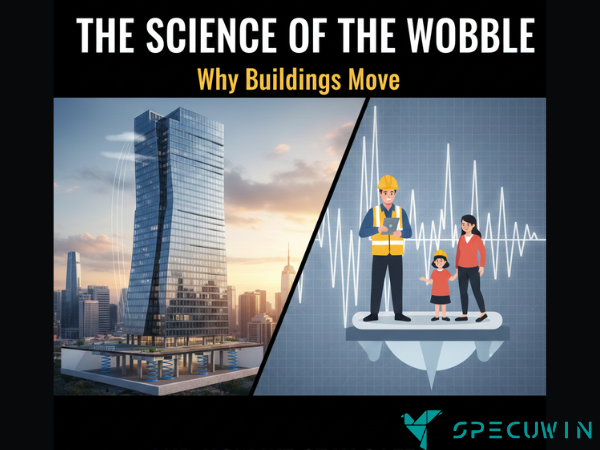
Have you ever stood on the upper floor of a skyscraper during a storm and felt a slight, unsettling shifting sensation beneath your feet? It can be a terrifying feeling a moment where the solid ground seems to betray you. However, this movement is rarely a sign of impending doom. In fact, that distinct sensation the wobble is often a sign that the building is doing exactly what it was designed to do.
If a massive structure were built to be perfectly rigid, it would likely snap under the immense forces of nature. Instead, engineers design buildings to be somewhat like trees, bending with the wind rather than breaking against it. But there is a fine line between a flexible, safe structure and one that makes occupants sick or scared. Today, we will explore why structures exhibit this wobble, how professionals calculate safe limits, and the incredible technology used to ensure your comfort.

The Physics Behind the Wobble in High-Rise Structures
To understand why a building moves, we have to look at the forces acting upon it. When we build vertically, we aren’t just fighting gravity; we are entering into a battle with the wind. At ground level, the breeze might feel gentle, but hundreds of feet up, wind speeds increase dramatically and behave differently.
Air currents don’t just push against a façade; they flow around it, creating vortices swirling eddies of air that pull the structure from side to side. This phenomenon, known as vortex shedding, causes lateral movement. If the building were completely stiff, the stress accumulated at the base and joints would be catastrophic. By allowing a calculated amount of drift, the structure dissipates this energy.
However, wind isn’t the only factor. Seismic activity transmits energy from the ground up. In these scenarios, the ability to flex is vital for survival. A rigid building is brittle, whereas a flexible one can ride out the waves of energy. To understand more about vertical challenges, check out our guide on Structural Engineering of High-Rise Buildings: Challenges and Solutions.
Is the Wobble Dangerous? Calculating Drift and Acceleration:-
For the average person, feeling a floor shift is alarming. However, structural engineers distinguish between two main types of movement: drift (the physical displacement of the building) and acceleration (how fast that change in speed happens).
Drift is usually measured as a ratio of the building’s height. For example, a 1,000-foot tower might be designed to move a few feet at the very top during a once-in-a-century storm. This displacement is generally imperceptible to the human eye from the inside.
Acceleration, however, is what your inner ear detects. Humans are incredibly sensitive to motion. If a building accelerates too quickly as it sways back and forth, it can cause motion sickness, anxiety, and discomfort. Engineers use complex algorithms to ensure that even when the building is flexing significantly, the movement remains slow and smooth enough that occupants barely notice it.
If you notice cracks in drywall or misaligned doors accompanying this movement, that is a different story. That indicates the flexibility has exceeded the elastic limit of the materials. If you are seeing physical damage, read about the Top 5 Signs Your Building Needs a Structural Inspection.
Engineering Solutions to Dampen the Wobble:-
So, how do we keep a 100-story tower from swinging like a metronome? Engineers employ a variety of ingenious techniques to “confuse” the wind and counteract the movement.
1. Aerodynamic Shaping:
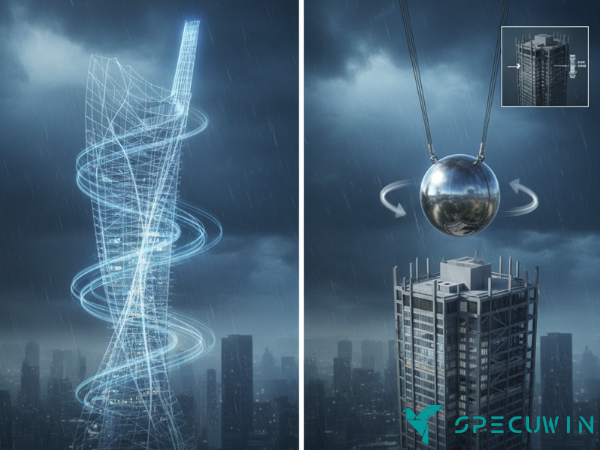
One of the most effective ways to reduce sway is to stop the wind from gripping the building in the first place. This is why many modern super-tall towers are not perfect rectangles. They might have tapered tops, twisted facades, or “blow-through” floors—empty levels that allow air to pass straight through the structure. These design choices break up the wind vortices, significantly reducing the lateral force pushing on the tower.
2. Tuned Mass Dampers (TMDs):
Perhaps the most fascinating solution is the Tuned Mass Damper. This is typically a massive pendulum often a giant steel sphere or a tank of water suspended near the top of the building. When the wind pushes the tower one way, the heavy damper swings the opposite way. This counter-movement pulls the building back to center, drastically reducing the sensation of swaying. It works on the same principle as a shock absorber in a car, smoothing out the ride. See how these principles are applied in extreme scenarios in our Case Study: Burj Khalifa – The Tallest Skyscraper.
Material Selection and its Role in the Wobble:-
The materials chosen for the skeleton of a building dictate how it behaves under load. Historically, concrete and steel have been the primary options, but they behave very differently.
Steel is lighter and more ductile, meaning it can stretch and bend significantly without breaking. This makes it excellent for seismic zones but can result in a “bouncier” building if not properly stiffened. Concrete, on the other hand, is heavy and rigid. While it offers great resistance to wind due to its sheer mass, it requires more steel reinforcement to handle the tension caused by swaying.
Modern engineering often uses a composite approach a strong concrete core for stiffness wrapped in a steel frame for flexibility. Furthermore, new high-performance materials are entering the market that allow for lighter, stronger structures that can handle dynamic loads better than traditional options. Learn about the evolution of these components in Modern Materials in Structural Engineering: Beyond Concrete and Steel.
Seismic Considerations: When the Wobble Saves Lives:-
In earthquake-prone regions, movement is not just about comfort; it is a matter of survival. Here, the goal isn’t necessarily to stop the sway, but to control it so the building doesn’t collapse.
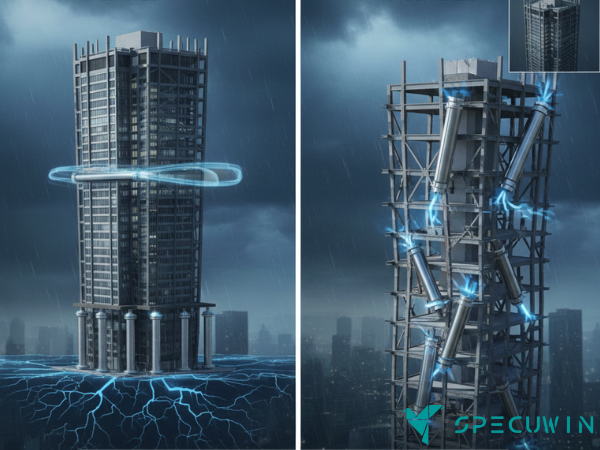
Base isolation is a common technique where the building sits on flexible bearings or pads that separate it from the shaking ground. During an earthquake, the ground moves violently beneath the building, but the structure itself glides gently on top of the bearings. This effectively decouples the building from the earth’s energy.
Another method involves viscous dampers essentially giant hydraulic pistons installed within the building’s frame. As the structure begins to rack back and forth, these pistons compress and expand, absorbing the kinetic energy and converting it into heat, which is then harmlessly dissipated. Dive deeper into these life-saving technologies in The Secrets of Earthquake-Resistant Design: What You Need to Know.
Conclusion: Embracing the Wobble:-
It is natural to seek stability. We want the ground beneath us to be firm and unyielding. But in the world of modern architecture and engineering, rigidity is often the enemy. The ability to move, to adapt to the forces of wind and earth, is what allows us to build higher and safer than ever before.
The next time you are in a high-rise and feel that subtle shift, try not to panic. Remember that thousands of hours of engineering, advanced physics, and massive damping systems are at work. That movement is the building’s way of flowing with nature rather than fighting it. It is a feature, not a bug a brilliant dance between forces that ensures you remain safe, secure, and comfortable in the clouds.
FAQ’s:-
1. How much does a skyscraper actually move?
A. Most skyscrapers are designed to drift between 1/500th and 1/200th of their height. For a very tall building like the Burj Khalifa or the Willis Tower, this can mean moving several feet at the very top during extreme weather events, though typical movement is much less and barely noticeable.
2. Can I get motion sickness from a building swaying?
A. Yes, it is possible. If a building accelerates too quickly during its sway cycle, it can disturb the inner ear, leading to nausea or dizziness. Engineers specifically design damping systems to keep this acceleration below the threshold of human perception to prevent “building sickness.”
3. Is a building safer if it doesn’t move at all?
A. Generally, no. A perfectly rigid building would be brittle. In high winds or earthquakes, a structure that cannot flex is more likely to suffer catastrophic structural failure or snap. Flexibility allows the building to absorb and dissipate energy without sustaining damage.
4. What is a Tuned Mass Damper?
A. A Tuned Mass Damper (TMD) is a device mounted in structures to reduce the amplitude of mechanical vibrations. It usually consists of a heavy mass attached to the building via springs or pendulums. It moves in opposition to the building’s sway, effectively stabilizing it against wind and earthquakes.
5. Do all tall buildings have dampers?
A. Not all, but most super-tall skyscrapers utilize some form of damping. While some rely on their inherent structural mass and shape to confuse the wind, many use auxiliary damping systems (like liquid column dampers or friction dampers) to ensure occupant comfort.
Read More On:-
For more information about engineering, architecture, and the building & construction sector, go through the posts related to the same topic on the Specuwin Blog Page.
Find out more accurately what we are going to take off in the course of applying leading new technologies and urban design at Specuwin.