

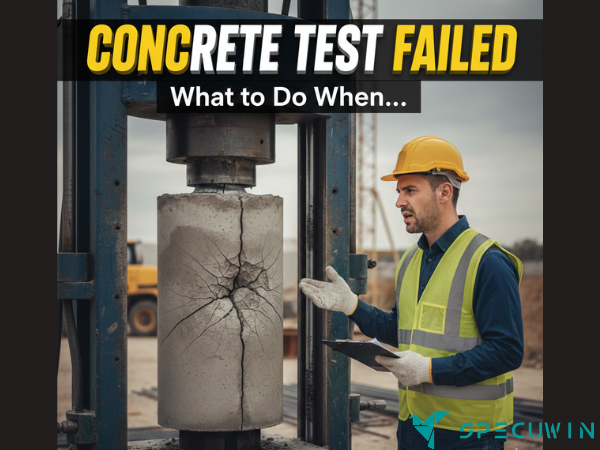
It is a nightmare scenario for any project manager or site engineer: the 28-day concrete strength results come back, and they are below the specified design requirements. After weeks of pouring, curing, and waiting, the data suggests that your structure might not be as robust as the blueprints demand.
When a concrete test fails, it doesn’t immediately mean the building must be demolished. However, it does trigger a mandatory set of protocols to ensure safety, compliance, and structural integrity. In this guide, we will walk through the systematic steps to take when your concrete doesn’t meet the mark, from investigating the cause to implementing remedial solutions.

1. Don’t Panic: Analyze the Concrete Test Results:-
The first step in managing a concrete failure is to verify the data. Was it a “true” material failure, or a failure of the testing process itself?
Verify the Concrete Sampling and Curing:
Before questioning the structural integrity of the pour, investigate the “chain of custody” for the test cylinders. Often, concrete fails because the samples were not handled according to standard protocols (like ASTM C31).
- Improper Curing: Were the cylinders kept in a temperature-controlled environment, or left in the sun on-site?
- Handling Damage: Were the cylinders bumped or dropped during transport to the lab?
- Testing Errors: Was the compression machine calibrated, and were the cylinder ends properly capped?
Identify the Magnitude of the Concrete Strength Gap:
If the specified strength was 4000 psi and the test resulted in 3950 psi, the structural engineer might determine the variance is within a safe margin. However, a result of 2800 psi is a significant concrete deficiency that requires immediate action.
Read more on:- Top 10 structural issues in residential buildings
2. Investigating the Cause of Defective Concrete:-
To prevent future failures, you must understand why this specific batch of concrete failed to perform.
1. Water-Cement Ratio Issues:
The most common culprit in concrete strength loss is the unauthorized addition of water on-site. While adding water makes the mix easier to pump, it increases the water-cement ratio, which directly compromises the final concrete strength.
2. Poor Consolidation and Placement:
If the concrete was not vibrated correctly, air pockets (honeycombing) can form. This reduces the density of the material, leading to a failure in both strength and durability.
3. Environmental Impact on Concrete:
Extreme heat or cold during the pour can disrupt the hydration process. If the concrete dries out too quickly or freezes before reaching initial set, the chemical bond is permanently weakened.
Read more on:- The impact of material selection on structural integrity.

3. Non-Destructive Concrete Testing Options:-
If the lab cylinders fail, the next step is to test the concrete that is actually in the structure.
Rebound Hammer (Schmidt Hammer):
This is a quick, non-destructive way to estimate the surface hardness of the concrete. While not as accurate as a core test, it helps identify if a specific area is significantly weaker than others.
Ultrasonic Pulse Velocity (UPV):
UPV testing involves sending sound waves through the concrete. The speed of the wave indicates the density and quality of the material, helping to locate internal voids or cracks.
In-Situ Core Testing:
This is the “gold standard” for verifying a concrete failure. A diamond-tipped drill is used to extract a cylinder directly from the structure. If the average of three cores exceeds 85% of the design strength (and no single core is below 75%), the concrete is usually accepted.
4. The Role of the Structural Engineer in Concrete Evaluation:-
Once the data is collected, the structural engineer of record (SER) must perform a “structural adequacy” check.
Recalculating Concrete Load Capacities:
The engineer will look at the specific location of the failed concrete. For example, a failure in a non-load-bearing wall is far less critical than a failure in a primary transfer beam or a foundation pile.
Accepting Concrete “As-Is”:
In some cases, the original design was conservative enough that the lower concrete strength still meets the required safety factors. The engineer may issue a “Letter of Acceptance” for the sub-par material, often with a slight penalty to the contractor.
Read more on:- How to choose the right structural engineer for your project

5. Remedial Solutions for Weak Concrete:-
If the engineer determines the concrete is unsafe, you have several paths forward.
Structural Strengthening:
Instead of demolition, you can reinforce the existing concrete using:
- Carbon Fiber Wrapping: Strengthening columns or beams with CFRP wraps.
- Section Enlargement: Adding a new layer of high-strength concrete around the original member.
- Steel Jacketing: Encasing a concrete column in a steel frame.
Partial or Full Demolition:
If the concrete is fundamentally unsound and cannot be retrofitted, removal is the only option. While costly and time-consuming, it is the only way to ensure the long-term safety of the building’s occupants.
6. Improving Quality Control in Future Concrete Pours:-
A failed test is a learning opportunity. To ensure your next concrete pour is successful, consider the following:
- On-site Supervision: Ensure no water is added to the truck without the engineer’s approval.
- Third-Party Testing: Hire a reputable lab to handle all concrete sampling.
- Advanced Modeling: Use digital tools to monitor the pour. Understanding The role of technology in structural analysis and design can help you track material performance more accurately.
FAQ’s:-
1. Can concrete still gain strength after 28 days?
A. Yes, concrete continues to hydrate and gain strength for months or even years. However, the 28-day mark is the industry standard for compliance. If it is significantly low at 28 days, it is unlikely to reach the required design strength naturally.
2. Who pays for the core testing if the initial concrete cylinders fail?
A. Typically, the party responsible for the failure pays. If the lab proves the cylinders were handled poorly, the lab may cover costs. If the mix was bad, the ready-mix supplier or contractor usually bears the expense.
3. Is a Schmidt Hammer test enough to prove concrete strength?
A. No. A rebound hammer only tests surface hardness. It is a screening tool and is not legally sufficient to override a failed cylinder test; core testing is required for definitive results.
4. What are the signs of structural concrete failure to look for?
A. Look for excessive cracking, spalling, or “dusting” on the surface. For a deeper dive into what to watch for, check out the top 5 signs your building needs a structural inspection.
5. Does a failed test mean the building will collapse?
A. Rarely. Modern engineering includes safety factors. A “failure” usually means the concrete didn’t meet the design specification, which is often much higher than what is required to simply keep the building standing.
Read More On:-
For more information about engineering, architecture, and the building & construction sector, go through the posts related to the same topic on the Specuwin Blog Page.
Find out more accurately what we are going to take off in the course of applying leading new technologies and urban design at Specuwin.