

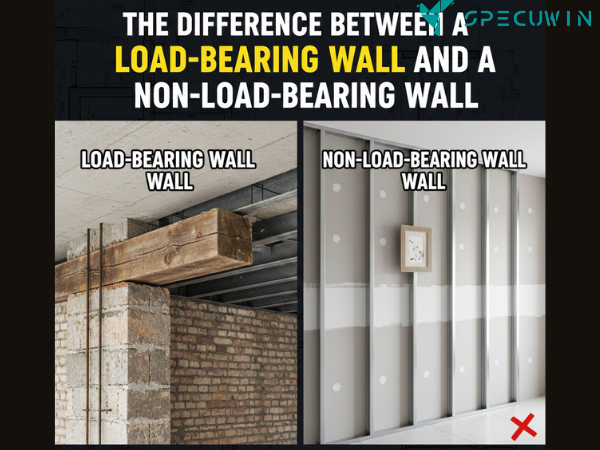
Home renovation shows make tearing down a Wall look incredibly satisfying. There is something primal and liberating about taking a sledgehammer to drywall and opening up a cramped living space. However, in the real world of construction and engineering, that sheet of drywall might be the only thing holding up your bathtub, your roof, or your second floor. Before you commit to an open-concept layout, you must understand the vital distinction between a structural element and a simple divider. In this guide, we will break down everything you need to know about the Load-Bearing Wall versus the Non-Load-Bearing Wall.
Understanding the Function of a Load-Bearing Wall:-
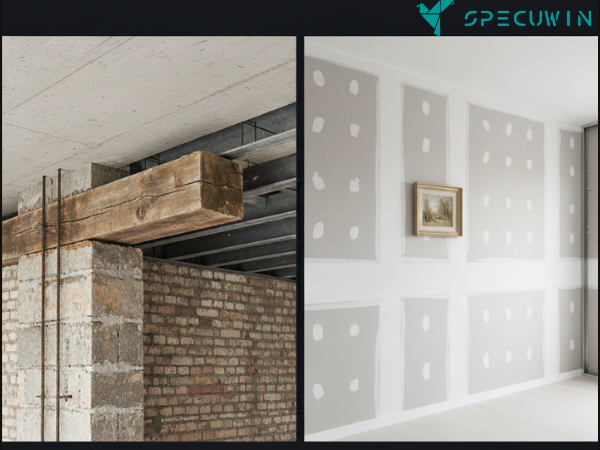
To put it simply, a load-bearing Wall is the muscle of your house. It is an active structural element responsible for conducting the immense weight of the structure above it down to the foundation. This weight is known as the “load.”
These loads include the “dead load” (the weight of the building materials themselves, like the roof, floor joists, and attic) and the “live load” (the weight of people, furniture, and snow on the roof). If you remove a load-bearing Wall without properly supporting the weight it was carrying, gravity will instantly take over. The consequences can range from sagging ceilings and cracked plaster to a catastrophic structural collapse.
In multi-story homes, these walls often stack directly on top of one another to create a continuous path for weight to travel downward. Identifying them is crucial because altering them requires significant engineering intervention, typically involving the installation of heavy-duty beams to act as a bridge for the weight. If you own an older property, the layout can be deceptive. Over time, settling can cause even partition walls to take on weight they weren’t designed for.
Read more on:-Common structural problems in old houses and how to fix them
The Role of a Non-Load-Bearing Wall:-
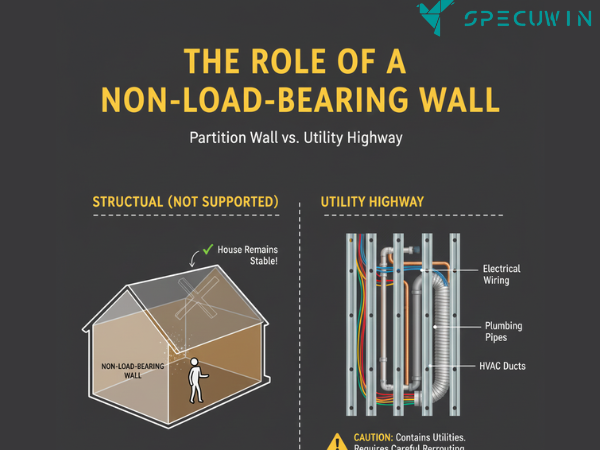
In contrast, a non-load-bearing Wall often called a “partition” or “curtain” wall is essentially there for privacy and division. It separates the kitchen from the living room or the bedroom from the hallway, but it does not support any structural weight of the building.
Think of a non-load-bearing Wall as a vertical piece of furniture that is permanently attached to the house. If you were to magically delete this wall, the house would stand perfectly still. The roof wouldn’t creak, and the floors wouldn’t sag.
However, just because it doesn’t hold up the roof doesn’t mean it is empty. These walls are often the preferred highways for your home’s nervous system: electrical wiring, plumbing pipes, and HVAC ducts. While removing a non-load-bearing Wall is structurally safer and cheaper, it still requires careful planning to reroute these essential utilities.
Clues to Spot Each Type of Wall:-
While the only way to be 100% certain is to consult a professional or check the original blueprints, several clues can give you a strong indication of what kind of Wall you are looking at.
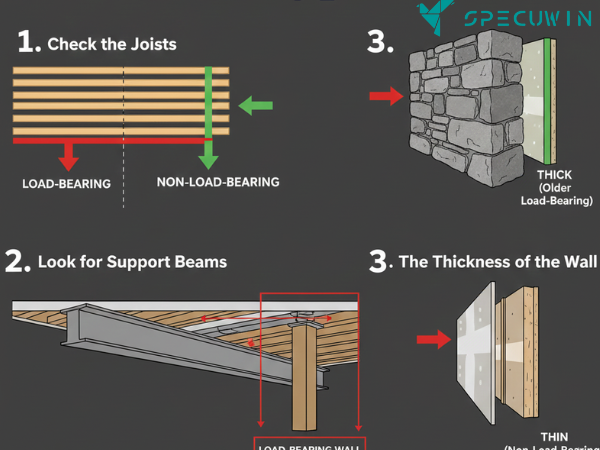
1. Check the Joists:
Go into the basement or the attic where the floor or ceiling joists are visible. If the Wall runs perpendicular (at a 90-degree angle) to the joists, there is a high chance it is load-bearing. Builders use these walls to support the long spans of the floor joists. If the wall runs parallel to the joists, it is likely a non-load-bearing partition.
2. Look for Support Beams:
In the basement, look for steel I-beams or multi-ply wood beams. Any Wall directly above these major supports is almost certainly load-bearing. The beam is there specifically to catch the load coming down through that wall.
3. The Thickness of the Wall:
In older masonry or stone buildings, a load-bearing Wall is often significantly thicker than a partition wall. However, in modern timber-frame houses, both types of walls are often framed with 2x4s, making thickness an unreliable metric without opening up the drywall.
Read more on:-Top 10 Structural issues in residential buildings
Risks of Removing a Structural Wall:-
The biggest mistake DIY enthusiasts make is assuming that because a Wall sounds hollow when tapped, it is safe to remove. This is a myth. A wall is mostly air regardless of whether it is holding up the roof or not.
Removing a load-bearing Wall without installing a temporary support wall (shoring) and a permanent replacement beam can lead to “racking.” This is where the geometric shape of the house distorts. Doors and windows on upper floors may stop closing properly, drywall will crack, and floors will slope. In worst-case scenarios, especially in areas with heavy snow loads or high winds, the integrity of the entire building envelope is compromised.
Even if the house doesn’t collapse immediately, the “creep” effect causes timber to slowly deform over months or years, leading to expensive repairs down the line.
Read more on:- What is Structural Engineering
Consulting Experts About Your Wall:-
If you have any doubt about a Wall, stop. The cost of a consultation is a fraction of the cost of repairing structural failure. A structural engineer can calculate the loads and design a beam (made of steel, LVL, or glulam) that can span the new opening safely.
They will provide you with a stamped report or drawing that is often required to get a building permit. Remember, most municipalities require a permit for structural alterations. Doing this work “off the books” can make your home unsellable in the future or void your insurance policy.
FAQ’s:-
1. Can a partial wall be a load-bearing wall?
A. Yes. Even short sections of a wall or columns can be carrying significant point loads from a beam above. Never assume a wall isn’t structural just because it doesn’t span the entire width of the room.
2. How much does it cost to remove a load-bearing wall?
A. It is significantly more expensive than removing a partition wall. Costs vary wildly but often range from $3,000 to over $10,000 because you are paying for engineering, temporary support, demolition, and the installation of a new structural beam.
3. Can I use a stud finder to tell if a wall is load-bearing?
A. No. A stud finder only tells you where the wood framing is, not how much weight rests on it. Both load-bearing and non-load-bearing walls use studs.
4. Do I need a permit to remove a non-load-bearing wall?
A. Usually, yes. Even if the wall isn’t structural, it likely contains electrical or plumbing lines. Most codes require a permit for demolition and moving utilities to ensure safety compliance.
5. What is a “shear wall”?
A. A shear wall is a specific type of structural wall designed to resist lateral forces, like wind or earthquakes. While it carries a load, its main job is to stop the house from swaying or twisting.
Read More On:-
For more information about engineering, architecture, and the building & construction sector, go through the posts related to the same topic on the Specuwin Blog Page.
Find out more accurately what we are going to take off in the course of applying leading new technologies and urban design at Specuwin.