

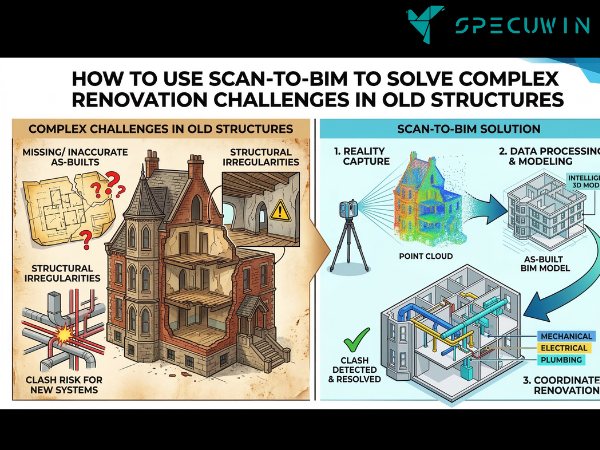
The global construction landscape is shifting. While new skyscrapers often capture the headlines, the real challenge for modern engineering lies in the shadows of our existing urban fabric. Aging infrastructure, historical landmarks, and mid-century commercial blocks are reaching critical points where “business as usual” maintenance is no longer enough. To preserve these structures, we need structural retrofitting a process that has historically been plagued by guesswork, manual measurement errors, and unforeseen site conditions.
However, a technological shift is fundamentally changing the way we approach these complex renovations. The integration of Scan-to-BIM into the retrofitting workflow is transforming “best guesses” into mathematical certainties. By utilizing High-Definition Surveying (HDS) or terrestrial laser scanning, engineers can now capture the exact “as-built” reality of a building with millimeter precision.
If you are new to this technology, start with BIM for Beginners to understand the foundational principles.
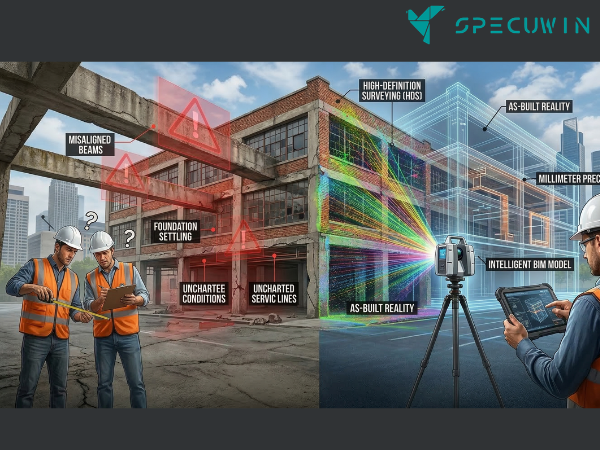
Why Structural Retrofitting Needs Scan-to-BIM:-
Traditional retrofitting projects often begin with a major hurdle: missing or inaccurate blueprints. For buildings constructed decades ago, the original paper drawings are often lost, or worse, they don’t reflect the “field changes” made during the original construction. Attempting to design a modern seismic reinforcement or a floor-load enhancement based on outdated 2D drawings is a recipe for project delays and budget overruns.
This is where the power of Scan-to-BIM becomes undeniable. Instead of sending a team with tape measures and clipboards to spend weeks documenting a site, a laser scanner captures millions of data points (a “point cloud”) in a matter of hours. This data doesn’t just show where the walls are; it captures the structural deviations, the slight leans in columns, and the sagging of beams that have occurred over half a century of service.
Eliminating the “Unknowns” in Aging Infrastructure:-
When dealing with aging buildings, the biggest risk is the “unknown.” What is behind that masonry wall? Is the steel beam truly level? Scan-to-BIM provides a 360-degree digital twin that acts as a transparent layer over the physical structure. In structural engineering, where the margin for error is non-existent, having a precise “as-built” model allows for:
- Accurate Load Path Analysis: Knowing exactly how weight is distributed through the current, weathered members.
- Conflict Detection: Identifying where new structural reinforcements might clash with existing mechanical, electrical, or plumbing (MEP) systems before any material is even ordered.
- Seismic Readiness: Evaluating how a building will react to lateral forces based on its actual geometry, not its theoretical design.
The Scan-to-BIM Workflow: From Point Clouds to Structural Models:-
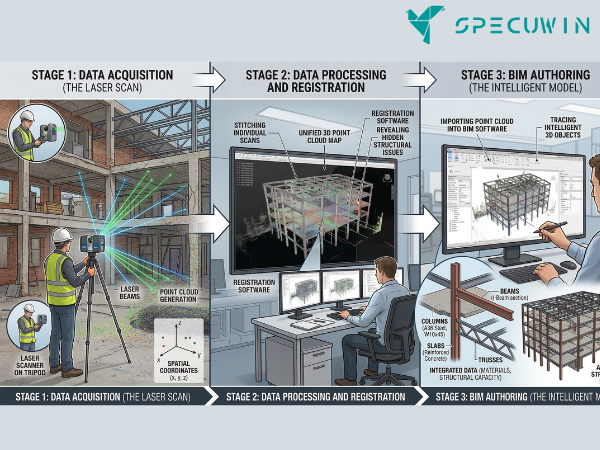
The transition from a physical site to a digital model is a sophisticated process that requires both high-end hardware and specialized BIM expertise. The Scan-to-BIM workflow generally follows three critical stages:
1. Data Acquisition (The Laser Scan):
A tripod-mounted or handheld laser scanner is moved through the building. It emits a laser beam that bounces off surfaces and returns to the sensor, measuring the distance and intensity. The result is a “point cloud” a massive dataset of spatial coordinates (x, y, z) that represents the building’s skin and bones.
2. Data Processing and Registration:
Individual scans from different rooms and floors are “stitched” together using registration software. This creates a unified 3D map of the entire facility. For structural retrofitting, this map is crucial because it reveals the structural integrity issues that are often invisible to the naked eye.
3. BIM Authoring (The Intelligent Model):
The point cloud is imported into software like Autodesk Revit. Here, BIM technicians “trace” over the points to create intelligent 3D objects columns, beams, slabs, and trusses. These objects aren’t just shapes; they contain data about material properties, age, and structural capacity.
This digital transformation highlights What is the role of a structural engineer in modernizing existing assets rather than just designing new ones.
Precision Retrofitting: How Scan-to-BIM Solves Complex Renovations:-
In a complex renovation, such as converting an old industrial warehouse into modern loft offices, the structural demands change entirely. You might be adding heavy HVAC units to a roof that wasn’t designed for them or cutting new elevator shafts through thick concrete slabs.
Seamless Integration of New and Old:
The primary advantage of Scan-to-BIM in these scenarios is the ability to design new structural elements that fit perfectly within the old ones. If you are fabricating steel jackets to reinforce old concrete columns, you can use the BIM model to ensure every bolt hole aligns with the existing conditions. This “pre-fabrication” approach significantly reduces on-site cutting and welding, which are both dangerous and expensive in confined, aging spaces.
Visualizing Structural Challenges Through Scan-to-BIM:
Before the first sledgehammer swings, stakeholders can take a virtual walkthrough of the retrofitted building. This isn’t just for aesthetics. Engineers can visualize the stresses on the building and how the new reinforcement system integrates with the historical architecture. It allows for a level of transparency with clients and city officials that was previously impossible.
Designing reinforcements requires a deep understanding of Modern materials in structural engineering to ensure the new components integrate with the aging substrate.
The Economic Impact of Choosing Scan-to-BIM:-
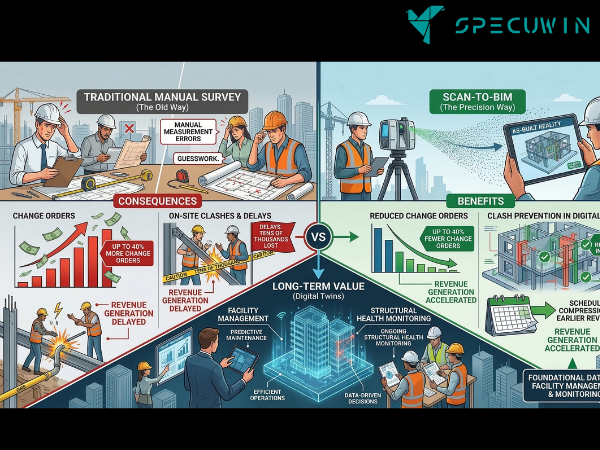
While the initial cost of a laser scan might seem higher than a manual survey, the Return on Investment (ROI) is staggering. Research in the AEC industry consistently shows that Scan-to-BIM can reduce change orders by up to 40%. In structural retrofitting, a single “clash” discovered on-site such as a new steel brace hitting a primary gas line can cost tens of thousands of dollars in delays. By solving these issues in the digital model, those costs are eliminated.
Furthermore, the speed of data collection means the building remains operational for longer, or the renovation schedule is compressed, allowing the owner to begin generating revenue sooner.
The value of the scan continues long after construction, providing the foundational data for Digital twins on facility management and ongoing structural health monitoring.
Conclusion: Embracing the Digital Future of Preservation:-
The aging of our cities is inevitable, but the failure of our structures is not. By leveraging the power of Scan-to-BIM, we are giving a second life to buildings that might otherwise be slated for demolition. This technology provides the precision, safety, and economic viability needed to tackle the most complex structural retrofitting projects of the 21st century.
Whether you are an architect looking to preserve a facade or a structural engineer tasked with seismic upgrades, the transition from “as-designed” to “as-built” is no longer a leap of faith it’s a calculated, digital certainty.
FAQ’s:-
1. How accurate is Scan-to-BIM for structural measurements?
A. Typical professional-grade laser scanners offer accuracy within 2mm to 6mm. This level of precision is far superior to manual measurements, especially in large-scale or complex aging structures where walls may be out of plumb.
2. Does Scan-to-BIM work for buildings that are still occupied?
A. Yes. Laser scanning is non-invasive and can be performed during off-hours or even during business hours with minimal disruption, as it does not require physical contact with the surfaces being measured.
3. Can Scan-to-BIM detect internal structural defects like rebar corrosion?
A. While the laser scan captures the surface (geometry), it does not “see through” walls. However, the resulting BIM model can be integrated with GPR (Ground Penetrating Radar) data to map internal elements like rebar and post-tension cables.
4. How long does the Scan-to-BIM process take?
A. Scanning a medium-sized commercial building usually takes 1–3 days. The “office work” of converting the point cloud into a structured BIM model takes longer, typically 1–2 weeks depending on the level of detail (LOD) required.
5. Is Scan-to-BIM only for large-scale skyscrapers?
A. Not at all. It is increasingly used for small historical residential projects and medium-sized industrial retrofits where accuracy is critical to preserving the architectural integrity of the site.
Read More On:-
For more information about engineering, architecture, and the building & construction sector, go through the posts related to the same topic on the Specuwin Blog Page.
Find out more accurately what we are going to take off in the course of applying leading new technologies and urban design at Specuwin.