

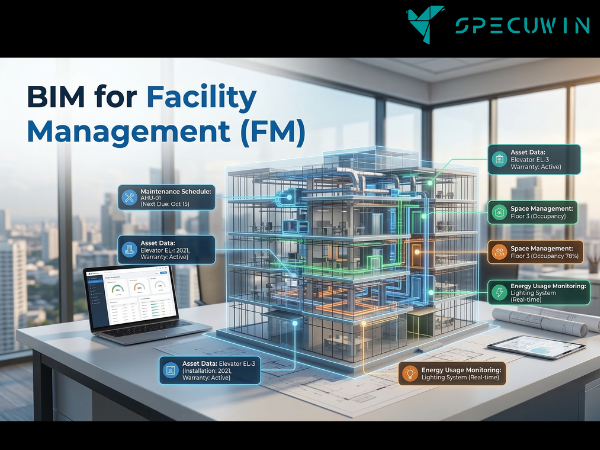
For most building owners, the “end” of a construction project is often marked by a ribbon-cutting ceremony and the handover of a massive stack of paper manuals, disorganized spreadsheets, and flat 2D CAD files. However, the true life of a building is just beginning at that moment. Statistics in the AEC industry consistently show that over 80% of a building’s total lifecycle cost occurs during its operational life, not during its design or construction. This is where Facility Management steps in to bridge the gap between a completed structure and a high-performing, long-term asset.
By leveraging Building Information Modeling (BIM) far beyond the design and construction phases, we can transform static structural models into “Living Digital Twins.” This approach ensures that the deep technical intelligence gathered during engineering continues to serve the client for decades, streamlining Facility Management and maximizing the return on investment for the owner.
Read more on:- The Value of BIM Outsourcing for Architectural and Engineering Firms
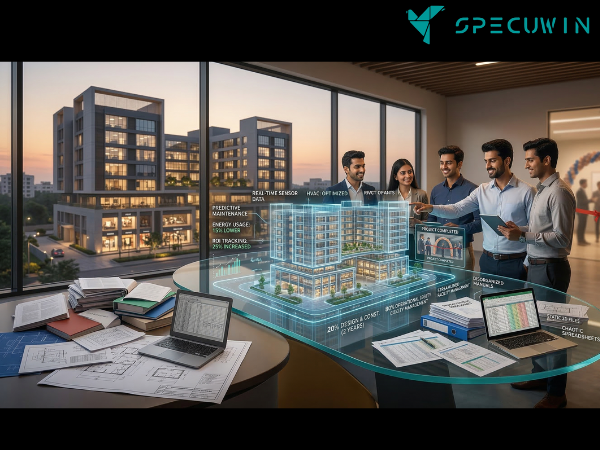
Why Facility Management Needs a Digital Evolution:-
Traditional handover processes are notoriously inefficient. Information is often lost, buried in unorganized folders, or simply forgotten as teams transition from construction to operations. Facility Management professionals frequently report spending more than 30% of their time simply searching for data such as the location of a specific structural reinforcement, the fire rating of a partition, or the load-bearing capacity of a specific floor slab.
The transition from 2D drawings to BIM-driven Facility Management solves this by providing a single, centralized “source of truth.” Instead of a “dead” document that begins to gather dust the moment it is printed, the structural model becomes a dynamic, living tool that evolves alongside the physical building.
The Cost of Data Fragmentation:-
When a facility manager lacks immediate access to structural data, every minor renovation or repair becomes a major investigative project. They may have to hire consultants to perform “as-built” surveys or invasive testing just to find out what is behind a wall. Integrating these details into a Facility Management workflow from day one eliminates this “information tax” that owners have paid for generations.
From Static Models to Living Digital Twins in Facility Management:-
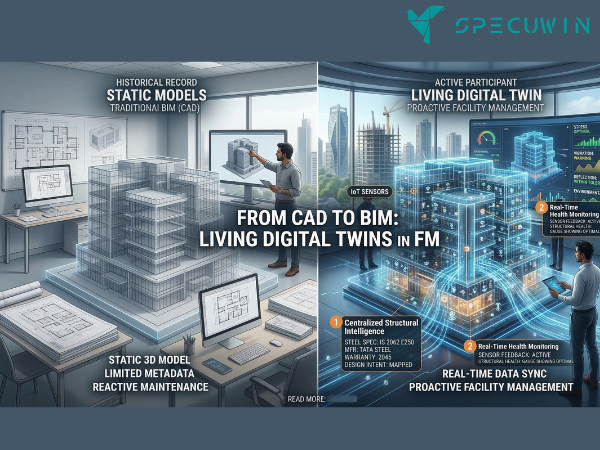
A “Digital Twin” is more than just a high-definition 3D picture of a building. It is a virtual replica that is mathematically and data-synced with its real-world counterpart. In the context of Facility Management, this means the structural model is no longer a historical record; it is an active participant in the building’s daily life.
1. Centralized Structural Intelligence:
In a living digital twin, every beam, column, and slab is embedded with metadata. For Facility Management teams, this means instant access to material specifications, manufacturer details, and warranty information. If a renovation is planned ten years down the line, the structural integrity and historical design intent are already mapped out, preventing costly onsite guesswork. This is a significant step beyond traditional methods.
Read more on:- From CAD to BIM: Navigating the Transition
2. Real-Time Health Monitoring for Facility Management:
Modern infrastructure often utilizes IoT sensors to monitor stress, vibration, deflection, and environmental factors. When these sensors feed back into the BIM model, Facility Management becomes proactive rather than reactive. The building “tells” the manager when a structural element requires attention or maintenance before a visible failure occurs. This is the essence of a “living” model it breathes with the data of the actual structure.
Read more on:- The Revolutionary Impact of Digital Twins on Facility Management and Operations
Key Benefits of BIM-Integrated Facility Management for Clients:-
When clients choose to utilize structural models long after construction finishes, they unlock strategic advantages that redefine the efficiency of their Facility Management departments.
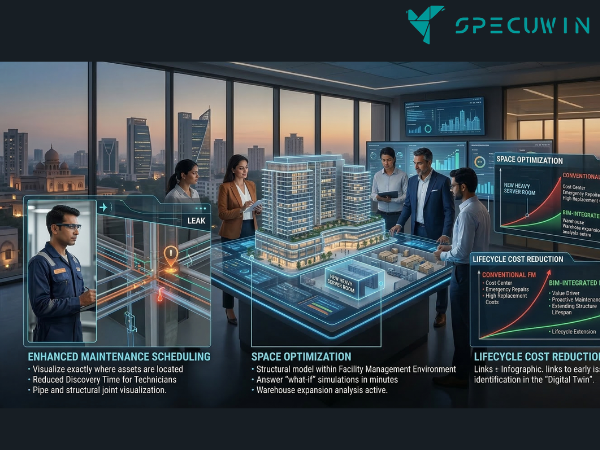
Enhanced Maintenance Scheduling in Facility Management:
Preventative maintenance is the backbone of a safe, functional building. With a BIM-based Facility Management system, managers can visualize exactly where assets are located within the structure. This spatial awareness reduces the “discovery time” for technicians. If a pipe leaks or a structural joint needs inspection, the technician can see exactly what is behind the ceiling tile in the virtual model before they even grab a ladder.
Space Optimization and Facility Management:
Buildings are not static; offices are reconfigured, and warehouses are expanded. Facility Management supported by BIM allows owners to run “what-if” simulations. Can this floor support a new heavy server room or a library? By checking the structural model within the Facility Management environment, engineers can provide answers in minutes rather than weeks. This level of agility is crucial for a future-ready career in the AEC industry.
Lifecycle Cost Reduction through Facility Management:
By identifying issues early through the digital twin, owners avoid the exponential costs of emergency repairs. Facility Management transitions from being a “cost center” to a “value-driver,” extending the lifespan of the structure and ensuring the building remains compliant with safety standards throughout its history.
Overcoming the Handover Gap: Implementing Facility Management Early:-
The biggest hurdle to successful Facility Management is the “Information Drop-off” at project completion. To turn a structural model into a living digital twin, the Facility Management requirements must be defined during the design phase.
- Data Standards: Ensure the structural model uses COBie (Construction Operations Building information exchange) or similar standards that Facility Management software can read.
- Asset Tagging: Every critical structural component should be tagged with a unique ID that correlates to the physical building, often using QR codes or RFID tags.
- Software Integration: Choose BIM tools that easily sync with existing Computer-Aided Facility Management (CAFM) or Integrated Workplace Management Systems (IWMS). This is part of the broader revolutionary impact digital twins have on the sector.
- Training: Empower the onsite staff to use the model, ensuring the digital twin doesn’t become an abandoned piece of technology.
The Future of Infrastructure: Smart Facility Management:-
As we look toward a future of “Smart Cities” and autonomous infrastructure, the role of Facility Management will only grow in complexity. Structural models will no longer be optional; they will be the operating systems of our buildings. By investing in a living digital twin today, clients aren’t just buying a building they are buying a lifetime of operational clarity and structural resilience through advanced Facility Management.
The transition from CAD to BIM was the first step. The next step is the transition from BIM as a construction tool to BIM as a permanent Facility Management asset.
FAQ’s:-
1. What is the difference between BIM and a Digital Twin in Facility Management?
A. BIM is a 3D model representing the physical and functional characteristics of a building during design/construction. A Digital Twin is that BIM model “brought to life” with real-time data from the physical building, used specifically for ongoing Facility Management.
2. Is it expensive to implement BIM for Facility Management?
A. While there is an initial investment in data organization, the long-term savings in reduced “search time” for data and extended building life far outweigh the setup costs.
3. Can an old building without a BIM model use Digital Twin technology?
A. Yes. Through “Scan-to-BIM” (using laser scanning), we can create a structural model of an existing building to kickstart a modern Facility Management strategy.
4. Who is responsible for updating the model during the building’s life?
A. Typically, the Facility Management team or a BIM consultant updates the model whenever significant repairs or renovations occur to ensure the “twin” remains accurate.
5. How does this help with sustainability?
A. BIM-driven Facility Management allows for better monitoring of energy use and structural health, helping owners meet green building standards and reduce waste.
Read More On:-
For more information about engineering, architecture, and the building & construction sector, go through the posts related to the same topic on the Specuwin Blog Page.
Find out more accurately what we are going to take off in the course of applying leading new technologies and urban design at Specuwin.