

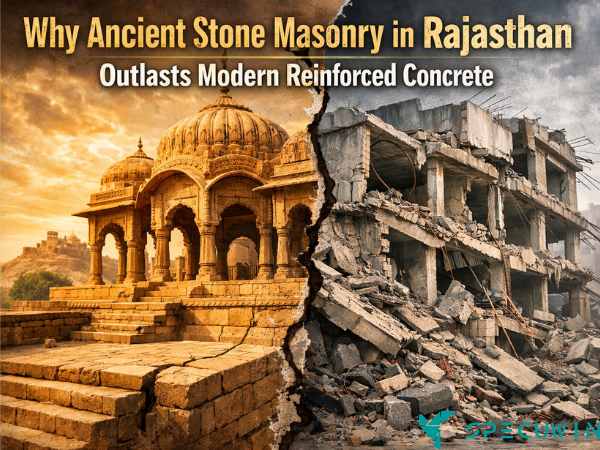
For centuries, the arid landscapes of Rajasthan have been guarded by stone giants. While modern skyscrapers rely on a skeletal diet of carbon steel and reinforced concrete, structures like the Jagdish Temple in Udaipur have stood firm since 1651 without a single rusted rebar. This isn’t just architectural beauty; it is a masterclass in Ancient Stone Masonry.
By analyzing how these structures have withstood weathering and seismic activity, we can uncover engineering secrets that remain highly relevant to the AEC industry today. The resilience of these temples offers a profound look into a time when “building for eternity” was the literal standard of practice.

The Philosophy of Weight: Foundations of Ancient Stone Masonry:-
Unlike modern construction, which often fights gravity through high-tensile materials, Ancient Stone Masonry uses gravity as its primary adhesive. In temples across Rajasthan, stability is derived from two factors: “interlocking” and “mass.”
- Dry Masonry Techniques: Many Rajasthani structures utilize dry stone masonry, where stones are dressed so precisely that they fit together without mortar. This allows for microscopic movements during thermal expansion or seismic shifts without cracking the main body.
- The Plinth (Jagati): These temples sit on massive, elevated platforms. This doesn’t just elevate the deity; it distributes the enormous load of the stone superstructure across a wider surface area, preventing the uneven settlement that modern soil testing aims to predict.
- Load Distribution: By using massive blocks, the vertical pressure keeps the stones “locked” in place. The sheer weight acts as a stabilizer against lateral wind forces that would rattle a lighter, modern frame.
Seismic Resilience: Why They Don’t Crumble:-
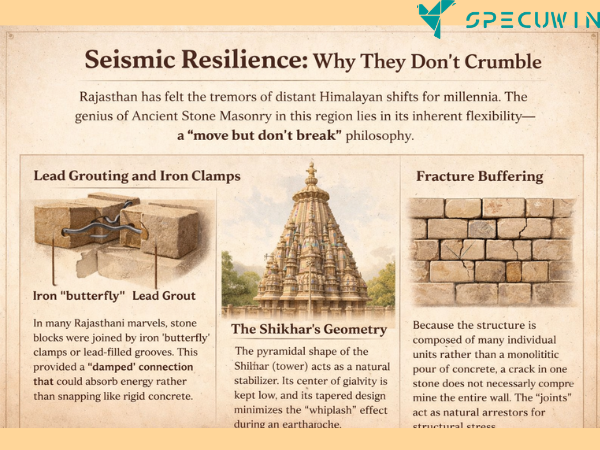
Rajasthan has felt the tremors of distant Himalayan shifts for millennia. The genius of Ancient Stone Masonry in this region lies in its inherent flexibility a “move but don’t break” philosophy.
- Lead Grouting and Iron Clamps: In many Rajasthani marvels, stone blocks were joined by iron “butterfly” clamps or lead-filled grooves. This provided a “damped” connection that could absorb energy rather than snapping like rigid concrete.
- The Shikhar’s Geometry: The pyramidal shape of the Shikhar (tower) acts as a natural stabilizer. Its center of gravity is kept low, and its tapered design minimizes the “whiplash” effect during an earthquake. This structural logic is a precursor to modern high-rise solutions.
- Fracture Buffering: Because the structure is composed of many individual units rather than a monolithic pour of concrete, a crack in one stone does not necessarily compromise the entire wall. The “joints” act as natural arrestors for structural stress.
Weathering the Storm: Material Selection in Ancient Stone Masonry:-
The choice of stone in Rajasthan wasn’t just about aesthetics; it was a calculated engineering decision based on the extreme desert climate.
- Red Sandstone and Marble: While marble provided cooling properties, the use of locally sourced sandstone ensured that the building material was already “acclimatized” to local temperature swings. This focus on material selection is still the bedrock of structural integrity.
- Thermal Mass: The thick stone walls of Ancient Stone Masonry act as a thermal battery, absorbing heat during the day and releasing it at night, naturally regulating the interior temperature without mechanical cooling.
- Self-Healing Surfaces: Over time, certain stones develop a patina a hard outer crust that protects the inner core from wind erosion, acting as a natural protective coating.
Decoding Ancient Stone Masonry: The Jagdish Temple Case Study:-
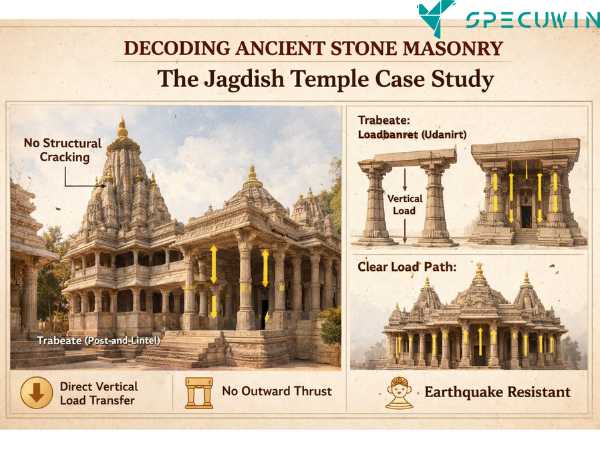
The Jagdish Temple is a three-storied wonder of Indo-Aryan architecture. If you look closely at the pillars, you’ll see no signs of the structural cracking common in 50-year-old concrete buildings.
The secret is the Trabeate system. Instead of arches that exert outward thrust (which requires heavy buttressing), these temples use post-and-lintel systems. Every vertical load is transferred directly down through massive, intricately carved columns. This ensures that even as the earth moves, the weight of the stone keeps the structure compressed and stable. This level of reliability is exactly why professionals seek structural inspections for modern assets today to ensure the load paths remain as clear as they are in these ancient wonders.
Lessons for the Future: Ancient Stone Masonry Meets Modern Tech:-
Why does this matter in the age of AI? As we move toward Sustainable structures, the carbon footprint of steel and cement is becoming a global liability.
By integrating these ancient interlocking geometries with Generative Design, engineers can create structures that rely on form rather than high-carbon materials. We are currently seeing a resurgence in “stone-on-stone” engineering, where BIM is used to model the complex gravity-based connections of the past.
FAQ’s:-
1. How did Ancient Stone Masonry stay together without cement?
A. Most Rajasthani temples used precision-cut interlocking joints and gravity-based stacking. When a binder was used, it was often a lime-surkhi mortar which remains flexible and breathable over centuries, unlike modern brittle cement.
2. Can Ancient Stone Masonry techniques be used in modern buildings?
A. While we may not build entire skyscrapers of solid stone, the principles of interlocking joints and high thermal mass are being integrated into green building designs to reduce energy consumption.
3. Is stone more durable than reinforced concrete (RCC)?
A. In the long term, yes. RCC is prone to “concrete cancer” (rusting of internal steel) and usually lasts 50–100 years. Ancient Stone Masonry can easily exceed 500–1,000 years with minimal maintenance.
4. Why was the Jagdish Temple built on such a high platform?
A. The Jagati (platform) protects the temple from local flooding and acts as a massive “raft foundation,” distributing the immense weight of the stone evenly across the ground to prevent sinking.
5. How do these temples handle the extreme Rajasthan heat?
A. The density of the stone provides “thermal lag.” It takes so long for the sun to heat the thick stone that the interior remains cool during the day, making it an early form of sustainable climate control.
Read More On:-
For more information about engineering, architecture, and the building & construction sector, go through the posts related to the same topic on the Specuwin Blog Page.
Find out more accurately what we are going to take off in the course of applying leading new technologies and urban design at Specuwin.