

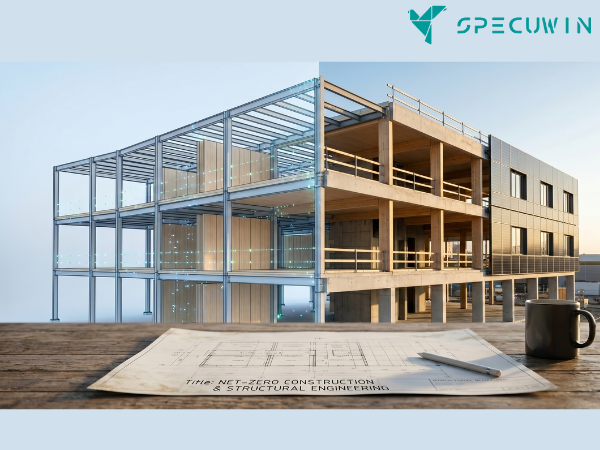
Let’s just be honest for a second. I am completely spent. If I have to look at another structural simulation model at two in the morning just to shave off a micro-fraction of embodied carbon, I might just walk into the woods and never look back. Everyone wants to talk about green buildings. They want solar panels. They want pretty rooftop gardens. But no one wants to talk about the actual bones of the building. The heavy lifting. The raw, unglamorous physics. Net-Zero Construction isn’t just a trendy buzzword you can slap onto a marketing brochure to look good at board meetings; it is a total, exhausting overhaul of how we design structures from the ground up.
Two weeks ago, I was sitting across from a developer who wanted a shiny new high-rise. He kept bragging about his “sustainable vision,” gesturing wildly with an expensive pen. Then I showed him the initial material bill. He nearly swallowed his tongue. “Why is the structural steel tonnage so high?” he yelled.
I had to patiently explain that if he wanted massive open spaces without intermediate pillars and a lower carbon footprint, we couldn’t just use standard practices. We ended up spending forty-eight straight hours recalculating the framing. It reminded me of a piece I wrote on Optimizing steel tonnage in high-rise commercial towers. It was brutal. We saved the client lakhs, but I lost half my hair in the process.
Why Net-Zero Construction Demands Smarter Material Selection:-
We are stuck between a rock and a hard place. Actually, we are stuck between concrete and steel. These two materials are the absolute bedrocks of modern civilization, but they are also carbon nightmares. Concrete production alone contributes to roughly 8% of global carbon emissions. Steel is right up there too. So, how do we hit net-zero? You can’t just wish the gravity away.
The Heavy Truth of Concrete Grades:
We have to use our brains instead of just throwing more cement at the problem. High-strength concrete grades allow us to design smaller columns. Smaller columns mean less volume. Less volume means less carbon. But you have to know exactly what you are doing. If you want to understand the basics of what we are dealing with here, take a look at this breakdown on Concrete grades as the backbone of construction.
But wait, there is a massive catch. If you switch to ultra-high-performance concrete, your local suppliers might mess it up. I have seen guys on-site add water to a mix because it “looked too dry,” completely ruining the water-cement ratio. If the pour gets messed up, you get structural flaws. You get honeycombing. Then you are stuck reading about How to prevent honeycombing before the pour begins just to salvage the project. It is an endless tightrope walk.
Timber is Stepping Up:
Mass timber is making waves. Cross-laminated timber (CLT) traps carbon instead of emitting it. It is fantastic. It is lightweight. But it is not a magic bullet for every single project. You still have to worry about acoustics, fire ratings, and long-term moisture.
Digital Integration in Net-Zero Construction:-
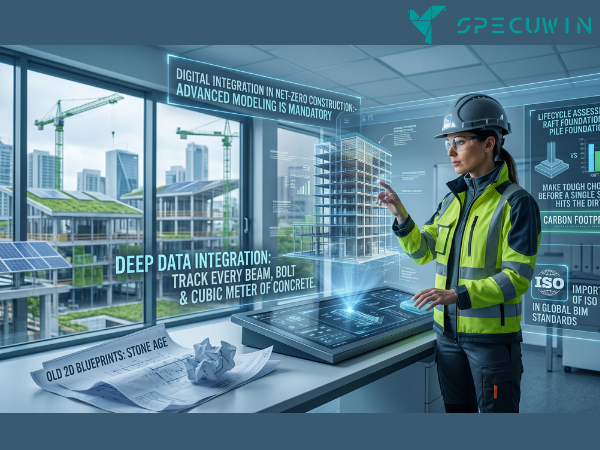
We cannot do this with old 2D blueprints. It is flat-out impossible. If you are still relying on basic CAD drawings to build a highly optimized, sustainable structure, you are living in the stone age. You are leaving money and carbon savings on the table.
Advanced Modeling is Mandatory:
We use Building Information Modeling to track everything. Every beam, bolt & every single cubic meter of concrete. This goes way beyond simple 3D visuals. We are talking about deep data integration. If you want a structured look at how this works globally, check out the guide on The importance of ISO 19650 in global BIM standards.
This precision allows us to run lifecycle assessments before a single shovel hits the dirt. We can compare the environmental impact of a raft foundation versus pile foundations. You can read more about calculating the Carbon footprint of your foundationto see the exact data models we use to make these tough choices.
The Ultimate Payoff of Structural Optimization:-
I am tired, yes. My coffee intake is reaching dangerous levels. But when a sustainable building finally gets completed, it is worth the sleepless nights.
Early structural involvement can cut total material costs by up to 15% while dropping the building’s carbon footprint significantly. It requires intense collaboration. Architects and engineers need to stop arguing and start talking during the very first sketch. We have to design for disassembly so materials can be recycled fifty years from now. Net-zero isn’t a final destination. It is a completely new way of thinking about the lifecycle of human shelter. Now, if you’ll excuse me, I am going to turn off my phone and sleep for a week.
Frequently Asked Questions:-
1. What is the main focus of Net-Zero Construction?
A. It aims to balance the greenhouse gases emitted during construction and operation with the amount removed from the atmosphere.
2. How does structural engineering affect a building’s carbon footprint?
A. Engineers specify the materials. Since concrete and steel hold massive embodied carbon, optimizing these designs directly lowers emissions.
3. Can old buildings achieve net-zero status?
A. Yes. Through deep structural retrofitting, energy upgrades, and material reinforcement, existing buildings can dramatically cut their carbon footprints.
4. Why is mass timber considered a sustainable structural material?
A. Wood naturally stores carbon dioxide absorbed by trees, keeping it locked away inside the building’s frame for decades.
5. Does Net-Zero Construction cost significantly more?
A. Initial design and material costs can be higher. However, advanced digital modeling and long-term energy savings usually offset these expenses quickly.
Read More On:-
For more information about engineering, architecture, and the building & construction sector, go through the posts related to the same topic on the Specuwin Blog Page.
Find out more accurately what we are going to take off in the course of applying leading new technologies and urban design at Specuwin.