

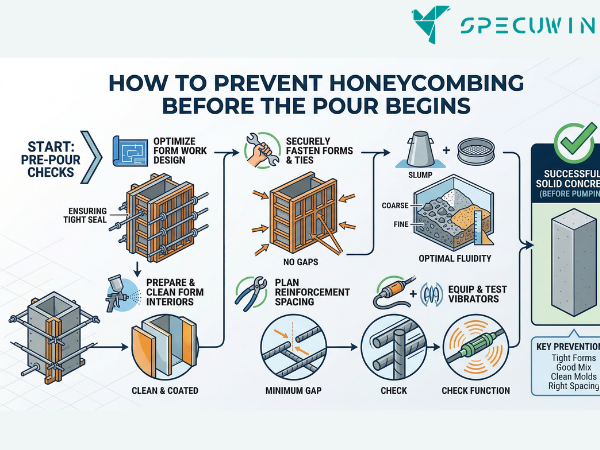
In the world of reinforced cement concrete (RCC) construction, the strength of a structure is often hidden beneath its surface. However, when that surface is stripped away to reveal “honeycombing” those dreaded hollow spaces and stony pockets that resemble a bee’s nest it’s a sign that the structural integrity and aesthetic finish have been compromised.
Honeycombing isn’t just a cosmetic flaw; it is a gateway for moisture and chlorides to reach the reinforcement steel, leading to corrosion and long-term degradation. While many contractors scramble to “patch” these holes after they appear, the secret to a flawless finish lies in the preparation phase. To prevent honeycombing, you must win the battle before the first cubic meter of concrete ever leaves the mixer.

Understanding the Root Causes of Honeycombing:-
Before we dive into the preventive measures, we must understand why these voids form. Honeycombing occurs when the mortar (the mix of cement, sand, and water) fails to fill the spaces between the coarse aggregate particles and the reinforcement bars. This usually stems from poor mix design, congested steel, or improper pouring techniques.
If you are looking to build a career in this field, understanding these technical nuances is vital. Much like how BIM training is a smart gateway to a future-ready AEC career, mastering the “on-site” fundamentals of concrete ensures you are a well-rounded professional.
Pre-Pour Strategy: How to Prevent Honeycombing Through Mix Design:-
The first line of defense to prevent honeycombing is the concrete mix itself. If the mix is too “harsh” or dry, it won’t flow around the rebar.
1. Optimize the Water-Cement Ratio:
A common mistake is thinking that adding more water makes concrete easier to pour. While it increases fluidity, it also leads to segregation, where the heavy stones sink and the watery paste rises, leaving voids. Use superplasticizers to achieve high workability without sacrificing strength.
2. Aggregate Size Matters:
The maximum size of the aggregate should be selected based on the clear spacing between reinforcement bars. If the stones are larger than the gaps in the steel cage, they will get stuck, creating a “bridge” that blocks the rest of the mix from filling the bottom of the formwork.
Reinforcement Detailing to Prevent Honeycombing:-
Congested reinforcement is perhaps the most frequent culprit behind honeycombed columns and beam-column junctions. When steel bars are packed too tightly, they act as a sieve, catching the large aggregates and preventing the slurry from passing through.
1. Maintain Proper Clear Cover:
Ensure that the “clear cover” (the space between the steel and the formwork) is consistent. Use high-quality cover blocks of the same concrete grade to ensure the mix can flow around the bars. This is a fundamental aspect of What the role of a structural engineer entails: ensuring that designs are not just theoretically sound but also “buildable” on-site.
2. Strategic Bar Spacing:
Where possible, bundle bars or adjust spacing to create “windows” for the concrete to pass. This is especially critical in seismic zones where heavy reinforcement is required. For more on how these designs impact safety, you can read about innovations in earthquake-resistant design.

Formwork Integrity: The Silent Protector:-
Even the best concrete mix will fail if your “mold” is leaking. Formwork must be watertight to prevent honeycombing.
- Seal the Joints: If cement slurry leaks through the gaps in the shuttering, you are left with only the stones against the formwork face. Use foam tape or sealant at the joints.
- Use Release Agents: Apply a uniform layer of shuttering oil. This prevents the concrete from sticking to the forms, ensuring a smooth finish when the boards are removed.
Advanced Techniques to Prevent Honeycombing During the Pour:-
The transition from planning to execution is where most errors occur. To prevent honeycombing, the actual pouring process must be disciplined.
1. The “Drop” Height Rule:
Never drop concrete from a height greater than 1.5 meters. Free-falling concrete causes the heavy aggregates to separate from the paste. Use tremies or chutes for deep columns or walls to ensure the mix reaches the bottom intact.
2. Systematic Vibration:
Mechanical vibration is the most effective way to prevent honeycombing.
- Don’t “over-vibrate”: This causes segregation.
- Don’t “under-vibrate”: This leaves air pockets.
- The Technique: Insert the needle vibrator vertically, ensuring it reaches the previous layer of concrete, and withdraw it slowly.
3. Pouring in Layers:
Always pour concrete in manageable “lifts” or layers (usually 300mm to 500mm). This allows the vibrator to effectively remove entrapped air from each section before the next layer is added.
The Role of Modern Technology in Concrete Quality:-
In the modern era, we don’t have to rely solely on guesswork. Digital tools like Building Information Modeling (BIM) allow engineers to simulate the reinforcement layout in 3D. By visualizing the steel density beforehand, we can identify areas where concrete flow might be restricted and adjust the design before a single bar is tied.
This digital shift is part of why BIM is a crucial skill for a future-ready career in AEC. Furthermore, The role of technology in structural analysis and design has expanded to include “pour simulations” that help contractors plan their logistics to avoid cold joints and honeycombs.
Why You Should Care: The Cost of Neglect:-
If you fail to prevent honeycombing, the repair costs are often triple the cost of doing it right the first time. Beyond the money, honeycombing can lead to serious Structural issues in residential buildings, including:
- Reduced Load Capacity: Voids mean less concrete is carrying the weight.
- Water Ingress: Especially dangerous in basements and water tanks.
- Carbonation: Speeding up the aging process of the building.

Summary of Best Practices to Prevent Honeycombing:-
| Stage | Action Item |
| Mix Design | Use plasticizers for workability; match aggregate size to rebar spacing. |
| Preparation | Ensure formwork is watertight and shuttering oil is applied. |
| Reinforcement | Use proper cover blocks and avoid over-congestion at joints. |
| Execution | Limit drop height to 1.5m and use systematic needle vibration. |
By following these RCC best practices, you ensure that your structure remains durable, safe, and visually clean. Quality construction is not an accident; it is the result of meticulous planning and a commitment to excellence from the ground up.
Frequently Asked Questions:-
1. Can I just plaster over honeycombing to fix it?
A. No. Simply plastering over the surface hides the problem but doesn’t fix the structural void. To properly repair it, you must remove the loose chips, clean the area, apply a bonding agent, and use a non-shrink grout or micro-concrete.
2. How does aggregate size help to prevent honeycombing?
A. If aggregates are too large, they get stuck between the steel bars, creating a “dam” that stops the rest of the wet concrete from filling the space below. Keeping aggregates smaller than the narrowest gap in the steel is key.
3. Does the weather affect honeycombing?
A. Yes. In very hot weather, concrete sets faster, reducing the time you have to vibrate it properly. In such cases, using retarders can help keep the mix workable longer to prevent honeycombing.
4. Is honeycombing always a sign of a weak building?
A. Not always, but it is always a sign of poor workmanship. Small, superficial honeycombing might not affect the load-bearing capacity immediately, but deep voids that expose steel are a major structural risk.
5. What is the best tool to prevent honeycombing in narrow columns?
A. A needle vibrator (immersion vibrator) is the standard. However, for very narrow or highly congested areas, external “form vibrators” that attach to the outside of the shuttering can be used to ensure the mix settles perfectly.
Read More On:-
For more information about engineering, architecture, and the building & construction sector, go through the posts related to the same topic on the Specuwin Blog Page.
Find out more accurately what we are going to take off in the course of applying leading new technologies and urban design at Specuwin.