


When you walk onto a modern construction site, you’ll likely see a technician performing what looks like a middle-school science experiment: flipping a metal cone upside down and measuring how much a pile of wet concrete “slumps.” It looks simple, perhaps even primitive, but this is the first line of defense in structural integrity.
Concrete testing is the heartbeat of any reliable build. Whether you are pouring a residential driveway or the foundation for a skyscraper, the liquid stone we call concrete is incredibly temperamental. It is a chemical soup that changes based on humidity, temperature, and the literal seconds ticking away on the clock.
In this guide, we’ll dive deep into the two most critical field tests the Slump Test and the Compressive Strength Test to understand what they really reveal about the skeleton of our buildings.
Why Concrete Testing is Non-Negotiable:-
Before we get into the “how,” we must understand the “why.” Concrete is unique because it is manufactured on-site (or delivered in a state of active chemical reaction). Unlike a steel beam, which arrives with a certified strength from a factory, concrete’s final quality depends on how it is handled in the first few hours.
Comprehensive concrete testing ensures that the mix design specified by the structural engineer is actually what is being placed in the forms. Without these tests, you are essentially guessing if a building can support its own weight.
The Slump Test: Measuring Workability and Water-Cement Ratio:-
The Slump Test is the most common form of concrete testing performed in the field. It’s done the moment the mixer truck arrives.
The Procedure:
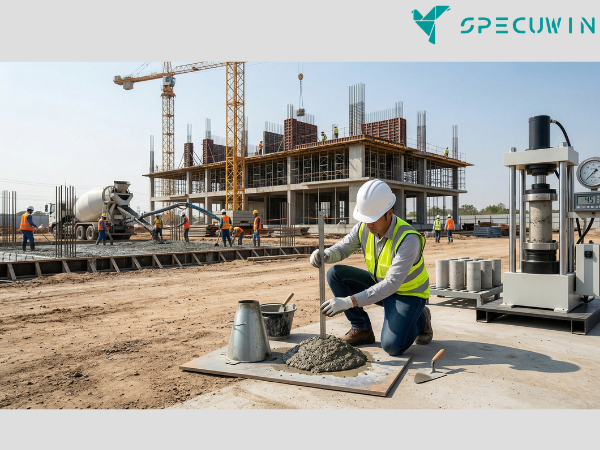
A metal cone (Abrams cone) is filled with fresh concrete in three layers, each tamped down with a steel rod. The cone is then lifted vertically, and the concrete “slumps” under gravity. The distance it falls from its original height is the “slump value.”
What it Tells You:-
The slump is a direct indicator of workability.
- High Slump: The concrete is very fluid. This is great for pumping into tight spaces with lots of rebar, but if the slump is too high, it usually means there is too much water.
- Low Slump: The concrete is stiff. It’s harder to work with, but often results in a stronger final product.
The Hidden Danger: The Water-Cement Ratio:
The primary reason we perform this concrete testing step is to monitor the water-cement ratio. If a crew adds too much water to make the concrete easier to pour, the particles of cement spread too far apart. As the water evaporates, it leaves behind microscopic voids (pores), which significantly weaken the structure.
Compressive Strength: The Ultimate Benchmark of Concrete Testing:-
While the slump test tells us about the concrete’s current state, the Compressive Strength Test tells us about its future. This is the “gold standard” of concrete testing.
The Cylinder Method:
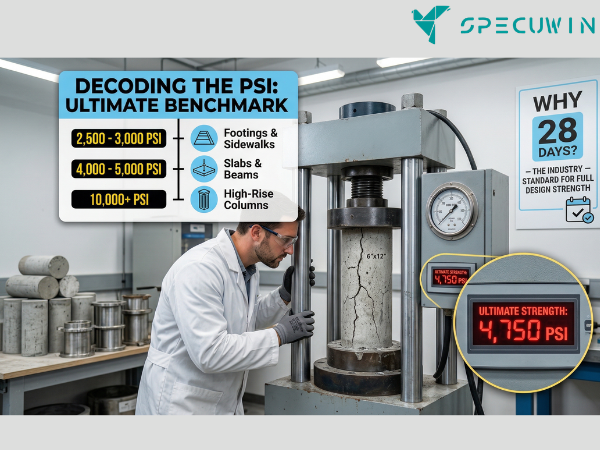
During the pour, samples are taken and placed into cylindrical molds (usually 6×12 inches or 4×8 inches). These cylinders are “cured” under controlled conditions and then placed into a hydraulic press at 7, 28, and sometimes 56 days. The machine applies pressure until the cylinder shatters.
Decoding the PSI:
Concrete strength is measured in Pounds per Square Inch (PSI).
- 2,500 – 3,000 PSI: Standard for residential footings or sidewalks.
- 4,000 – 5,000 PSI: Used for suspended slabs and heavy-duty beams.
- 10,000+ PSI: High-strength concrete for high-rise columns.
Why 28 Days?
In the world of concrete testing, 28 days is the industry standard for “full strength.” While concrete continues to harden for years, it typically reaches about 99% of its design strength by the 28th day.
The Relationship Between Slump and Strength:-
A common misconception in concrete testing is that a “bad” slump means “bad” strength. This isn’t always true.
Modern chemistry has introduced “superplasticizers.” These admixtures allow concrete to have a very high slump (flowing like water) without adding extra water. This is why a structural engineer’s oversight is vital; they can determine if a high slump is due to a “wet” mix (dangerous) or a “plasticized” mix (engineered).
Understanding these nuances is a key part of What the role of a structural engineer entails ensuring that the material science matches the architectural vision.
Field Variables: What Can Mess Up Your Results?
Even with strict concrete testing protocols, things can go wrong. Here are the most common culprits:
- Temperature: If it’s too hot, the water evaporates too quickly, leading to “flash set” and cracking.
- Curing: If the test cylinders aren’t kept moist and at a stable temperature, the test results will show a lower strength than what is actually in the building.
- Vibration: Failing to properly vibrate the concrete during placement can leave “honeycombs” (air pockets), making the concrete testing on cylinders irrelevant because the actual structure is full of holes.
This is why The importance of soil testing in structural engineering is often paired with concrete checks; you need a solid foundation and a solid material to ensure a building’s longevity.
Advanced Concrete Testing: Moving Beyond the Basics:-
As technology evolves, so does concrete testing. We are moving toward non-destructive methods that allow us to see inside the concrete without breaking it.
- Ultrasonic Pulse Velocity: Sending sound waves through the slab to find cracks.
- Rebound Hammer (Schmidt Hammer): A spring-loaded device that measures surface hardness.
- Maturity Sensors: Sensors embedded in the pour that provide real-time data on strength gain via a smartphone app.
These innovations are part of a broader shift in the industry, much like how BIM (Building Information Modeling) is transforming consultancy by allowing for better data integration from the field to the office.

Conclusion: Quality Control is Safety:-
At the end of the day, concrete testing isn’t just about checkboxes and paperwork. It’s about ensuring that the residents of a home or the employees in an office tower are safe.
If you are a property owner or a developer, never skip these tests to save a few dollars. Whether you are dealing with Top 10 structural issues in residential buildings or building the next Burj Khalifa, the data provided by slump and compressive strength tests is your only true guarantee of quality.
By respecting the science of the mix, we build structures that don’t just stand today, but endure for generations.
Frequently Asked Questions:-
1. Can I perform concrete testing myself for a home project?
A. While you can perform a basic slump test, compressive strength testing requires specialized hydraulic machinery and controlled curing environments. It is always best to hire a certified third-party lab for official results.
2. What happens if my concrete fails the 28-day strength test?
A. Don’t panic immediately. Usually, the engineer will request a “core test,” where a physical piece of the actual structure is drilled out and tested. If that also fails, the structure may need reinforcement or, in extreme cases, demolition.
3. Does the color of the concrete indicate its strength?
A. Not reliably. Color is mostly affected by the source of the aggregate (sand and stone) and the brand of cement. Strength can only be verified through proper concrete testing.
4. Why is the slump test done multiple times during a single pour?
A. Concrete consistency can change from the first truck to the last truck due to traffic delays, temperature changes, or variations at the batch plant. Regular testing ensures consistency across the entire project.
5. How does weather affect concrete testing results?
A. Extreme cold can freeze the water in the mix, stopping the chemical reaction (hydration) entirely. Extreme heat can cause the water to evaporate before it can react with the cement. Both scenarios require special adjustments to the testing and curing process.
Read More On:-
For more information about engineering, architecture, and the building & construction sector, go through the posts related to the same topic on the Specuwin Blog Page.
Find out more accurately what we are going to take off in the course of applying leading new technologies and urban design at Specuwin.