

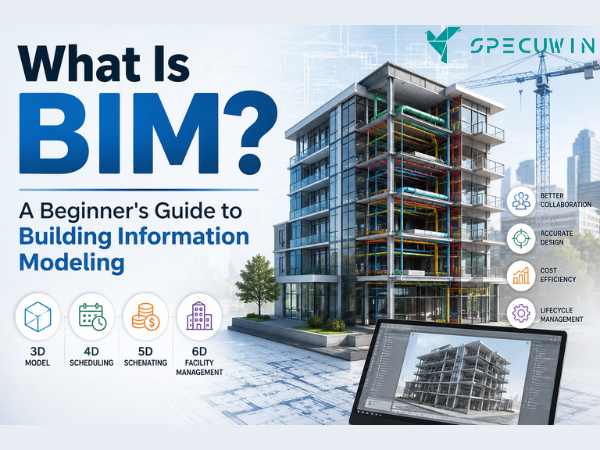
If you have worked in architecture, engineering, or construction, you have probably heard the term What is BIM. However, many people still confuse BIM with 3D modeling software. In reality, BIM is much more than creating three-dimensional models.
Building Information Modeling (BIM) is a collaborative process that helps architects, engineers, contractors, and owners plan, design, construct, and manage buildings more efficiently. Instead of working with disconnected drawings, every stakeholder uses a shared digital model that contains accurate project information.
As construction projects become larger and more complex, BIM helps reduce errors, improve collaboration, and save both time and money. This guide explains what BIM is, how it works, and why it has become an industry standard.
What Is BIM?
Building Information Modeling (BIM) is a digital process that creates and manages information about a building throughout its lifecycle. Unlike traditional CAD drawings, BIM models contain intelligent data as well as geometry.
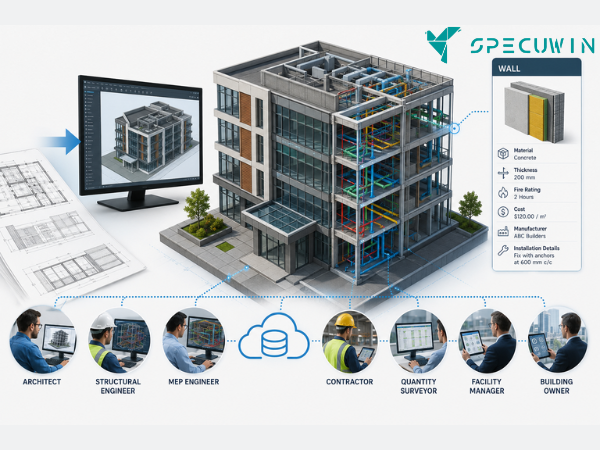
For example, a wall in a BIM model includes information such as:
- Material
- Thickness
- Fire rating
- Cost
- Manufacturer
- Installation details
As a result, every project participant works with the same reliable information.
How Does BIM Work?
A BIM project begins with creating a digital model. Different disciplines contribute their own information to the same coordinated model.
Typical BIM workflow includes:
| Stage | Purpose |
|---|---|
| Planning | Define project requirements |
| Design | Create architectural, structural, and MEP models |
| Coordination | Detect clashes between disciplines |
| Documentation | Generate drawings and schedules |
| Construction | Support site execution |
| Facility Management | Maintain the building after completion |
Therefore, everyone works from the latest project information instead of outdated drawings.
Why Is BIM Important?
Construction projects involve many stakeholders. Miscommunication often causes delays, design conflicts, and additional costs.
BIM solves these issues by improving collaboration.
Major benefits include:
- Better visualization
- Faster design changes
- Accurate quantity takeoffs
- Reduced rework
- Improved project coordination
- Lower construction costs
- Better scheduling
- Easier facility management
Moreover, BIM allows teams to identify problems before construction begins.
BIM vs Traditional CAD:-
Many people assume BIM simply replaces CAD. However, the two serve different purposes.
| CAD | BIM |
|---|---|
| Drawing-based | Information-based |
| 2D documentation | Intelligent 3D model |
| Separate files | Centralized model |
| Limited collaboration | Real-time collaboration |
| Manual updates | Automatic updates |
Consequently, BIM offers greater efficiency throughout the project lifecycle.
Who Uses BIM?
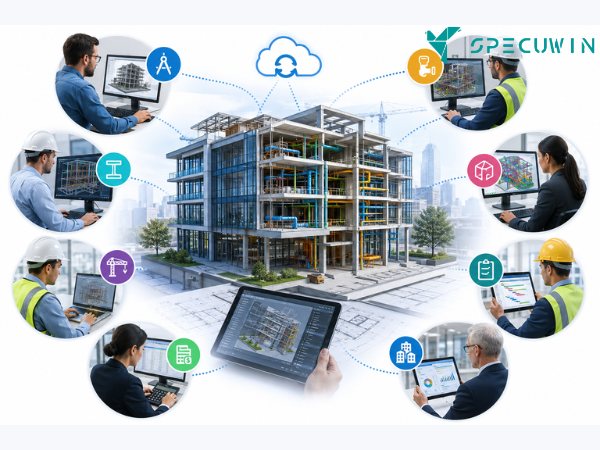
BIM benefits nearly every professional involved in construction.
Common users include:
- Architects
- Structural engineers
- MEP engineers
- BIM coordinators
- Contractors
- Quantity surveyors
- Facility managers
- Building owners
Because everyone works on shared information, project coordination becomes much easier.
Industries That Benefit from BIM:-
BIM is no longer limited to commercial buildings.
It supports projects such as:
- Residential developments
- Hospitals
- Airports
- Industrial facilities
- Educational campuses
- Rail infrastructure
- Bridges
- Smart cities
Furthermore, governments worldwide increasingly require BIM for public infrastructure projects.
Common Misconceptions About BIM:-
Many beginners misunderstand BIM. Here are a few common myths.
BIM is only 3D software
False. BIM is a complete information management process.
BIM is only for large companies
Small and medium-sized firms also benefit from BIM through better coordination and reduced errors.
BIM replaces engineers
No. BIM supports engineering decisions but does not replace professional expertise.
Frequently Asked Questions:-
1. What does BIM stand for?
A. BIM stands for Building Information Modeling.
2. Is BIM only used for design?
A. No. BIM supports planning, construction, operation, and facility management.
3. Which industries use BIM?
A. Architecture, structural engineering, infrastructure, manufacturing, and facility management all use BIM.
4. Is BIM better than CAD?
A. For collaborative construction projects, BIM provides more information and better coordination than traditional CAD.
Conclusion:-
Understanding What is BIM is the first step toward adopting a smarter construction workflow. BIM improves collaboration, minimizes errors, and provides reliable project information from design through operation.
Whether you are an architect, engineer, contractor, or project owner, BIM helps deliver projects more efficiently while improving quality. As digital construction continues to evolve, learning BIM is no longer optional it is becoming an essential skill for the future of the AEC industry.
Read More On:-
For more information about engineering, architecture, and the building & construction sector, go through the posts related to the same topic on the Specuwin Blog Page.
Find out more accurately what we are going to take off in the course of applying leading new technologies and urban design at Specuwin.