

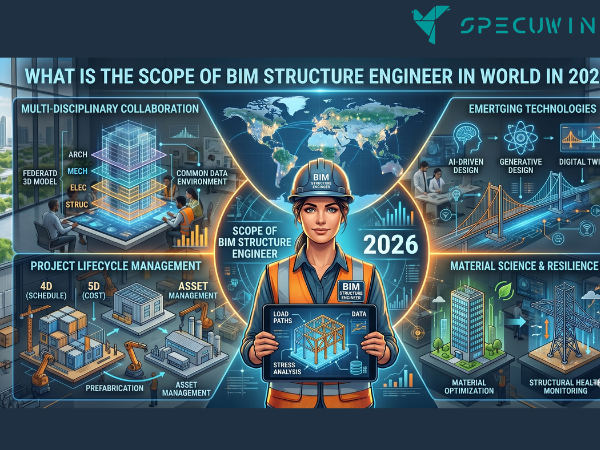
The construction landscape is no longer about just bricks, mortar, and 2D blueprints. As we move through 2026, the digital transformation of the AEC (Architecture, Engineering, and Construction) industry has reached a tipping point. At the heart of this revolution stands a specific professional: the structural expert who speaks the language of data. If you are looking into the professional horizon, understanding the BIM Structure Engineer in World today is essential for anyone aiming to build a resilient career.
Gone are the days when Building Information Modeling (BIM) was considered an “optional luxury” for high-budget projects. Today, it is the global standard. From the skyscrapers of Dubai to the infrastructure overhauls in North America and the rapid urban development in India, the integration of structural analysis with 3D intelligent modeling has redefined what it means to design safely and efficiently.

The Evolution and Role of a BIM Structure Engineer in World:-
To understand the scope, we must first look at the role. A BIM Structure Engineer in World is not merely a drafter or a traditional designer. They are data managers and coordinators. In 2026, their responsibility extends beyond ensuring a beam can carry a load; they ensure that every bolt, plate, and reinforcement bar is digitally accounted for in a collaborative environment.
The transition from CAD to BIM has been a journey of moving from lines to “objects.” When a structural engineer works within a BIM workflow, they are creating a “Digital Twin” of the building. This model contains parametric information—meaning if the depth of a slab changes, the connected columns, reinforcement schedules, and quantity take-offs update automatically. This level of synchronization is why the demand for this role has skyrocketed.
Global Demand: Where is the BIM Structure Engineer in World Most Needed?
The scope is truly international. However, certain regions are seeing an unprecedented surge in demand:
- Europe and the UK: With strict government mandates on BIM Level 2 and Level 3 compliance, the UK remains a hub for structural BIM experts.
- The Middle East: Countries like Saudi Arabia, through “Vision 2030” and mega-projects like NEOM, are seeking structural engineers who can handle massive scale and complexity using high-end BIM workflows.
- India and Southeast Asia: As infrastructure projects become more complex, there is a massive shift toward BIM for bridge design and metro rail projects. Understanding BIM in bridge design has become a niche yet highly lucrative sub-sector.
- North America: The focus here has shifted toward sustainable retrofitting and “smart” structures, where BIM data is used for the entire lifecycle of the building.
Technical Skills Defining the BIM Structure Engineer in World in 2026:-
If you want to excel as a BIM Structure Engineer in World, your toolkit must be diverse. It is no longer enough to know just one software.
1. Advanced Modeling and Analysis:
Proficiency in Autodesk Revit Structure remains the foundation. However, the modern engineer must integrate this with analytical software like Robot Structural Analysis, STAAD.Pro, or ETABS. The “Golden Thread” of 2026 is the seamless interoperability between the analytical model and the physical BIM model.
2. Generative Design and AI:
We are seeing a massive shift where AI acts as a co-designer. Using tools like Dynamo or Grasshopper, engineers can now run thousands of iterations to find the most weight-efficient or cost-effective structural layout. This Generative design in structural engineering is a key differentiator for top-tier professionals.
3. Automation through Scripting:
The ability to automate repetitive tasks such as placing thousands of rebars or checking for clashes is what separates a junior modeler from a high-level BIM Structure Engineer. Python and C# skills are becoming increasingly common in structural consultancies.

Why the Scope of BIM Structure Engineer in World is Expanding:-
Several factors are driving this expansion. First is the global push for sustainability. Structural engineers are responsible for the “embodied carbon” of a building the CO2 emitted during the production of steel and concrete. BIM allows for precise material tracking, helping engineers choose Sustainable structures and eco-friendly approaches that reduce waste.
Second is the rise of Pre-Engineered Buildings (PEB) and Modular Construction. These methods require extreme precision, as components are manufactured off-site and assembled like LEGO blocks. A BIM Structure Engineer in World is the only person capable of providing the millimetric accuracy required for these projects to succeed.
Career Pathways for a BIM Structure Engineer in World:-
The career ladder for this role is no longer a straight line; it’s a web of opportunities:
- BIM Structural Coordinator: Focusing on clash detection and multi-disciplinary coordination.
- Structural BIM Manager: Managing the standards, protocols, and execution plans for entire firms.
- Computational Design Specialist: Using algorithms to solve complex structural geometries.
- BIM Consultant: Helping firms through the Transition from CAD to BIM for enhanced project delivery.
Challenges Faced by the BIM Structure Engineer in World:-
Despite the bright scope, the role is not without its hurdles. The rapid pace of technology means that a “future-ready” engineer must be a lifelong learner. Data security is another rising concern. As models become more detailed and cloud-based, the role of cybersecurity in smart infrastructure becomes a peripheral but vital knowledge area for engineers handling sensitive project data.
Additionally, the “Human Element” remains irreplaceable. While AI can optimize a beam, it cannot negotiate with a contractor or understand the cultural nuances of a site in a different country. The future belongs to the “Hybrid Engineer” one who is technically brilliant but also an expert communicator.
Salary Trends and Economic Outlook:-
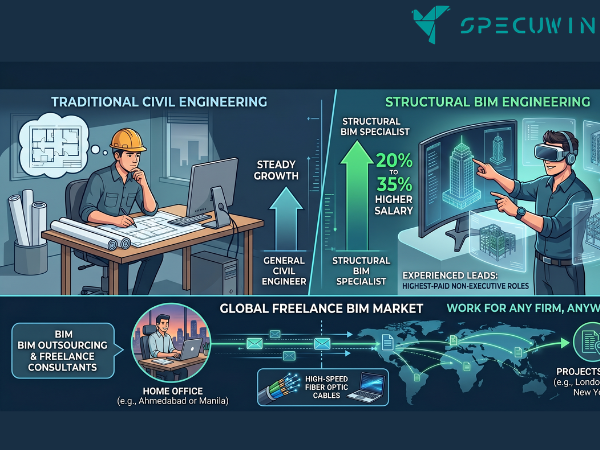
In 2026, the specialized nature of structural BIM work commands a premium. While general civil engineers see steady growth, those with “BIM” in their title often see salaries 20% to 35% higher than their traditional counterparts. In developed markets, experienced BIM structural leads are among the highest-paid non-executive roles in construction firms.
Moreover, the rise of BIM outsourcing has created a massive market for freelance structural consultants. A BIM Structure Engineer in World can now work for a firm in London while sitting in a home office in Ahmedabad or Manila, provided they have the right hardware and a high-speed connection.
Conclusion: Is it the Right Path for You?
The scope of a BIM Structure Engineer in World in 2026 is virtually limitless. We are building faster, higher, and greener than ever before, and none of that is possible without the digital backbone provided by BIM.
If you are a student or a working professional, the message is clear: the industry is moving, with or without you. Investing in BIM training is no longer just a career move; it is a “future-proofing” necessity. The world needs engineers who can bridge the gap between physical reality and digital precision.
FAQ’s:-
1. Is BIM only for large-scale structural projects?
A. No. While it started with mega-projects, BIM is now widely used in residential and commercial projects to prevent costly on-site errors and to provide clients with accurate structural reports.
2. What is the best software to start with as a BIM Structure Engineer?
A. Autodesk Revit is the industry standard for modeling. For analysis, learning ETABS or Tekla Structures (specifically for steel) is highly recommended for a well-rounded profile.
3. Does BIM replace the need for traditional structural calculations?
A. Absolutely not. BIM is a tool for coordination and visualization. The fundamental physics and engineering principles still require a human engineer to verify and sign off on the safety of the design.
4. Can I transition from a traditional Structural Engineer to a BIM role?
A. Yes, and it is a very common transition. Most engineers start by taking a professional BIM course and gradually implementing BIM workflows into their existing design processes.
5. How does BIM help in seismic retrofitting?
A. BIM allows engineers to create a precise model of an existing “as-built” structure. They can then simulate earthquake forces on this digital model to see exactly where reinforcements are needed, making seismic retrofitting much more accurate.
Read More On:-
For more information about engineering, architecture, and the building & construction sector, go through the posts related to the same topic on the Specuwin Blog Page.
Find out more accurately what we are going to take off in the course of applying leading new technologies and urban design at Specuwin.