


Let’s be entirely honest for a moment. Nobody wakes up thrilled to spend money hiring a structural consultant. You’d much rather splurge that portion of your hard-earned budget on gorgeous Italian marble, a sprawling modular kitchen, or panoramic floor-to-ceiling windows. But physics is a stubborn, unforgiving beast. If you skip out on professional structural engineering & structural consultancy, those beautiful windows might just buckle under the weight of a sagging roof.
I still vividly remember a frantic call I received at two in the morning a few years back. It was a panicked local developer who had tried to cut corners on a commercial project by using generic plans he found online. He called me because his freshly poured concrete third-story slab was literally starting to bow downward. He was terrified the whole thing was going to come crashing down.
I had to drag myself out of bed, drive out to the pitch-black site with a flashlight, and figure out a structural triage plan on the fly. It was a complete nightmare for him, and honestly, a massive headache for me. That entire mess could have been avoided if he had just brought in a proper team for a comprehensive structural consultancy right from the very start.
Why Cheap Plans End Up Costing a Fortune:-
People frequently ask me why they can’t just copy a neighbor’s blueprint. It looks sturdy enough, right? Wrong.
Every single plot of land possesses completely unique soil characteristics. For instance, building a foundation on the notorious Black cotton soil found in parts of India requires an entirely different engineering approach than anchoring a structure into solid rock or shifting coastal sand. If you try to skimp out here, you are playing Russian roulette with your property.
The Reality Check: Opting for unlicensed or recycled blueprints is a recipe for disaster that will almost certainly return to haunt your wallet.
When you pay for professional structural consultancy, you aren’t just buying lines on a piece of paper. You are paying for rigorous mathematics, deep material science, and legal accountability. Advanced computational tools allow us to run thousands of design iterations. This ensures your columns are perfectly sized—neither dangerously thin nor ridiculously over-engineered.
The True ROI of Structural Consultancy:-
Let’s look at the hard data. Many developers mistakenly believe that engineers just love to add unnecessary steel to boost safety margins. However, the exact opposite is true.
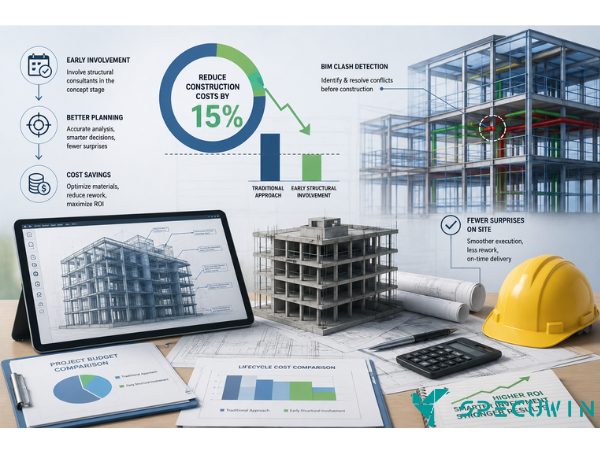
By involving a consultant during the earliest concept phases, you can learn How early structural involvement can slash construction costs by 15%. We utilize advanced 3D building information modeling to catch design conflicts long before a single drop of concrete is poured on-site. This proactive coordination prevents chaotic, costly changes later on. This proactive coordination prevents chaotic, costly changes later on.
Navigating Modern Building Challenges:-
The construction landscape is shifting rapidly. We are no longer just designing basic concrete boxes. Today, structural consultancy involves implementing base isolation techniques for earthquake zones and utilizing Scan-to-BIM technology to safely restore ancient heritage structures.
Waterproofing is another critical area where projects frequently fail. Poor moisture protection isn’t just an ugly cosmetic issue; it is a direct structural threat that actively corrodes internal rebar and cuts your building’s lifespan right in half.
Investing in high-quality engineering right from the start is the only way to ensure your project stands strong for decades to come. Don’t learn that lesson the hard way at two o’clock in the morning.
Frequently Asked Questions:-
1. What does a structural consultant actually do?
A. We design the invisible skeleton of your building. While architects focus heavily on the spatial layout, aesthetics, and overall functionality, our job is to ensure the building can successfully withstand all internal and external forces. This includes managing dead loads, live loads, high winds, and seismic activity.
2. Can I remove an interior wall to create an open-plan layout?
A. Do not touch that sledgehammer yet. You absolutely must determine if the wall is load-bearing or non-load-bearing before making any alterations. Knocking down a structural wall without installing a properly engineered replacement beam can cause your ceiling to sag or collapse entirely.
3. Why are the concrete columns in my building so large?
A. Column sizes are determined by precise mathematical equations based on the total weight they must support. If you are planning a vertical expansion to add an extra floor down the line, your columns and foundations must be specifically engineered for those future loads right from day one.
4. Is more steel in a concrete structure always better?
A. This is a massive myth. Over-reinforcing concrete with excessive steel actually makes the element brittle. Perfectly balanced design ensures that if failure ever occurs, it happens gradually rather than instantly, giving occupants plenty of time to safely evacuate.
5. How do I choose the right structural engineering partner?
A. Look far beyond the lowest bid. Check their specific track record with your project type, verify that they carry proper professional licenses, and ask if they utilize modern workflows like Revit and Navisworks for seamless coordination.
Read More On:-
For more information about engineering, architecture, and the building & construction sector, go through the posts related to the same topic on the Specuwin Blog Page.
Find out more accurately what we are going to take off in the course of applying leading new technologies and urban design at Specuwin.