

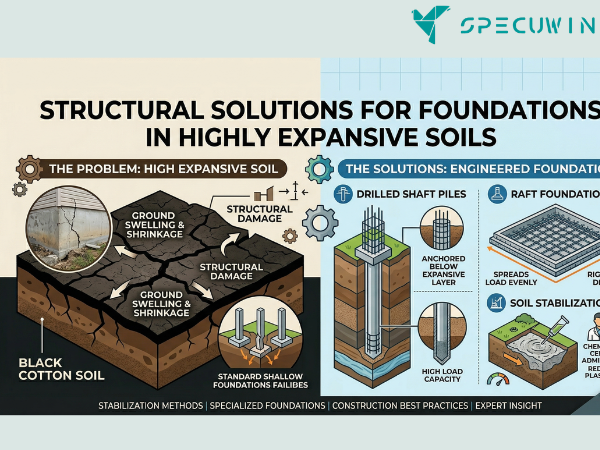
Building a dream structure is often a journey of overcoming natural hurdles, but few challenges are as formidable as the Black Cotton soil challenge. Known in the engineering world as “expansive soil,” Black Cotton soil is a literal moving target. It breathes with the seasons—swelling when it drinks and shrinking when it thirsts creating a volatile environment that can snap concrete and shift entire buildings if not handled with surgical precision.
For developers, architects, and homeowners, understanding the Black Cotton soil challenge isn’t just about technical compliance; it’s about ensuring the longevity and safety of an investment. In this deep dive, we will explore why this soil behaves the way it does and the sophisticated structural solutions that allow modern engineering to conquer these tricky terrains.
Understanding the Black Cotton Soil Challenge:-
Before we can solve the problem, we must understand the “enemy.” Black Cotton soil, prevalent in many parts of India and Africa, is rich in a mineral called montmorillonite. This mineral has a high affinity for water. When it rains, the soil can increase in volume by up to 30% or more. Conversely, during dry summers, it loses that moisture and develops deep, wide fissures.
This cycle of heave (lifting) and settlement (sinking) exerts massive upward and downward pressure on foundations. Standard footings, which work perfectly fine on stable red soil or rocky terrain, are often insufficient here. This is exactly why the Black Cotton soil challenge requires specialized foundation design.
Why Conventional Foundations Fail the Black Cotton Soil Challenge:-
Most residential buildings use “open footings” or “isolated footings.” In stable ground, these footings distribute the weight of the building safely. However, when placed in expansive soil, these footings move independently. As one corner of the house heaves and the other settles, the rigid masonry walls cannot cope with the stress, leading to the dreaded diagonal cracks that signal structural distress.
To navigate the Black Cotton soil challenge, engineers must look deeper literally. The goal is to bypass the “active zone” (the top layer of soil that changes volume) and transfer the building’s load to stable strata below.
Structural Solutions to the Black Cotton Soil Challenge:-
Modern structural engineering offers several robust methods to counteract soil movement. Let’s look at the primary weapons in an engineer’s arsenal:
1. Under-Reamed Piles: The Gold Standard:
Perhaps the most effective way to meet the Black Cotton soil challenge is the use of under-reamed piles. These are bored cast-in-situ concrete piles with a “bulb” or “flare” at the bottom.
- The Anchor Effect: The bulb is anchored deep below the active zone (usually 3.5 to 6 meters deep), where moisture content remains constant.
- Resisting Uplift: When the top soil swells and tries to pull the pile upward, the bulb acts as an anchor, holding the structure firmly in place.
2. Mat or Raft Foundations:
For larger structures, a raft foundation is a popular way to address the Black Cotton soil challenge. Instead of individual footings, the entire building sits on a single, thick “mat” of reinforced concrete.
- Unified Movement: If the soil moves, the entire mat moves as a single unit, preventing the differential settlement that causes cracking.
- Pressure Distribution: It spreads the load over a wider area, reducing the pressure exerted on any single point of the expansive soil.
3. Sand Cushioning and Soil Replacement:
Sometimes, the best way to handle the Black Cotton soil challenge is to remove the problem entirely. Engineers may excavate the expansive soil to a certain depth and replace it with a “sand cushion” or non-expansive cohesive soil. This layer acts as a buffer, absorbing the swelling pressure before it reaches the foundation.
Read more on:- The importance of soil testing in structural engineering
The Role of Site Investigation in the Black Cotton Soil Challenge:-
You cannot fight what you cannot measure. A comprehensive geotechnical report is the first step in any project. Soil testing identifies the “swelling index” and the depth of the active zone. Without this data, any structural solution is merely a guess. Professional engineers rely heavily on these reports to determine whether a simple sand layer will suffice or if a complex system of grade beams and piles is necessary.
Read more on:- How to choose the right structural engineer for your project
Preventive Measures: Beyond the Foundation:-
While the foundation is the heart of the solution, the Black Cotton soil challenge also demands smart site management.
- Proper Drainage: Ensuring water flows away from the building is critical. Stagnant water near the foundation is a recipe for disaster.
- Plinth Protection: A wide concrete apron around the building prevents surface water from seeping directly into the soil under the footings.
- Vegetation Control: Large trees with high water demands should not be planted too close to the structure, as their roots can exacerbate soil shrinkage during dry periods.
Conclusion:-
Building on expansive soil doesn’t have to be a nightmare. While the Black Cotton soil challenge presents unique risks, the evolution of structural engineering provides us with the tools to build safely and permanently. By choosing the right foundation type whether it’s under-reamed piles or a well-engineered raft and ensuring professional oversight, we can turn a geological hurdle into a stable base for the future.
Read more on:- What is the role of a structural engineer
Frequently Asked Questions:-
1. How do I know if I’m dealing with the Black Cotton soil challenge on my plot?
A. Look for deep cracks in the ground during summer. The soil will also feel extremely sticky and “plastic” when wet. However, the only certain way is to conduct a professional soil test.
2. Is it more expensive to build on Black Cotton soil?
A. Yes, typically. Addressing the Black Cotton soil challenge requires deeper excavation, specialized piling, or extra reinforcement, which can increase foundation costs by 20% to 50% compared to stable ground.
3. Can I use a regular strip foundation for a small house?
A. It is highly discouraged. Even small structures are susceptible to the Black Cotton soil challenge. Without proper anchoring, even a compound wall can tilt or crack over time.
4. What is the “active zone” in soil?
A. The active zone is the upper layer of soil where moisture levels fluctuate due to weather. In the context of the Black Cotton soil challenge, this is the layer that does all the moving and must be bypassed by the foundation.
5. Are cracks in my existing house on Black Cotton soil fixable?
A. Minor cracks can be repaired, but if the foundation is moving, the cracks will return. Structural “underpinning” can sometimes stabilize the building, but it is much easier to solve the problem during the initial construction.
Read More On:-
For more information about engineering, architecture, and the building & construction sector, go through the posts related to the same topic on the Specuwin Blog Page.
Find out more accurately what we are going to take off in the course of applying leading new technologies and urban design at Specuwin.