


Architects draw beautiful visions. We make sure they don’t collapse into expensive piles of rubble. If you’ve ever looked at a soaring skyscraper or a clean, cantilevered residential home and thought, “How on earth is that staying up?” welcome to the chaotic, brilliant world of the Structural Design Process. It is a high-stakes puzzle where physics meets budgeting, and quite frankly, it’s why most structural engineers look perpetually exhausted.
Just last Tuesday, I found myself sitting at my desk at 2:00 AM, staring at a jagged line on my dual monitors. A frantic developer had sent over a “minor” late-stage layout change. They wanted to knock out a vital ground-floor column to create an open-concept lobby. My coffee was ice-cold. My eyes were burning. I had to completely re-run our non-linear simulation models to shift that massive load safely to adjacent shear walls. That sleepless night wasn’t an anomaly; it is a standard glimpse into the real-world grit required to push a project from a sketchy napkin drawing to a fully stamped, structurally sound reality.
Step 1: The Concept Phase (Where the Wrangling Begins):-
Every project kicks off with raw architectural ideas. Architects focus intensely on aesthetics, spatial flow, and natural light. Our job during the initial Structural Design Process is to ground those dreams in reality.
We look at the bones. We ask basic questions:
- Will this be steel?
- Will it be reinforced concrete?
- Is mass timber an option?
We also evaluate what the earth beneath us can actually support. You cannot design a building without understanding the soil beneath it. If you are building on the notorious Black cotton soil found across parts of India, your foundation strategy will look radically different than if you are anchoring into solid bedrock. Early collaboration right here can save massive headaches later. Honestly, getting your structural consultant involved early can slash overall construction costs by up to 15%.
Step 2: Load Calculations (The Heavy Math):-
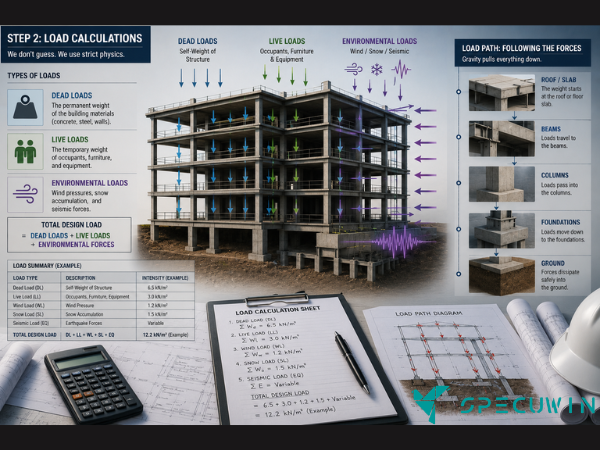
Once the structural scheme is set, we calculate loads. We don’t guess. We use strict physics.
Structures must withstand several distinct types of forces:
- Dead Loads: The permanent weight of the building materials (concrete, steel, walls).
- Live Loads: The temporary weight of occupants, furniture, and equipment.
- Environmental Loads: Wind pressures, snow accumulation, and seismic forces.
Total Design Load = Dead Loads + Live Loads + Environmental Forces
We map how these forces travel. The path must be seamless. Gravity pulls everything down. The weight of the roof travels to the beams, passes into the columns, moves down to the foundations, and safely dissipates into the ground. If you miss a single link in this chain, gravity wins.
Step 3: Detailed Analysis and Deep Modeling:-
Next comes the heavy digital lifting. The days of relying solely on basic 2D drafts are completely dead. Today, the shift from 2D to 3D means AutoCAD is no longer enough for complex structures. We build incredibly sophisticated digital twins.
We use advanced finite element analysis software to simulate reality. We subject our virtual building to simulated hurricanes and massive earthquakes. We test how the building handles movement because Buildings must move to stay safe. If a structure is too rigid, it snaps under pressure.
We check for clashes here too. There is nothing worse than discovering on-site that a massive structural steel beam is blocking a major HVAC duct. Using intelligent software platforms allows for seamless clash detection before any concrete is ever poured on the job site.
Step 4: Construction Documentation (The Source of Truth):-
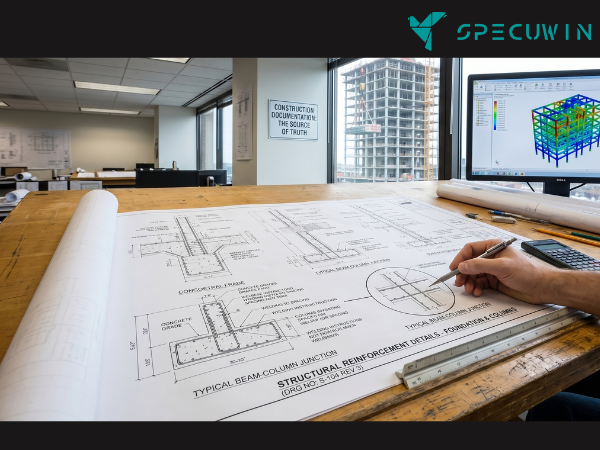
An analysis model on a computer screen cannot build a real-world tower. Contractors need clear blueprints. This phase transforms our complex calculations into precise, actionable engineering drawings.
Every single detail matters. We specify exact concrete grades, precise rebar spacing, and explicit welding instructions. Skimping here is a recipe for disaster. Opting for Cheap structural drawings often results in massive confusion, dangerous on-site delays, and catastrophic structural failures. The drawings must explicitly state the exact, because missing a few millimeters can cut a building’s lifespan squarely in half.
Step 5: Construction Administration (The Final Frontier):-
Our job does not end when we hand over the blueprints. The final phase of the Structural Design Process happens right out in the mud, dust, and chaos of the active construction site.
We perform critical site inspections. We verify that the field crew places the steel reinforcement exactly as drawn. We check the formwork. We review concrete slump tests and compressional strength reports to make sure the mix matches our exact design specifications. When unexpected site issues pop up and they always do we are the ones who figure out how to solve them safely without compromising the building’s integrity. It is an exhausting process, but watching a complex design safely rise out of the ground makes every single sleepless night worth it.
Frequently Asked Questions:-
1. What are the main stages of the Structural Design Process?
A. The process consists of five primary phases: initial conceptual design, rigorous load evaluation, detailed computer analysis, structural drafting, and on-site construction administration.
2. Why is soil testing critical before starting structural designs?
A. Soil dictates your foundation strategy. Different soil profiles, like highly expansive clay or loose sand, handle loads differently and require specific engineering solutions to prevent dangerous building settlement.
3. Can an architect complete the structural design of a building?
A. No. Architects design the spatial layouts, form, and aesthetics. Licensed structural engineers must calculate the internal physics, specify structural materials, and ensure the building safely resists all applied forces.
4. What is the difference between dead loads and live loads?
A. Dead loads represent the permanent, static weight of the building’s own structure and fixed components. Live loads encompass transient, temporary forces like people, furniture, vehicles, and stored goods.
5. How does 3D modeling improve the design process?
A. 3D modeling allows engineers to run complex behavioral simulations, visualize load paths clearly, and detect spatial clashes with mechanical, electrical, and plumbing systems before construction begins.
Read More On:-
For more information about engineering, architecture, and the building & construction sector, go through the posts related to the same topic on the Specuwin Blog Page.
Find out more accurately what we are going to take off in the course of applying leading new technologies and urban design at Specuwin.