

Building Information Modeling (BIM) has transformed the Architecture, Engineering, and Construction (AEC) industry by improving collaboration, reducing design errors, and enhancing project efficiency. Governments and private organizations worldwide are increasingly mandating BIM for public infrastructure and commercial projects because of its proven ability to streamline project delivery.
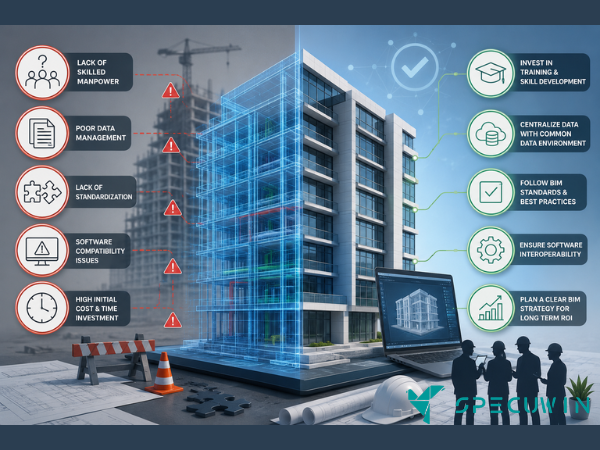
However, adopting BIM is not simply about purchasing software like Autodesk Revit or Navisworks. It requires changes in workflows, company culture, staff skills, and project management practices. Many firms underestimate this transition and face several BIM Implementation Challenges that delay adoption and reduce the return on investment.
According to industry reports, organizations using BIM effectively can reduce project rework by up to 25%, improve design coordination by nearly 40%, and shorten project delivery schedules by 10–15%. These benefits are only achievable when implementation challenges are identified and addressed early.
In this article, we’ll explore the most common BIM Implementation Challenges and provide practical solutions to help organizations successfully adopt BIM.
Why BIM Implementation Can Be Challenging:-
Unlike traditional CAD workflows, BIM is a collaborative process that integrates people, technology, and data into a single digital environment.
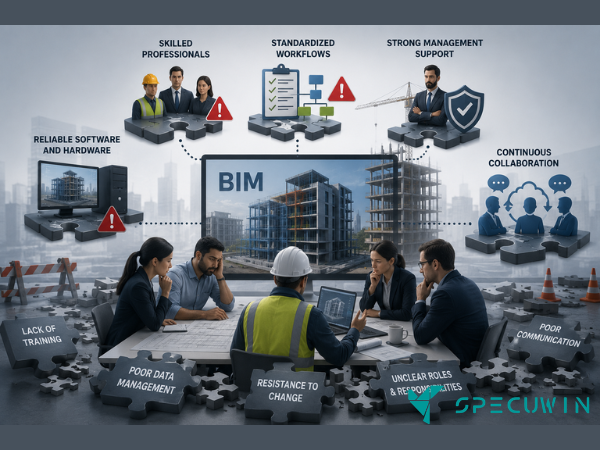
Successful BIM implementation depends on:
- Skilled professionals
- Standardized workflows
- Strong management support
- Reliable software and hardware
- Continuous collaboration
When any of these elements are missing, implementation becomes significantly more difficult.
1. Resistance to Change:-
One of the biggest BIM Implementation Challenges is employee resistance.
Many architects, engineers, and contractors have spent years using traditional CAD software. Transitioning to BIM often requires learning new software, adopting new workflows, and changing established work habits.
Common concerns include:
- Fear of new technology
- Temporary reduction in productivity
- Additional training requirements
- Uncertainty about new responsibilities
How to Overcome It:
Organizations should:
- Communicate the long-term benefits of BIM.
- Involve employees in the implementation process.
- Provide practical training sessions.
- Start with pilot projects before full implementation.
Building confidence among employees significantly improves BIM adoption.
2. Lack of Skilled BIM Professionals:-
The demand for BIM specialists continues to increase across the construction industry.
Many companies struggle to recruit professionals with expertise in:
- BIM Modeling
- BIM Coordination
- Clash Detection
- BIM Management
- Digital Construction
This shortage can lead to poor-quality models and inefficient workflows.
How to Overcome It
To close the skills gap:
- Invest in employee training.
- Encourage professional BIM certifications.
- Hire experienced BIM consultants during the transition.
- Develop internal mentoring programs.
Continuous learning is essential because BIM technologies evolve rapidly.
3. High Initial Investment
Implementing BIM requires investment in:
- Software licenses
- High-performance computers
- Staff training
- Cloud collaboration platforms
- Process development
For smaller organizations, these costs may appear overwhelming.
How to Overcome It:
Companies can reduce financial pressure by:
- Implementing BIM gradually.
- Using subscription-based software.
- Starting with high-value projects.
- Measuring savings from reduced rework and better coordination.
Most organizations recover implementation costs through improved project efficiency over time.
4. Poor Collaboration Between Project Teams:-
BIM depends on effective collaboration between architects, structural engineers, MEP consultants, contractors, and project managers.
Without clear communication, teams often experience:
- Duplicate work
- Version conflicts
- Miscommunication
- Design inconsistencies
How to Overcome It:
Improve collaboration by:
- Establishing a Common Data Environment (CDE).
- Creating a BIM Execution Plan (BEP).
- Holding regular coordination meetings.
- Defining clear responsibilities for every discipline.
Effective collaboration reduces errors before construction begins.
5. Inconsistent BIM Standards:-
Different project teams may follow different modeling practices, creating inconsistencies.
Common issues include:
- Different naming conventions
- Incorrect object classification
- Inconsistent Levels of Development (LOD)
- Misaligned coordinate systems
These inconsistencies make model coordination difficult.
How to Overcome It:
Organizations should:
- Adopt ISO 19650 standards.
- Create internal BIM standards.
- Standardize file naming conventions.
- Perform regular quality reviews.
Consistency improves model accuracy and project coordination.
6. Data Management Challenges:-
BIM projects generate enormous amounts of digital information.
Without proper management, organizations face:
- Duplicate files
- Outdated models
- Missing project information
- Poor document control
How to Overcome It:
Successful organizations:
- Use a centralized Common Data Environment.
- Implement version control.
- Define approval workflows.
- Assign dedicated data managers.
Well-managed project data improves collaboration and reduces costly mistakes.
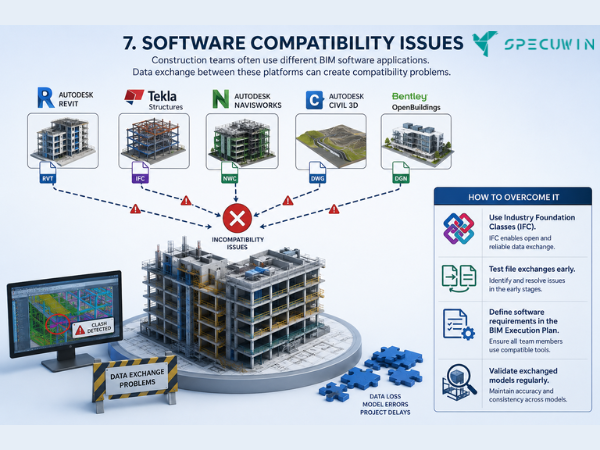
7. Software Compatibility Issues:-
Construction teams often use different BIM software applications.
Examples include:
- Autodesk Revit
- Tekla Structures
- Navisworks
- Civil 3D
- Bentley OpenBuildings
Data exchange between these platforms can create compatibility problems.
How to Overcome It:
Organizations should:
- Use Industry Foundation Classes (IFC).
- Test file exchanges early.
- Define software requirements in the BIM Execution Plan.
- Validate exchanged models regularly.
Early interoperability testing prevents coordination issues later.
8. Unrealistic Expectations:-
Some organizations expect BIM to deliver immediate results after implementation.
In reality, BIM adoption requires:
- Training
- Process improvements
- Workflow adjustments
- Continuous learning
How to Overcome It
Set realistic expectations by:
- Creating measurable implementation goals.
- Monitoring progress regularly.
- Improving processes continuously.
- Celebrating incremental successes.
Successful BIM implementation is a long-term investment rather than a one-time software purchase.
Industry Statistics Supporting BIM Adoption:-
The benefits of overcoming BIM Implementation Challenges are supported by industry research.
| Performance Indicator | Typical Improvement |
|---|---|
| Design Clash Reduction | Up to 40% |
| Construction Rework | Reduced by 25% |
| Project Delivery Time | Improved by 10–15% |
| Quantity Estimation Accuracy | Increased by 20–30% |
| Team Collaboration | Significantly Improved |
These improvements explain why BIM continues to become the preferred project delivery method worldwide.
Frequently Asked Questions:-
1. What are the biggest BIM Implementation Challenges?
A. The most common challenges include resistance to change, lack of skilled professionals, high implementation costs, poor collaboration, inconsistent standards, data management issues, software compatibility, and unrealistic expectations.
2. Why do companies struggle with BIM implementation?
A. Many organizations focus only on software while overlooking training, standardized workflows, and organizational change management.
3. Can small companies successfully implement BIM?
A. Yes. Small firms can adopt BIM gradually by starting with pilot projects, investing in employee training, and using subscription-based software solutions.
4. How can organizations improve BIM adoption?
A. Organizations should develop a BIM strategy, establish clear standards, invest in continuous training, and encourage collaboration across all project disciplines.
Conclusion:-
Although organizations face several BIM Implementation Challenges, these obstacles are entirely manageable with the right strategy. Successful BIM adoption requires more than advanced software it demands skilled professionals, standardized workflows, effective collaboration, and strong leadership.
By addressing challenges such as employee resistance, training gaps, data management, software interoperability, and inconsistent standards, organizations can unlock BIM’s full potential. The result is better project coordination, fewer construction errors, lower costs, and improved building lifecycle management.
As digital construction continues to evolve, firms that invest in overcoming BIM implementation challenges will be well-positioned to deliver smarter, more efficient, and higher-quality projects.
Read More On:-
For more information about engineering, architecture, and the building & construction sector, go through the posts related to the same topic on the Specuwin Blog Page.
Find out more accurately what we are going to take off in the course of applying leading new technologies and urban design at Specuwin.