

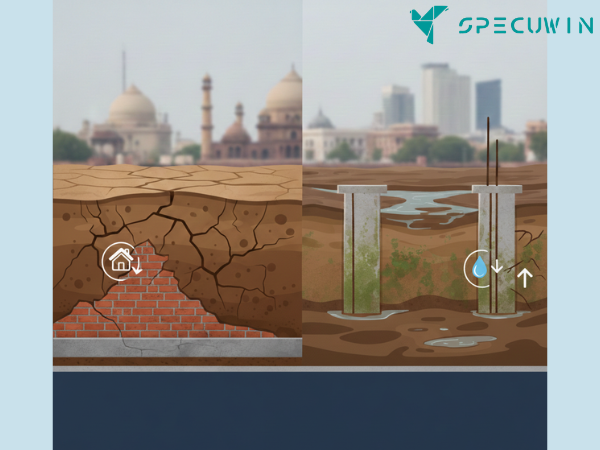
Building a home or a high-rise in India’s capital is a unique challenge that goes far beyond just architectural design. Delhi sits on a complex geological mix of river alluvium, rocky ridges, and shifting sands. For any builder or homeowner, understanding the ground beneath your feet is the first step to ensuring a long-lasting structure. This guide explores the most critical Soil Issues affecting foundations in Delhi and how you can navigate them.
Initial Research: Start by understanding the fundamentals of your build in What is structural engineering.

1. The Core Soil Issues in Delhi’s Diverse Terrain:-
Delhi is not geologically uniform. Depending on where you build, the Soil Issues you face can vary from rock-hard stability to swamp-like softness. The city is generally divided into three zones:
- The Yamuna Floodplains: Areas like Okhla, Wazirabad, and Mayur Vihar deal with “squishy” alluvial soil. These soils have low bearing capacity and are prone to liquefaction during earthquakes.
- The Ridge Area: Parts of South and Central Delhi (like Mehrauli or Greater Kailash) sit on the Delhi Quartzite ridge. Here, the Soil Issues involve hard rock excavation, which is expensive and requires specialized machinery.
- Older Alluvial Plains: Regions like Najafgarh or Rohini feature a mix of sand, silt, and clay. These areas often face Soil Issues related to varying moisture levels.
2. High Water Table and Soil Issues in East Delhi:-
If you are building near the river, the water table is your biggest adversary. A high water table reduces the effective stress of the soil, significantly lowering its bearing capacity.
Common Soil Issues in these water-logged zones include:
- Foundation Upheaval: As soil becomes saturated, it can push the foundation upward.
- Dampness and Seepage: Water can seep through micro-cracks, leading to rusted reinforcement bars (rebars) and weakened concrete.
- De-watering Costs: During construction, you’ll likely need to pump out water continuously, which adds a hefty margin to your budget.
3. Settlement and Soil Issues in Reclaimed Lands:-
Much of Delhi’s expansion has happened on “filled” or reclaimed land. One of the most silent yet destructive Soil Issues here is Differential Settlement.
When a building is constructed on loose fill, one corner might sink faster than the others. This creates massive structural stress, leading to:
- Diagonal cracks in walls.
- Doors and windows that no longer latch or stick in their frames.
- Sloping floors that can be felt while walking.
4. Seismic Vulnerability and Soil Issues:-
Delhi falls under Seismic Zone IV, making it a high-risk area for earthquakes. The Soil Issues here are compounded because loose, sandy soils (common in North and East Delhi) can undergo liquefaction. During a quake, the soil behaves like a liquid, causing buildings to tilt or sink suddenly. To counter these Soil Issues, engineers often recommend Raft Foundations or Pile Foundations to ensure the building stays anchored even when the topsoil loses its grip.
Don’t DIY your foundation; learn why a specialist is vital in How to choose the right structural engineer for your project.
5. Mitigating Soil Issues: The Importance of Geotechnical Reports:-
Before you pour a single drop of concrete, you must conduct a professional soil test. Ignoring Soil Issues at the start can lead to repair costs that are ten times the price of a proper foundation.
A standard report will identify:
- Net Bearing Capacity: How much load the ground can actually take.
- Soil Stratigraphy: The layers of sand, clay, or rock beneath.
- Chemical Analysis: Checking for sulfates or chlorides that might eat away at your concrete.

6. The Impact of Silt and Clay: Seasonal:-
In many parts of North and West Delhi, the soil contains a high percentage of silt and expansive clay. These materials are notorious for “breathing” expanding when they absorb monsoon rains and shrinking during the blistering summer heat.
These Soil Issues can lead to:
- Cyclical Stress: Constant expansion and contraction put immense pressure on foundation footings.
- Interior Damage: You might notice tiles popping up or interior walls developing cracks that seem to “heal” and then reappear with the seasons.
- Mitigation: Engineers often suggest replacing the top layer of expansive soil with compacted sand or using under-reamed piles to anchor the building into more stable strata.
7. Understanding the “Bearing Capacity”:-
The term “Bearing Capacity” refers to the maximum load the soil can support without failing or settling excessively. In Delhi, this capacity fluctuates wildly.
Common Soil Issues related to bearing capacity include:
- Overloading: Attempting to build a four-story structure on soil only capable of supporting two.
- Unpredictable Silt Pockets: Even on a single plot, one corner might have firm soil while the other sits on a soft pocket of silt.
- The Fix: This is why professional structural analysis is non-negotiable. An expert can determine if your land requires a simple spread footing or a more complex mat foundation.
8. Identifying Soil Issues Through Site Observations:-
While a lab test is essential, there are early warning signs of Soil Issues you can spot just by walking the site:
- Standing Water: If puddles remain long after a rainstorm, the soil has poor drainage, indicating high clay content or a high water table.
- Neighboring Structures: Look at older buildings nearby. Do they have leaning balconies or visible cracks? These are often “community-wide” indicators of unstable ground.
- Vegetation: Certain types of lush, water-loving weeds can signal a shallow water table that will need to be managed during excavation.
If you are moving into an existing building, check for Common structural problems in old houses and how to fix them.

9. Leveraging Technology to Solve Soil Issues:-
Modern construction in India is rapidly evolving. We no longer rely on guesswork to handle Soil Issues. From 3D ground modeling to Building Information Modeling (BIM), technology allows us to “see” underground.
- Digital Mapping: Engineers use software to simulate how a building will settle over 20 years based on soil data.
- Smart Foundations: In high-risk areas of Delhi, sensors can be embedded in the foundation to monitor shifts in real-time.
- Resource: Understanding how these digital tools integrate with structural design can be found in The role of technology in structural analysis and design.
Read More On:-
For more information about engineering, architecture, and the building & construction sector, go through the posts related to the same topic on the Specuwin Blog Page.
Find out more accurately what we are going to take off in the course of applying leading new technologies and urban design at Specuwin.