

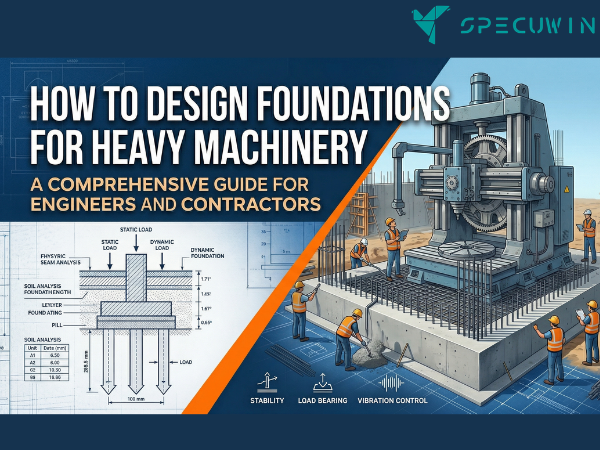
In the world of industrial engineering, the stability of your facility is only as reliable as the ground beneath your equipment. When dealing with massive industrial assets, the stakes are incredibly high. Improperly designed Foundations for Heavy Machinery can lead to catastrophic structural failures, excessive vibration that ruins precision work, and astronomical maintenance costs. Designing these systems is not just about pouring concrete; it is a sophisticated blend of geotechnical analysis, structural dynamics, and precision engineering. This guide explores the critical steps required to create robust, long-lasting support systems for the heavy hitters of the manufacturing world. When designing complex industrial bases, understanding The role of technology in structural analysis and design
is vital for creating accurate 3D models and stress simulations.
Understanding the Primary Requirements of Foundations for Heavy Machinery:-
Before a single shovel hits the dirt, an engineer must understand the personality of the machine being installed. Unlike standard building foundations that primarily handle static loads (the weight of the walls and roof), Foundations for Heavy Machinery must account for dynamic forces the energy generated by moving parts. Before breaking ground on a manufacturing facility, knowing How to choose the right structural engineer for your project ensures you have an expert who understands dynamic loading requirements.
The primary goals of a successful design are:
- Stability: Ensuring the machine does not settle unevenly or tilt.
- Vibration Control: Absorbing or isolating the harmonic frequencies produced by the equipment.
- Durability: Resisting the chemical spills, heat, and impact loads common in industrial environments.
- Precision Maintenance: Keeping the machine in perfect alignment over decades of operation.
Step 1: Geotechnical Investigation for Foundations for Heavy Machinery:-
The soil is the ultimate recipient of all loads. For Foundations for Heavy Machinery, a standard soil test is rarely sufficient. You need a comprehensive geotechnical report that includes dynamic soil properties.
- Soil Bearing Capacity: This determines the maximum load the soil can support without shear failure or excessive settlement.
- Shear Modulus (G): A critical value in calculating how the soil will react to vibrations.
- The Water Table: High groundwater can significantly alter the soil’s damping characteristics and lead to buoyancy issues for large foundation blocks.
If the soil is found to be “soft” or unstable, engineers may need to look toward deep foundation solutions, such as piles or piers, to reach more competent strata.
Step 2: Static and Dynamic Load Analysis in Foundations for Heavy Machinery:-
One of the most complex aspects of designing Foundations for Heavy Machinery is the load calculation. You aren’t just looking at the weight of the machine (Static Load); you are looking at the “unbalanced forces” (Dynamic Load).
Static Loads:
These include the self-weight of the machine, the weight of the concrete foundation block, and the weight of any secondary equipment or fluids (like large oil reservoirs).
Dynamic Loads:
These are the forces generated during operation. For example, a reciprocating compressor creates vertical and horizontal forces that change direction hundreds of times per minute. If the frequency of the machine matches the “natural frequency” of the foundation, resonance occurs. This can cause the foundation to vibrate violently, potentially shaking the entire building apart.
Tip: In the design of Foundations for Heavy Machinery, the mass of the foundation should typically be at least 3 to 5 times the mass of the machine to provide adequate damping.
Step 3: Selecting the Right Type of Foundations for Heavy Machinery:-
Depending on the equipment, several different structural designs might be used:
1. Block Foundations:
This is a massive, solid block of reinforced concrete. It is the gold standard for Foundations for Heavy Machinery that produce high-frequency vibrations. The sheer mass of the block acts as a “heat sink” for kinetic energy.
2. Combined Foundations:
Used when multiple machines are located close together. By tying the machines to a single large mat or raft, you increase the overall mass and reduce the risk of differential settlement between the units.
3. Piled Foundations:
When the topsoil cannot handle the load or the vibration limits are extremely tight, piles transfer the load to deeper, more rigid soil or rock layers.
Step 4: Material Selection for Foundations for Heavy Machinery:-
The concrete used in Foundations for Heavy Machinery is not your standard driveway mix. It requires specific properties to survive the industrial lifecycle:
- High Compressive Strength: Usually 4,000 to 6,000 PSI or higher.
- Low Heat of Hydration: Because these blocks are often very thick (mass concrete), the heat generated during curing can cause “thermal cracking.” Using fly ash or slag in the mix helps control this.
- Precision Grouting: Once the foundation is poured, the machine is leveled on “anchor bolts.” The gap between the machine base and the concrete is filled with non-shrink epoxy grout. This ensures 100% contact and load transfer.
Step 5: Vibration Isolation and Damping in Foundations for Heavy Machinery:-
Sometimes, mass alone isn’t enough. In high-precision manufacturing (like CNC machining) or high-impact environments (like forge hammers), isolation is key. Engineers are increasingly looking at Modern materials in structural engineering beyond concrete and steel
to find high-strength composites that offer superior vibration damping.
- Isolation Pads: These are placed between the machine and the foundation to “break” the path of vibration. Materials include cork, neoprene, or specialized composite polymers.
- Spring Mounts: For massive low-frequency equipment, the entire foundation block may sit on high-capacity steel springs.
- Trench Isolation: A physical gap or a trench filled with sand/gravel around the foundation can prevent vibrations from traveling through the floor to sensitive office areas or other machines.
Step 6: Installation and Quality Control of Foundations for Heavy Machinery:-
The best design in the world can be ruined by poor execution. During the construction of Foundations for Heavy Machinery, attention to detail is paramount:
- Reinforcement Placement: Ensure that steel rebar is placed with adequate “cover” to prevent corrosion from industrial chemicals.
- Anchor Bolt Precision: These bolts must be positioned within millimeters. If they are off-center, the machine simply won’t fit.
- Curing Time: Heavy machinery should never be mounted until the concrete has reached at least 75% to 80% of its design strength, typically 7 to 14 days after pouring.
Conclusion: Ensuring Longevity for Foundations for Heavy Machinery:-
Designing Foundations for Heavy Machinery is a high-responsibility task that requires a deep understanding of physics, geology, and material science. By prioritizing a thorough geotechnical investigation, calculating precise dynamic loads, and ensuring high-quality construction practices, you can protect your equipment investment and ensure the safety of your facility.
Remember, the foundation is the only part of your industrial setup that you cannot easily replace. It pays to get it right the first time.
Frequently Asked Questions:-
1. Why is the mass of Foundations for Heavy Machinery so important?
A. The mass acts as a damping mechanism. Since heavy machines generate significant kinetic energy, a massive foundation absorbs these vibrations, preventing them from causing structural damage or affecting the machine’s precision.
2. Can I use a standard floor slab for industrial machinery?
A. Generally, no. Standard slabs are designed for static loads and light traffic. Heavy machinery requires specialized Foundations for Heavy Machinery that are thicker, more heavily reinforced, and often isolated from the rest of the building’s floor to prevent vibration transfer.
3. What is the role of soil testing in designing Foundations for Heavy Machinery?
A. Soil testing provides the “bearing capacity” and “dynamic modulus.” This tells the engineer how much weight the ground can support and how it will react when the machine starts vibrating. Without this data, the foundation might sink or resonate.
4. How long should I wait before installing a machine on a new foundation?
A. While concrete hardens quickly, it takes time to gain strength. Most engineers recommend waiting at least 28 days for a full cure, though the machine can often be placed (but not fully tightened or operated) once the concrete reaches 75% strength, usually around 10 to 14 days.
5. What is “Resonance” in the context of Foundations for Heavy Machinery?
A. Resonance occurs when the operating frequency of a machine matches the natural frequency of the foundation-soil system. This can cause the vibrations to amplify exponentially, leading to rapid wear of the machine and potential cracking of the concrete.
Read More On:-
For more information about engineering, architecture, and the building & construction sector, go through the posts related to the same topic on the Specuwin Blog Page.
Find out more accurately what we are going to take off in the course of applying leading new technologies and urban design at Specuwin.