

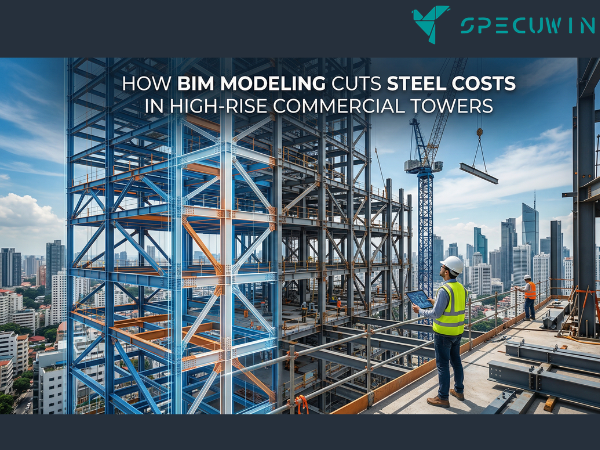
The skyline of modern India is reaching new heights, driven by an insatiable demand for premium commercial office space. As developers race to build the next iconic landmark, the primary challenge remains the soaring cost of construction. In high-rise developments, Steel stands as one of the most significant line items on the balance sheet. With fluctuating global commodity prices, even a 5% reduction in total tonnage can translate into savings of several lakhs if not crores for a single project.
Historically, structural engineering relied on conservative estimates and manual calculations that often led to “over-engineering.” Today, however, the shift from traditional methods to advanced Building Information Modeling (BIM) and generative design is changing the game. By leveraging data-driven design, engineers can now shave off unnecessary weight without compromising structural integrity, ensuring that every kilogram of Steel serves a precise purpose. If you are just starting to explore digital construction, you can refer to this BIM for Beginners: A Guide to Getting Started in Building Information Modeling to understand the foundational principles of the technology.
The Rising Cost of Structural Steel in Modern Construction:-
The economics of high-rise construction are unforgiving. As a building climbs higher, the lateral loads from wind and potential seismic activity increase exponentially. To counter these forces, traditional designs often defaulted to thicker sections and denser reinforcement patterns. However, this “safety through bulk” approach is no longer financially sustainable.
The price of Steel is influenced by global supply chains, energy costs, and local demand. For a commercial tower in a metro like Mumbai or Bangalore, the structural framework can account for nearly 30% of the total civil cost. When we talk about optimizing tonnage, we aren’t just talking about cutting corners; we are talking about precision engineering that aligns material distribution with actual stress patterns.
Leveraging BIM to Reduce Steel Consumption:-
One of the most effective ways to control a project’s budget is to integrate BIM early in the design phase. Unlike 2D CAD, which often misses the complex intersections of structural members, BIM allows for a “clash-free” environment where the exact volume of material can be visualized.
Advanced modeling provides a granular view of the structure. Engineers can simulate various load cases and see exactly how the Steel responds. This level of insight allows for the reduction of redundant supports and the optimization of beam-to-column connections. By creating a digital twin of the tower, developers can identify areas where high-strength material can replace high-volume material, effectively lowering the overall tonnage.
Generative Design: Using AI to Shape Steel Structures:-
The next frontier in material savings is generative design. Instead of an engineer manually testing three or four different structural layouts, AI algorithms can test thousands of permutations based on specific constraints like height, wind speed, and budget.
In this workflow, the software acts as a co-designer. It explores organic shapes and optimized lattice structures that a human might never consider. The result is a Steel skeleton that is perfectly tuned to its environment. This approach is particularly effective in high-rise commercial towers where the “stacking effect” means that even minor optimizations on a single floor are multiplied by forty or fifty stories, leading to massive cumulative savings. Vertical expansion brings unique complexities, which is why engineers must address the specific Structural engineering of high-rise buildings: challenges and solutions during the design phase.
Strategic Material Selection: High-Strength Steel vs. Traditional Grades:-
Not all metal is created equal. One of the simplest ways to optimize tonnage is by moving toward higher grades of Steel. While the cost per ton for high-strength steel (like Fe 550 or higher) might be slightly more than standard grades, the reduction in the required volume often results in a lower total bill.
Using high-strength Steel allows for slimmer columns and shallower beams. This doesn’t just save money on the material itself; it also increases the “carpet area” or leasable space of the commercial tower. In the world of real estate, every square foot gained is additional revenue, making the case for optimized structural design even more compelling.
Reducing Steel Waste Through Pre-Engineered Accuracy:-
On-site fabrication is a notorious source of waste. Off-cuts, welding errors, and mid-construction changes can lead to a 10% wastage factor. Advanced modeling solves this by facilitating a move toward pre-engineered components.
When the Steel components are modeled with 100% accuracy in a BIM environment, they can be precision-cut in a factory setting using CNC machines. These “Lego-like” pieces arrive at the site ready for assembly. This “Just-in-Time” delivery model reduces site clutter, lowers labor costs, and ensures that the developer only pays for the material that actually ends up in the building.
Seismic Resilience and Optimized Steel Distribution:-
In earthquake-prone regions, structural weight is actually a liability. The heavier a building is, the more seismic force it attracts. Therefore, reducing Steel tonnage is not just a financial move it’s a safety move.
By using advanced structural analysis software, engineers can place Steel exactly where it is needed to absorb energy during a seismic event. Innovations like Buckling Restrained Braces (BRBs) or tuned mass dampers allow for a lighter overall frame while providing superior protection. This strategic distribution ensures that the tower remains resilient without being unnecessarily heavy.
The Financial Impact: Saving Lakhs on the Final Bill:-
Let’s look at the math. In a typical high-rise commercial project requiring 2,000 tons of Steel, a successful optimization strategy that reduces tonnage by just 8% saves 160 tons. At current market rates, this results in a direct saving of nearly ₹80 lakhs to ₹1 crore. Vertical expansion brings unique complexities, which is why engineers must address the specific Structural engineering of high-rise buildings: challenges and solutions during the design phase.
Furthermore, a lighter Steel frame reduces the load on the foundations. This leads to a secondary saving in concrete and excavation costs. When you add up the direct material savings, the reduced foundation costs, and the faster assembly time, the “ROI of Optimization” becomes undeniable.
Conclusion: The Future of Steel in High-Rise Design:-
Optimizing Steel is no longer an optional luxury for high-end projects; it is a necessity for any developer looking to remain competitive in the modern market. Through the combination of BIM, generative design, and high-strength materials, we are entering an era where buildings are leaner, greener, and significantly more cost-effective.
As we look toward the future of Indian skylines, the focus will remain on how we can use data to build more with less. By embracing these advanced modeling techniques, the AEC industry can ensure that the “material bill” is no longer a barrier to architectural innovation.
FAQ’s:-
1. Does reducing Steel tonnage affect the safety of the building?
A. Not at all. Optimization is about removing “redundant” material that doesn’t contribute to the building’s strength. Using advanced modeling ensures the building meets or exceeds all safety codes while using material more efficiently.
2. How much can a developer realistically save by optimizing Steel?
A. Depending on the project’s scale, developers typically see savings between 5% and 15% of the total structural material cost. In high-rise towers, this frequently amounts to several lakhs or even crores of rupees.
3. Is BIM only useful for large-scale Steel projects?
A. While the savings are most visible in large towers, BIM provides accuracy and waste reduction for projects of all sizes, ensuring that the final material bill matches the initial estimate.
4. What is the role of the structural engineer in Steel optimization?
A. The engineer uses specialized software to analyze load paths. Instead of using a “one-size-fits-all” approach, they tailor the thickness and grade of the metal to the specific needs of each floor.
5. Can existing designs be optimized for Steel later in the process?
A. It is possible, but most effective during the schematic design phase. Early intervention allows for the most significant changes to the structural system, leading to the highest cost savings.
Read More On:-
For more information about engineering, architecture, and the building & construction sector, go through the posts related to the same topic on the Specuwin Blog Page.
Find out more accurately what we are going to take off in the course of applying leading new technologies and urban design at Specuwin.