

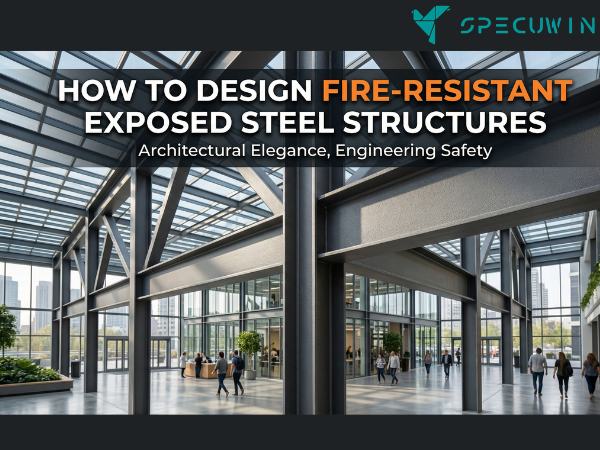
Exposed steel is a hallmark of modern architecture, offering a sleek, industrial aesthetic that celebrates a building’s skeleton. However, steel’s greatest architectural strength is also its functional vulnerability: heat. When temperatures rise during a blaze, structural steel begins to lose its load-bearing capacity long before it actually melts. Learning how to design fire-resistant exposed steel structures is therefore a critical balancing act between visual purity and rigorous life-safety engineering.
In this comprehensive guide, we will explore the methodologies, material choices, and innovative coatings that allow architects and engineers to keep their steel designs visible without compromising on safety.
The Fundamental Challenge of Fire-Resistant Steel:-
Steel is non-combustible, but it is highly thermally conductive. At approximately 550°C (1,022°F), carbon steel loses about 50% of its strength. In a fully developed building fire, temperatures can easily exceed 1,000°C. Without proper fire-resistant strategies, exposed members can buckle or fail, leading to catastrophic structural collapse.
To design effectively, one must move beyond “hiding” steel behind drywall and instead embrace specialized protection methods that respect the geometry of the sections.
1. Material Selection: Inherently Fire-Resistant Steel Alloys:-
The first step in the design process is choosing the Right material. While standard A36 or A992 steel is common, there are high-performance alloys specifically engineered for better thermal performance.
- FR Steel (Fire-Resistant Steel): Some manufacturers produce steel with specific molybdenum and niobium content. These alloys maintain a higher percentage of their yield strength at elevated temperatures compared to conventional steel.
- Heavy Sections: Massive steel sections have a higher “mass-to-perimeter” ratio (A/Hp). Thicker, heavier members heat up more slowly than thin-walled sections, providing a natural, albeit limited, fire-resistant advantage.
2. Intumescent Coatings: The Aesthetic Solution:-
When the design intent requires the crisp lines of a wide-flange beam or a hollow structural section (HSS) to remain visible, intumescent coatings are the gold standard.
How Intumescent Paint Works:
Unlike thick, cementitious sprays that look like oatmeal, intumescent paint is applied in thin films similar to high-end industrial paint. When exposed to extreme heat, a chemical reaction occurs:
- Expansion: The coating swells to 20 or 50 times its original thickness.
- Insulation: It forms a carbonaceous “char” or foam layer.
- Protection: This char acts as an insulating barrier, slowing the heat transfer to the steel core.
Design Considerations for Intumescent Applications:
To ensure a fire-resistant finish that looks professional, designers must specify the level of finish (Level 1 through Level 4). For high-visibility areas like atriums, a Level 4 finish involves sanding and specialized topcoats to achieve a smooth, automotive-grade appearance.
3. Concrete-Filled Hollow Sections (CFHS):-
For columns, one of the most effective ways to achieve a fire-resistant rating while keeping the steel skin exposed is to fill the interior with concrete.
- Heat Sink Effect: The concrete core acts as a heat sink, absorbing thermal energy from the steel shell.
- Structural Redundancy: Even if the outer steel shell weakens, the reinforced concrete core is designed to carry the building’s dead and live loads during a fire event.
- Reduced Footprint: This method allows for smaller column profiles compared to wrapping steel in bulky fireproofing boards.
4. Performance-Based Fire Engineering:-
Traditional codes are often “prescriptive” they tell you exactly how many millimeters of protection you need. However, for complex exposed structures, fire-resistant design often utilizes Performance-Based Engineering (PBE).
Using advanced computational fluid dynamics (CFD) and finite element analysis (FEA), engineers can simulate how a specific fire will behave in a specific room.
- Localized Fire Modeling: If a steel column is 20 feet away from any combustible material, it may not need the same level of protection as a column in a storage room.
- Structural Analysis: Designers can prove that even if one exposed beam loses strength, the surrounding “cool” structure can redistribute the load, potentially allowing for less invasive fire-resistant treatments.
Read more on:-The future of structural engineering: trends and innovations
5. Geometric and Shielding Strategies:-
Sometimes, the best fire-resistant design isn’t a coating, but a clever architectural layout.
- Shielding: Placing the steel members behind non-combustible architectural fins or using the building’s own geometry to “shade” the steel from direct flame contact.
- Distance: Increasing the ceiling height allows hot gases to pool far above the structural members, reducing the rate of temperature rise.
- External Steel: For structures where steel is outside the glass line, the risk is significantly lower. However, flame impingement through broken windows must still be calculated to ensure the exterior frame remains fire-resistant.
6. Connection Design and Thermal Bridging:-
A chain is only as strong as its weakest link. In fire-resistant design, the connections (bolts, plates, and welds) are often the most vulnerable points.
- Cover Plates: Connection details should be simplified. Protruding bolts and thick plates increase the surface area, which can lead to faster heating.
- Intumescent Compatibility: Ensure that the chosen fire-resistant coating can be applied effectively over bolts and narrow gaps. Failure to protect a connection can lead to the “unzipping” of a structure even if the beams themselves are protected.
Maintenance and Long-Term Durability:-
A fire-resistant system is not a “set it and forget it” solution. Exposed steel is subject to environmental wear, especially in semi-outdoor spaces.
- Topcoating: Intumescent coatings require a compatible topcoat to protect against UV radiation and moisture.
- Inspections: Periodic checks are required to ensure the coating hasn’t been chipped or abraded. Any damage to the fire-resistant layer must be repaired with the exact same specified product to maintain the hourly fire rating.
Read more on:- Top 5 signs your building needs a structural inspection
Conclusion:-
Designing exposed steel requires a marriage of aesthetics and physics. By choosing between intumescent coatings, concrete filling, or performance-based modeling, architects can showcase the raw beauty of structural steel without sacrificing safety. The goal of a fire-resistant design is to buy time for occupants to evacuate and for first responders to do their jobs all while maintaining the architectural integrity of the vision.
Internal Backlinking from Specuwin
To further enhance your understanding of modern engineering and digital workflows, explore these related topics:
- Material Selection: Understanding the impact of different alloys is vital; see how the impact of material selection on structural integrity shapes modern builds.
- Future Trends: As technology evolves, so do safety standards. Read about the future of structural engineering trends and innovations to see what’s next for steel.
- Digital Integration: Fire safety is now often managed through digital twins. Learn about the revolutionary impact of digital twins on facility management for long-term safety monitoring.
- Professional Guidance: If you are managing a complex project, knowing how to choose the right structural engineer is the first step in ensuring a fire-safe design.
Frequently Asked Questions:-
1. Can I use regular house paint over a fire-resistant coating?
A. No. You must use a compatible topcoat specified by the intumescent manufacturer. Using the wrong paint can inhibit the chemical expansion of the fire-resistant layer during a fire.
2. How thick is an intumescent fire-resistant coating?
A. It varies based on the required fire rating (e.g., 1-hour vs. 2-hour). Generally, it ranges from 0.5mm to several millimeters, which is significantly thinner than traditional spray-on fireproofing.
3. Is exposed steel more expensive to fireproof?
A. Yes. Achieving a fire-resistant rating while keeping steel exposed usually requires intumescent paint or specialized engineering, both of which carry a premium over standard “hidden” fireproofing methods.
4. Does concrete-filling a column make it fully fire-resistant?
A. It provides significant protection and can achieve high fire ratings, but it must be calculated by a structural engineer to ensure the reinforcement and concrete type meet local safety codes.
5. How does BIM help in designing fire-resistant structures?
A. BIM allows for precise “clash detection” and material scheduling, ensuring that every square inch of steel requiring a fire-resistant coating is accounted for in the budget and construction phase.
Read More On:-
For more information about engineering, architecture, and the building & construction sector, go through the posts related to the same topic on the Specuwin Blog Page.
Find out more accurately what we are going to take off in the course of applying leading new technologies and urban design at Specuwin.