

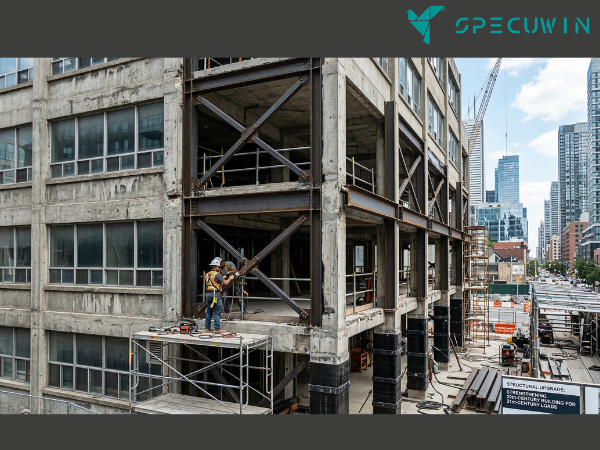
The most sustainable building is the one that already exists. As urban landscapes in 2026 prioritize carbon neutrality, the industry is shifting away from demolition in favor of adaptive reuse. However, transforming a mid-century warehouse into a modern residential complex or a high-tech laboratory presents a significant technical hurdle: the original structure was rarely designed to handle contemporary Loads.
In this comprehensive guide, we explore how structural engineering bridges the gap between vintage construction and modern safety standards, ensuring that historic icons can safely support 21st-century Loads.
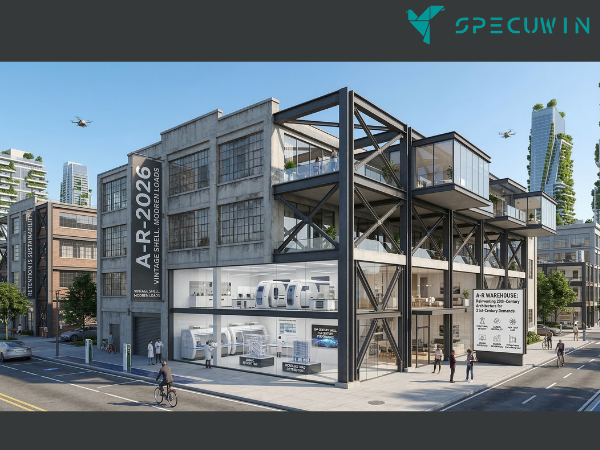
The Forensic Phase: Evaluating Historical Loads:-
Before any reinforcement begins, a structural engineer acts as a forensic investigator. 20th-century buildings were constructed using a wide variety of standards, some of which are now obsolete. The first step is determining the original design Loads to establish a baseline capacity.
Many structures from the early-to-mid 1900s utilized “overbuilt” steel or early forms of reinforced concrete. While robust, these materials often lack the ductility required by modern seismic codes. Furthermore, the intended use of a building has a direct impact on the gravity Loads it can sustain. A residential floor plate designed in 1950 may not support the heavy mechanical equipment or high-density occupancy required today. To effectively communicate these complex findings to project stakeholders, professionals often rely on How to read a structural engineering report.
The Physics of Change: Why We Must Recalculate:-
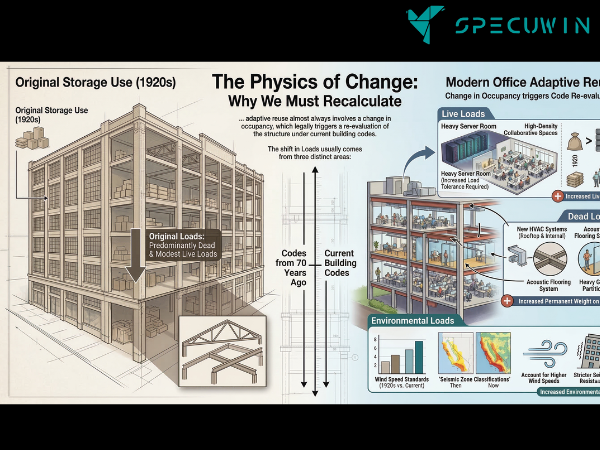
Adaptive reuse almost always involves a change in occupancy, which legally triggers a re-evaluation of the structure under current building codes. The shift in Loads usually comes from three distinct areas:
- Live Loads: Modern office environments with heavy server rooms or high-density collaborative spaces require different weight tolerances than 1920s storage facilities.
- Dead Loads: The addition of modern HVAC systems, acoustic flooring, and heavy glass partitions increases the permanent weight on the frame.
- Environmental Loads: Climate change and updated geological data mean we must now account for higher wind speeds and significantly stricter seismic resistance than was required seventy years ago.
Assessing Material Integrity for Modern Loads:-
You cannot strengthen what you do not fully understand. Engineers perform non-destructive testing (NDT) to check for carbonation in concrete, corrosion in steel, or rot in timber. If the assessment reveals significant degradation, the building may already be showing Top 10 structural issues in residential buildings, which must be remediated before the structure can handle new Loads.
Key focus areas during assessment include:
- Concrete Carbonation: This process reduces the alkalinity of the concrete, leading to the corrosion of the internal rebar and a decrease in the ability to carry tensile Loads.
- Steel Fatigue: Especially prevalent in buildings that formerly housed heavy vibrating machinery.
- Foundation Integrity: Ensuring the soil and footings can still handle redistributed Loads without excessive settlement.
Strengthening Strategies for Vertical Loads:-
When existing columns or floor slabs are found to be insufficient for the new programmatic requirements, several strengthening techniques are employed:
- Section Enlargement: Adding a “jacket” of new reinforced concrete or steel around existing columns to help them carry greater vertical Loads.
- FRP (Fiber Reinforced Polymers): Applying carbon fiber sheets to the underside of beams. This is a low-profile way to increase tensile strength without adding significant weight.
- Steel Plate Bonding: Bolting steel plates to existing members to stiffen the structure against sagging under heavy Loads.
Seismic Retrofitting: Managing Lateral Loads:-
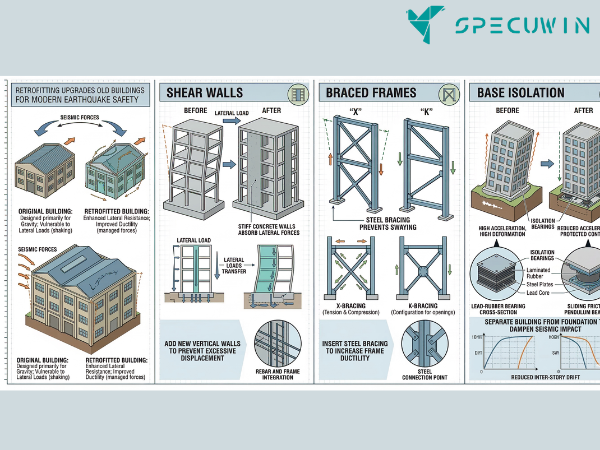
Perhaps the greatest challenge in adaptive reuse is bringing an older building up to modern earthquake standards. Older buildings were often designed primarily for gravity, with little consideration for lateral Loads.
To address this, engineers implement Seismic retrofitting techniques such as:
- Shear Walls: Adding new, stiff concrete walls that run the height of the building to absorb lateral forces.
- Braced Frames: Inserting steel “X” or “K” bracing into existing bays to prevent swaying.
- Base Isolation: In sensitive or high-value projects, separating the building from its foundation to dampen the impact of seismic Loads.
Understanding Innovations in earthquake-resistant design is essential for any engineer working on 20th-century retrofits.
Foundation Reinforcement for New Loads:-
If the adaptive reuse plan involves adding new floors a common practice to increase density the foundation must be reinforced. Micropiles or underpinning may be necessary to transfer the increased Loads deeper into the ground. This process is highly dependent on the local geography, making The importance of soil testing a critical first step in the design phase.
Modern Tools for Historic Loads:-
The digital age has revolutionized how we handle these projects. Through BIM (Building Information Modeling), engineers can create a “Digital Twin” of a historic building. This allows for precise simulations of how the structure will behave under various 21st-century Loads before a single hammer is swung.
By integrating The role of technology in structural analysis and design, we can optimize material use, reducing the cost and environmental impact of the strengthening process.
Conclusion: Balancing History and Loads:-
Structural engineering for adaptive reuse is a delicate balance of preservation and performance. By understanding the legacy of 20th-century materials and applying modern strengthening techniques, we can ensure these buildings are not just remnants of the past, but resilient structures capable of supporting the Loads of the future.
Frequently Asked Questions:-
1. Is it more expensive to retrofit for new loads or build a new structure?
A. While structural retrofitting can be costly, it often saves money on site preparation and raw materials. On average, adaptive reuse can be 15-20% cheaper than new construction, though heavy foundation work for new Loads can narrow that gap.
2. What are the first signs that an old building is failing under current loads?
A. Common indicators include large diagonal cracks in masonry, sagging floor joists, or doors and windows that no longer close properly. These are often symptoms of the building struggling to distribute its existing Loads.
3. Can I add a rooftop garden to a 20th-century building?
A. Rooftop gardens add significant “Dead Loads” (soil, water, plants). Most older roofs were only designed for snow or maintenance Loads, so structural reinforcement of the top floor and columns is usually required.
4. How does seismic retrofitting differ from regular strengthening?
A. Standard strengthening focuses on vertical gravity Loads. Seismic retrofitting focuses on lateral (sideways) Loads caused by earthquakes, ensuring the building doesn’t collapse from side-to-side movement.
5. How long does a structural assessment for adaptive reuse take?
A. Depending on the size of the building and the availability of original blueprints, a thorough assessment of the building’s capacity for new Loads can take anywhere from three weeks to two months.
Read More On:-
For more information about engineering, architecture, and the building & construction sector, go through the posts related to the same topic on the Specuwin Blog Page.
Find out more accurately what we are going to take off in the course of applying leading new technologies and urban design at Specuwin.