

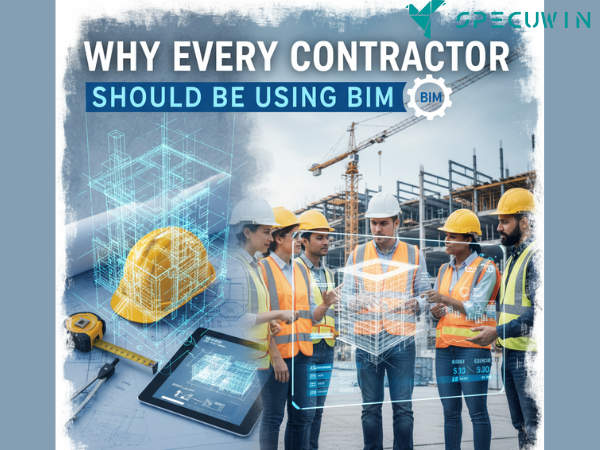
For years, the construction industry has relied on two-dimensional blueprints, often leading to miscommunication, on-site clashes, and costly rework. But the landscape is changing, and Building Information Modeling (BIM) is leading the charge. BIM is more than just 3D modeling; it is a holistic process a digital methodology for creating and managing all information related to a built asset.
For you, the contractor, BIM isn’t just a technical upgrade; it’s a strategic necessity. It’s the difference between reacting to problems on-site and proactively solving them in a virtual environment. Adopting BIM is about gaining control, maximizing your margins, and delivering exceptional quality to your clients.
This guide will show you exactly how BIM transforms your operations, from pre-construction planning to final handover.
The Contractor’s Edge: Key Benefits of Embracing BIM:-
1. Eliminate Costly Rework with Early Clash Detection:
In traditional workflows, design errors like a structural beam interfering with HVAC ductwork are often discovered mid-construction, leading to expensive, time-consuming fixes. BIM’s core functionality includes advanced clash detection, which identifies these conflicts virtually, long before ground is broken.
- Proactive Problem-Solving: By integrating architectural, structural, and MEP models, BIM pinpoints spatial conflicts and maintenance access issues, allowing your team to resolve them digitally.
- Backlinking Opportunity: This directly addresses the importance of early-stage coordination. For more on ensuring structural soundness, see: Top 10 Structural Issues in Residential Buildings.
2. Achieve Budget Certainty with 5D BIM:
Accurate cost estimation is vital to a contractor’s profitability, and 2D takeoffs are notoriously error-prone. This is where 5D BIM (the 3D model plus time (4D) and cost (5D)) provides a massive advantage.
- Automated Quantity Take-Offs: The intelligent BIM model contains comprehensive data on material quantities and components. This feature automates takeoffs, drastically improving the accuracy and speed of your estimates, and enabling you to focus on higher-value risk analysis.
- Minimize Waste: Precise material quantification reduces over-ordering and waste, leading to direct cost savings.
3. Boost On-Site Efficiency with 4D BIM Scheduling:
Time is money, and project delays are a contractor’s nightmare. 4D BIM links the intelligent model to your project schedule, allowing for visual construction sequencing and simulation.
- Visualizing the Build: You can literally see the project unfold virtually, allowing you to identify potential bottlenecks, optimize workflows, and plan logistics like equipment routes and staging areas effectively.
- Backlinking Opportunity: Understanding how technology supports your planning and analysis is key. Explore further: The Role of Technology in Structural Analysis and Design.
The Collaboration Revolution: BIM as the Single Source of Truth:-
Construction projects involve dozens of stakeholders subcontractors, engineers, architects all relying on up-to-date information.
1. The Shared Data Environment:
BIM establishes a Common Data Environment (CDE), a centralized platform where all project information design updates, material specifications, and documentation is instantly accessible to everyone.
- Enhanced Communication: This “single source of truth” eliminates confusion caused by outdated drawings and duplicate information, streamlining communication and decision-making on-site.
- Stronger Partnerships: Seamless collaboration with design teams and structural engineers is key to success. BIM facilitates this digital cooperation.
- Backlinking Opportunity: Collaboration is paramount to project success. Read more about the value of strong teamwork: Why Collaboration Between Contractors and Structural Engineers is Key to Successful Projects.
2. Increasing Safety and Minimizing Risk:
Worker safety must always take precedence. BIM allows for detailed safety planning through model-based visualization and hazard identification before construction even starts. You can plan safe equipment routes and workspace layouts, actively reducing on-site risks.
Post-Construction Value: The Digital Handover with BIM:-
The benefits of BIM extend beyond the last beam placed. The data-rich model becomes an essential deliverable for the client, enabling smoother facility management.
- Accurate As-Built Documentation: The final BIM model provides owners and facility managers with an accurate digital twin, containing all component specifications, maintenance schedules, and warranties.
- Future-Proofing: This information is invaluable for future maintenance, repairs, or cost-effective renovations, offering a service that paper-based documents can’t match.
Conclusion:-
The construction industry is rapidly digitizing. For every contractor, adopting BIM is no longer optional it’s the new standard for competitiveness, efficiency, and profitability. By leveraging BIM for enhanced collaboration, early clash detection, accurate cost estimation, and detailed scheduling, you can minimize risk, maximize your margins, and secure your position as a forward-thinking, reliable partner. The investment in training and software pays for itself through reduced rework, fewer delays, and higher-quality project delivery.
The future of construction is digital, and your competitive edge depends on your embrace of BIM.
FAQ’s:-
1. Is BIM only for large-scale or complex projects?
A. No. While BIM is widely used in large, complex commercial projects, it is increasingly being adopted for smaller, even residential, projects. The benefits of clash detection, accurate takeoffs, and better coordination apply to projects of any size, allowing contractors to gain control and improve ROI on every job.
2. How does BIM help me with cost and material estimating?
A. BIM software leverages 5D capabilities to automate material quantifications directly from the intelligent model, generating highly accurate and detailed quantity take-offs. This significantly reduces manual effort, minimizes errors, and allows for faster, more reliable cost estimates and budget control.
3. What is “Clash Detection” in BIM and why is it important for a contractor?
A. Clash detection is a BIM tool that virtually identifies conflicts or interferences between different building systems (e.g., HVAC ductwork passing through a structural beam). It’s crucial because it allows contractors to resolve these design conflicts in the model before construction starts, preventing costly on-site rework, delays, and change orders.
4. Does using BIM require a lot of training for my on-site team?
A. While initial training for modeling specialists is necessary, the field benefits are often accessed through user-friendly viewers on tablets. Your on-site team can use the BIM model for 3D visualization, checking component locations, and validating installations, which is often simpler and more informative than interpreting multiple 2D drawings.
5. How does BIM improve project timelines and scheduling?
A. BIM incorporates 4D capabilities by linking the model to the project schedule. This allows contractors to create a visual simulation of the construction sequence, identifying potential scheduling conflicts and allowing for better resource and logistics planning.
Read More On:-
For more information about engineering, architecture, and the building & construction sector, go through the posts related to the same topic on the Specuwin Blog Page.
Find out more accurately what we are going to take off in the course of applying leading new technologies and urban design at Specuwin.