

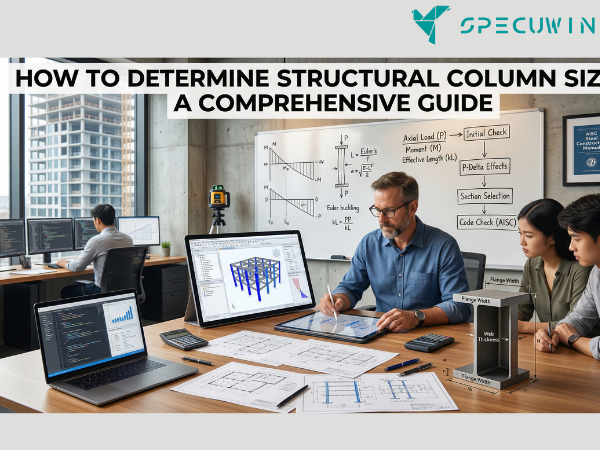
In the world of construction, columns are the unsung heroes that keep our roofs overhead and our floors steady. They are the primary vertical load-bearing elements that transfer the weight of a structure down to the foundation. If a beam fails, you might have a sagging floor; if a column fails, the entire structure is at risk. That is why understanding How to Determine Structural Column Size is one of the most critical steps in the architectural and engineering process.
Whether you are a student, a budding developer, or a homeowner curious about the skeleton of your house, sizing a column isn’t just about picking a thick piece of concrete or steel. It is a delicate balance of physics, material science, and safety factors. In this guide, we will break down the complex world of axial loads, slenderness ratios, and material properties to help you understand the fundamentals of column design.
The Importance of Knowing How to Determine Structural Column Size:-
Before we dive into the math, we must understand the “why.” A column that is too small will buckle under pressure, leading to catastrophic structural failure. Conversely, a column that is excessively large wastes expensive materials, increases the building’s self-weight, and eats up valuable floor space.
When engineers look at How to Determine Structural Column Size, they aren’t just looking at the weight of the furniture. They are looking at “Dead Loads” (the weight of the building itself), “Live Loads” (people and movable objects), and environmental loads like wind and seismic forces. In fact, if you’re interested in how buildings survive extreme conditions, you might want to read about Innovations in earthquake-resistant design.
Step 1: Calculate the Tributary Area:-
The first step in How to Determine Structural Column Size is identifying how much area a specific column is responsible for supporting. This is known as the Tributary Area.
Imagine a grid of columns in a warehouse. A single interior column typically supports half the distance to the next column in every direction. If your columns are spaced 20 feet apart in a square grid, one interior column supports a 20′ \times 20′ square of the floor above it.
Why Tributary Area Matters:
The larger the tributary area, the more load the column accumulates. For multi-story buildings, you must multiply this area by the number of floors above the column. This cumulative force is what dictates the eventual thickness of the column.
Step 2: Identify Loading Requirements:-
Once you have the area, you need to know the pressure being applied to it. In the context of How to Determine Structural Column Size, loads are generally categorized into three types:
- Dead Loads: This includes the weight of the concrete slabs, beams, walls, flooring, and permanent fixtures.
- Live Loads: This varies by building use. An office building has higher live load requirements than a residential house, and a library (with heavy books) has even higher requirements.
- Environmental Loads: Depending on your location, you must account for snow, wind, and seismic activity. For those working in high-risk zones, understanding seismic retrofitting is essential for column reinforcement.
Step 3: Material Selection and Its Impact on How to Determine Structural Column Size:-
The material you choose changes the calculation entirely. A 12-inch reinforced concrete column has very different load-bearing capacities than a 12-inch steel I-beam.
Reinforced Concrete Columns:
Concrete is excellent in compression but weak in tension. To fix this, we add steel rebar. When determining size, we look at the “Short Column” vs. “Slender Column” distinction. Most residential columns are designed as short columns to avoid buckling.
Steel Columns:
Steel is much stronger per square inch than concrete, allowing for slimmer profiles. However, steel is highly susceptible to buckling if the column is too tall and thin. This leads us to a critical concept in How to Determine Structural Column Size: The Slenderness Ratio.
Step 4: The Slenderness Ratio and Buckling:-
You can’t talk about How to Determine Structural Column Size without mentioning Euler’s Buckling Formula.
P{cr} = \frac{\pi^2 EI}{(KL)^2}
Where:
- P{cr} is the critical buckling load.
- E is the Modulus of Elasticity of the material.
- I is the Moment of Inertia (related to the shape of the column).
- KL is the effective length of the column.
Basically, the taller the column, the more likely it is to “bow” or buckle in the middle before the material actually crushes. If you are designing a high-ceiling lobby, your columns will need to be significantly thicker than those in a standard 8-foot basement, even if they are carrying the same weight.
Step 5: Preliminary Sizing Rules of Thumb:-
While software like Revit and STAAD.Pro handle the heavy lifting today, every engineer uses “rules of thumb” for initial sketches. If you are exploring The role of technology in structural analysis, you know that these digital tools are only as good as the initial logic provided by the human designer.
- For Concrete: A common starting point for a typical two-story residential building is a 12″ \times 12″ (300mm x 300mm) column with 1% to 2% steel reinforcement.
- For Steel: Engineers often look at the depth of the beam it supports; the column is often roughly the same depth to ensure a clean connection.
The Role of BIM in How to Determine Structural Column Size:-
Modern construction has moved away from manual 2D drafting. Using Building Information Modeling (BIM) allows engineers to simulate loads in a 3D environment. This ensures that column sizes are optimized not just for safety, but for cost-efficiency. If you are new to this tech, check out this BIM for beginners guide.
BIM helps identify if a column size interferes with plumbing or HVAC ducts before a single drop of concrete is poured. This level of coordination is why BIM is transforming consultancy worldwide.
Common Mistakes in Column Sizing:-
Even professionals can run into issues when considering How to Determine Structural Column Size. Some of the most frequent errors include:
- Ignoring Eccentric Loading: Not all weight sits perfectly on the center of a column. If a beam connects to the side, it creates a “bending moment,” which requires a larger column or more reinforcement.
- Neglecting Future Use: If a homeowner decides to add a rooftop garden or a third story later, the original columns may not be sufficient.
- Poor Material Quality: Even the best calculations fail if the concrete mix is poor. This highlights the impact of material selection on structural integrity.
When to Consult a Professional:-
Trying to figure out How to Determine Structural Column Size on your own is a great intellectual exercise, but for actual construction, you must hire a licensed structural engineer. They provide the legal and technical assurance that your building won’t just stand today, but will withstand the tests of time and nature.
Choosing the right expert is vital. If you’re unsure where to start, read this guide on How to choose the right structural engineer.
Conclusion: Final Thoughts on How to Determine Structural Column Size:-
Determining the size of a structural column is a journey from the top of the building to the bottom of the soil. It starts with the roof’s weight, travels through the beams, gets calculated via the tributary area, and is finally finalized based on material strength and height. By mastering How to Determine Structural Column Size, builders ensure that our built environment remains safe, functional, and beautiful for generations to come.
Frequently Asked Questions:-
1. What is the minimum size for a concrete column in a residential building?
A. Generally, for a single-story or two-story home, the minimum size is often 9″ \times 9″ or 12″ \times 12″, depending on local building codes and the span between columns.
2. Does the shape of the column affect how to determine structural column size?
A. Yes. Square, rectangular, and circular columns have different “Moments of Inertia.” Circular columns are often more efficient for purely axial loads, while rectangular columns are better at resisting bending forces from one direction.
3. Can I reduce the column size if I use higher-strength steel?
A. Yes, increasing the grade of the steel reinforcement or using high-strength concrete can allow for a smaller cross-sectional area, though you must still watch out for the slenderness ratio to prevent buckling.
4. How does soil quality impact column sizing?
A. While soil doesn’t change the column size directly, it dictates the importance of soil testing for the foundation. If the soil is weak, the column’s load must be distributed over a much larger footing.
5. How often should columns be inspected for safety?
A. In older buildings, you should check for cracks or “spalling” every few years.
Read More On:-
For more information about engineering, architecture, and the building & construction sector, go through the posts related to the same topic on the Specuwin Blog Page.
Find out more accurately what we are going to take off in the course of applying leading new technologies and urban design at Specuwin.